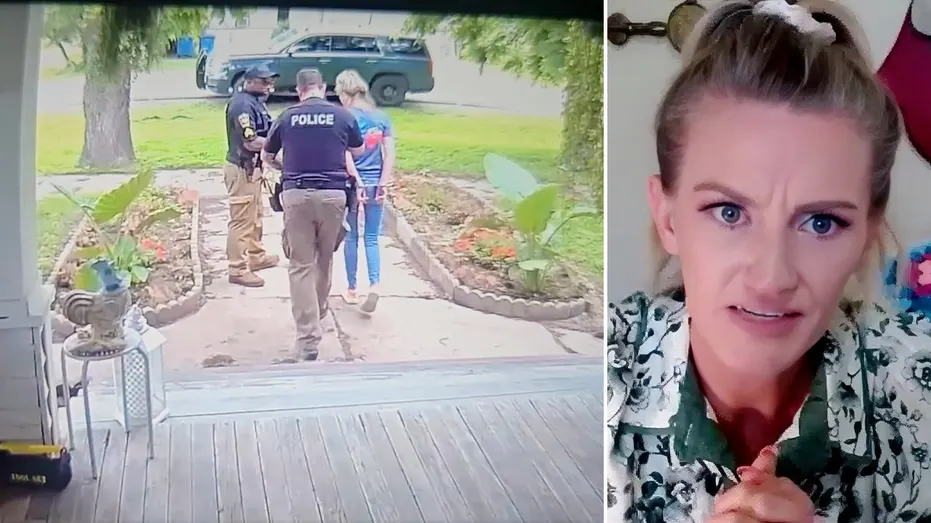
SouthernWorldwide.com – Jennifer Combs, a mother of four from Trinidad, Texas, found herself in an unimaginable situation when she was arrested and jailed on a felony warrant stemming from a Facebook post. Combs insists she was merely trying to facilitate communication between concerned residents and state officials regarding issues with the town’s water supply.
For years, some residents of Trinidad had been voicing complaints about the quality of their tap water, citing issues such as discoloration, sediment, unpleasant odors, and potential health concerns. Combs, through her Facebook page, “Southern Belle Watch,” began collecting these reports with the intention of forwarding them to the state for investigation.
Her efforts, however, took a drastic and bewildering turn when, according to Combs, law enforcement officers arrived at her home and apprehended her based on a felony warrant. This arrest, for a single Facebook post, came as a shock to Combs, who stated she had no prior criminal record, not even a speeding ticket.
Combs shared that her involvement began after she saw a post from an elderly woman struggling to afford bottled water. This woman, living on a fixed income, had already depleted a portion of her monthly funds for bottled water, as her doctor had advised her against using or cooking with tap water.
This incident profoundly impacted Combs, who firmly believes in transparency, especially from elected officials. She stated, “I stand on it. I think if you’re going to be in government, there should be zero reasons for you not to be transparent with your people that elected you to be there.”
Her strategy was straightforward: gather residents’ water-related complaints and relay them to the state, providing inspectors with specific areas to investigate. Combs highlighted that the water issues in Trinidad had been ongoing for years, emphasizing the reality of the situation and dismissing any notion of artificial representations.
Many residents were hesitant to speak publicly due to fear of reprisal. Combs noted, “A lot of them wanted to be able to message me anonymously, because the retaliation in Trinidad is very, very real.” This fear prompted her to create a safe space for anonymous reporting.
In the Facebook post that led to her arrest, Combs reported that her page had received information about residents being hospitalized due to bacteria in the water, labeling it a “serious public health concern that deserves immediate attention.” The post urged residents to share details like discolored water, sediment, strong odors, health concerns, general neighborhood areas, photos, videos, dates, and times.
The post was eventually removed by Facebook after being flagged by a group of individuals from the community. Prior to its removal, the then-Trinidad Police Chief, Charles Gregory, had reportedly taken a screenshot and posted it on the Trinidad Police Department’s Facebook page, accusing Combs of filing a false report.
Combs explained that the city had engaged a contractor to manage the water issues. Boil notices often directed residents to this contractor instead of City Hall, leading to increased frustration as many felt they weren’t receiving clear answers. Consequently, more complaints were channeled to Combs.
Adding a significant layer to the narrative, Combs revealed that the individual who filed the complaint leading to her arrest was the same contractor hired by the city to address the water problem. This contractor, paid to solve the issue, was also the one who reported her for collecting complaints about it.
The situation escalated on April 6 when two officers arrived at Combs’ home with a felony arrest warrant from Henderson County. She was handcuffed in her front yard and taken to Navarro County Jail, where she spent 23 hours before being released.
Combs was charged with a felony false report, allegedly tied to creating public panic regarding the water system. She expressed her disbelief at the charges.
Chief Gregory, according to Combs, publicly defended her arrest. However, what troubled Combs further was that, after Gregory’s post, residents who had reported issues to her commented on the police department’s post, confirming the validity of their complaints. Combs lamented that these individuals were never interviewed by the authorities.
This raises a critical question: if residents were corroborating the reports, why was the person collecting them treated as a criminal?
Following her arrest, Combs faced mounting expenses, including her husband’s bail payment of over $300 and subsequent legal fees. The felony charge was later presented to a grand jury, which ultimately no-billed the case, meaning no indictment was issued due to insufficient evidence.
Despite the grand jury’s decision, Combs’ attorney had to continue the process of formally removing the charge. By then, she had already endured a night in jail, incurred bail costs, and hired legal representation, with her name associated with a felony allegation over a water-related Facebook post.
The repercussions extended beyond Combs. A man identified as “Otto the Watchdog” protested outside Trinidad City Hall after her arrest. He was reportedly handcuffed and detained for disorderly conduct, with officials claiming he offended a water clerk.
However, Combs stated that the water clerk later claimed she was not offended. The clerk was subsequently fired for refusing to sign a statement confirming she was offended. A judge later dismissed the disorderly conduct charge against the protester, and then, according to Combs, the judge himself was fired. The city attorney was also reportedly fired the same night during a recorded city council meeting.
SouthernWorldwide.com reached out to the City of Trinidad for comment. Zachary Smith, an associate attorney with Iglesias Law Firm, responded on behalf of the city, stating that while they acknowledge the public’s desire for answers, the ongoing lawsuits prevent them from commenting on specifics, a standard practice in active litigation.
Smith asserted that the claims against the City of Trinidad would be addressed in court and that the city officials have acted and continue to act in the best interests of the people of Trinidad. The firm expressed anticipation for addressing these claims fully during the litigation process.
In everyday life, people frequently voice concerns online about various local issues, from infrastructure to public services. While some posts may be emotionally charged or contain unverified claims, this should not result in a citizen being treated as a criminal for seeking information.
Combs aptly summarized, “You have the right to question what anybody is doing. You have the right to figure out what is in your water, what you’re drinking.” She added, “I’m never going to tell people, ‘Oh, just keep your mouth shut. Don’t say anything and just be quiet.’ That’s not me. I don’t hush very well.”
Combs believes the water issue in Trinidad still requires external intervention, noting the mayor’s public request for the Texas Rangers to step in. She also expressed her need for support, stating, “I need someone to help. It’s insane. It’s not going to get fixed the way it is.” She emphasized that the residents of Trinidad have waited long enough for solutions, and now people are being jailed for speaking about it.
When asked for her message to those who speak out online about local matters, Combs responded directly: “I think people that speak out for their communities are extremely brave. So I’m never going to not tell people to speak out.” She urged others not to let her experience silence them, stating, “You can’t let what happened to me prevent you from standing up and doing what’s right to people. You can’t because then there’s no good people left.”
While Facebook can be a powerful tool for raising local concerns, it is advisable to exercise caution. For alerting the public, a public post can be effective. However, if information is still being gathered, private groups or direct messages might offer a safer approach while verifying reports.
Before posting, it’s recommended to save screenshots of drafts, final posts, and supporting comments. This creates a record in case a post is removed or flagged. It’s also crucial to protect the privacy of individuals who provide information. While requesting details like photos, dates, and general locations is important, exact addresses, phone numbers, or sensitive medical information should be avoided without explicit permission.
Clarity about what is confirmed versus what is still under investigation is also key. Using phrases like “residents reported” or “according to messages sent to me” can help demonstrate that community concerns are being collected rather than presenting unverified claims as facts.
Jennifer Combs sought clean water, transparency, and answers, but instead, she faced arrest and jail time. This case should be a cause for concern for anyone who has ever voiced a complaint about a local issue online. When citizens question public officials, they should be met with facts and accountability, not with a police response.
This narrative underscores the enduring importance of local journalism and citizen watchdogs. Small towns can harbor significant problems, and sometimes, the individual asking the difficult questions is performing a public service. The central question remains: if a Facebook post about contaminated water can lead to a felony arrest, what prevents other local governments from employing similar tactics?
For those who have experienced similar situations, feeling ignored or intimidated when speaking up about local problems, SouthernWorldwide.com encourages sharing these experiences by writing to CyberGuy.com.