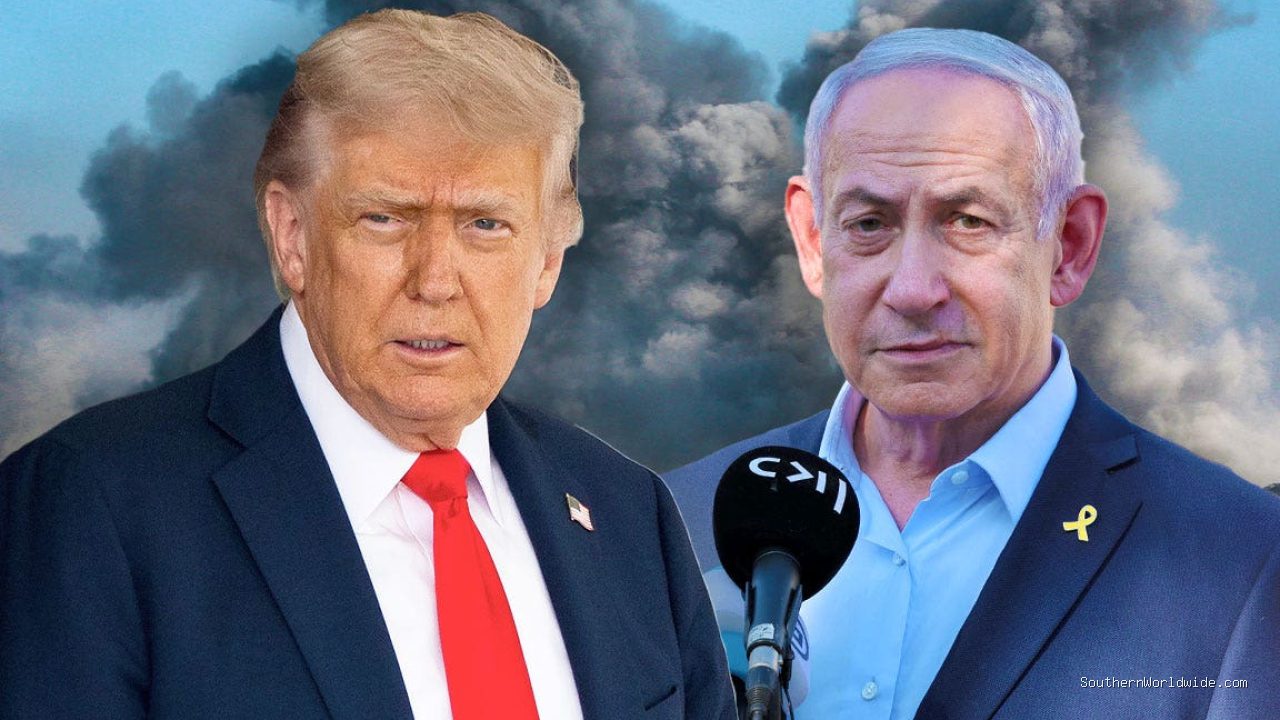
SouthernWorldwide.com – Former President Donald Trump has confirmed a heated phone exchange with Israeli Prime Minister Benjamin Netanyahu, during which Trump reportedly called Netanyahu “f***ing crazy.” The dispute reportedly stemmed from Israel’s military operations in Lebanon against Hezbollah, revealing a rare public disagreement between the two leaders who have long been considered close allies.
The confirmation came during an interview on Miranda Devine’s “Pod Force One” podcast, where Trump was asked directly about the alleged expletive-laden call and a statement that Netanyahu would be in prison without Trump’s support. Trump responded with a simple, “I did.”
This public acknowledgment of a rift with Netanyahu is unusual, given Trump’s history of describing the Israeli Prime Minister as a close partner. The disagreement specifically targets Israel’s escalating military campaign against Hezbollah in Lebanon.
Israeli officials stated that these operations are designed to dismantle Hezbollah’s infrastructure. This comes after the Iranian-backed group launched numerous rocket and drone attacks into Israeli territory, despite ongoing ceasefire discussions.
According to Secretary of State Marco Rubio, Lebanese officials conveyed to the U.S. that Hezbollah would cease missile attacks if Israel refrained from striking Beirut. This presented what the administration viewed as an opportunity for a wider ceasefire.
However, this understanding quickly deteriorated when Hezbollah launched additional rocket barrages towards Israel. The group later claimed it did not believe the ceasefire had officially taken effect. Consequently, Israel resumed its strikes against Hezbollah targets in Lebanon.
While Israel’s actions in Lebanon and U.S.-Iran negotiations might seem like separate issues, Iranian officials have explicitly connected them. Hezbollah is identified as Tehran’s most significant regional proxy. Iranian officials have warned that continued Israeli operations in Lebanon could negatively impact talks with Washington.
Furthermore, Iran insists that any comprehensive agreement must address multiple fronts across the region. This stance has complicated the administration’s diplomatic efforts with Tehran, while simultaneously supporting Israel’s campaign against the Iranian-backed Hezbollah terrorist group.
“I was a little bit perturbed at his constantly fighting with Lebanon, you know. At some point I said, ‘Bibi, we’ve got to stop this. We gotta stop it,” Trump stated, expressing his concern about the ongoing conflict.
“I really love Bibi and work with him excellently,” Trump added, despite the reported disagreement. The phone call was initially reported by Axios on Monday.
During a Wednesday interview with CNBC, Netanyahu declined to comment directly on the phone call. However, he alluded to “tactical disagreements” that he sometimes experiences with Trump.
“Sometimes we have, as in the best of families, you have these tactical disagreements,” Netanyahu told the outlet. He also emphasized, “we always find a way to work them out, and we do so as great friends.”
Trump has since suggested that the call helped prevent a larger Israeli operation in Lebanon. In a Truth Social post following the conversation, Trump stated that Israeli troops were en route to Beirut but were subsequently “turned back” after their discussion.
“I had a very productive call with Prime Minister Bibi Netanyahu, of Israel, and there will be no Troops going to Beirut, and any Troops that are on their way, have already been turned back,” Trump wrote in his post.
In a separate post, he elaborated: “I had a conversation with Bibi Netanyahu today, asking him not to go into a major raid of Beirut, Lebanon. He turned his Troops around. Thank you Bibi!”
The White House referred to Trump’s social media posts when questioned about the reasons behind Trump’s urging for restraint in Lebanon. This indicates that Trump’s public statements are being used as the official response on the matter.
Some Israeli officials reportedly encouraged Netanyahu to disregard the U.S. president’s advice and continue the military campaign in Lebanon. National security minister Ben Gvir posted on X, “Mr. Prime Minister, you said that a strong prime minister tells the president of the United States ‘yes’ when possible, and ‘no’ when necessary.”
Gvir continued, “This is the time to tell our friend, President Trump, ‘no.’ Now is the time to do what is required and necessary to strike Hezbollah, to unleash the hands of our fighters and to restore security to the north.” This highlights a division within the Israeli government regarding the approach to the conflict.
Lawmakers questioned Rubio about the call during a House Foreign Affairs Committee hearing. Representative Joaquin Castro, D-Texas, expressed his concerns, stating, “My worry is that Israel’s insistence on continuing this war against Hezbollah will jeopardize the president’s efforts and the American government’s efforts to reach an agreement with Iran.”
Castro posed the question: “And so my question is, do you agree that Israel should stop its military campaign in Lebanon and support the presence and go for a peace agreement with Iran?” This question underscores the perceived link between the Lebanon conflict and broader U.S.-Iran diplomacy.
Rubio responded by stating that the administration had received “multiple indications” that Israel was considering strikes against Hezbollah targets in Beirut. He reiterated that Lebanese authorities had conveyed Hezbollah’s willingness to halt missile launches if Israel refrained from striking Beirut.
“The president pursued” that potential opening, Rubio explained, but Hezbollah subsequently launched additional rockets. “Unfortunately, within an hour or two of that conversation, they launched two waves of rockets from Hezbollah against Israel and Israeli territory,” Rubio added.
Israel has continued its operations against Hezbollah, maintaining that the group poses a significant threat despite ongoing ceasefire efforts. Rubio defended Israel’s actions in southern Lebanon, stating, “The Israelis see Hezbollah moving around, maybe even launching a missile from the South, and they acted it in defense.”
He further elaborated, “They go after it in the southern portion. And that’s what we’re seeing in many cases is the defensive strikes. What they are increasingly doing is taking more territory in the South to deny them launching space, because understand, these rockets are being launched into northern villages and cities in Israel, and populations can’t even return to their homes as a result of it.”
The call occurred amid threats from Iran to withdraw from ongoing negotiations with the U.S. Tehran warned that Israeli military operations in Lebanon could jeopardize broader diplomatic efforts in the region.
For months, the Trump administration has been engaged in negotiations with Iran. The goal of these talks was to extend a fragile ceasefire between Washington and Tehran, reopen the Strait of Hormuz to international shipping, and reach a comprehensive agreement regarding Iran’s nuclear program, including its stockpile of highly enriched uranium.
While officials have reported progress in these negotiations, several significant issues remain unresolved. The talks have been repeatedly threatened by escalating tensions across the region.
Israel has intensified its operations against Hezbollah in Lebanon. This includes sending troops further into southern Lebanon and capturing the strategic Beaufort Castle near Nabatieh. Israeli forces have also conducted multiple airstrikes across southern Lebanon in recent days.
These attacks are reportedly aimed at degrading Hezbollah’s infrastructure, following continuous rocket and drone attacks on Israeli territory. Trump has consistently urged Israel to limit its response to Hezbollah attacks.
He has argued that military actions should be carefully calibrated to avoid triggering a wider regional conflict. This position appears to be the core of the disagreement between Trump and Netanyahu.