SouthernWorldwide.com – The U.S. Supreme Court’s decision to end Temporary Protected Status (TPS) for Haitian and Syrian nationals has sparked outrage among leaders of several “blue states.” The ruling, which prevents individuals with TPS from challenging the revocation of their legal status in federal courts, has been met with strong criticism and vows of local resistance.
In a significant 6-3 decision in the case of Mullin v. Doe, the Supreme Court sided with the Trump administration’s policy. This ruling means that Haitian and Syrian nationals with TPS can no longer seek federal court intervention to delay the termination of their protected status while they contest the administration’s decisions.
Adding to the impact, the court also ruled that migrants denied entry at the U.S. southern border are not entitled to apply for asylum. This dual ruling has amplified concerns among immigrant advocates and their political allies.
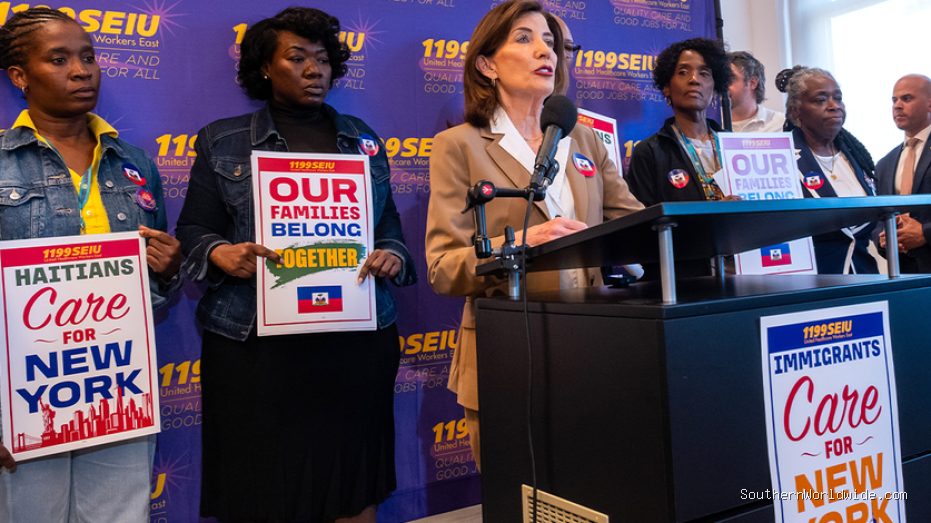
New York Governor Kathy Hochul was among the first to react, announcing measures her state would take to counter the Supreme Court’s decision. She declared that New York would designate “sensitive locations” to prevent Immigration and Customs Enforcement (ICE) agents from conducting operations there.
Furthermore, Governor Hochul stated that masks would be banned for immigration enforcement officers within New York. “This is New York. We fight back. We defend our people,” Hochul asserted during a press conference.
New York City Public Advocate Jumaane Williams delivered particularly strong criticism, accusing the Trump administration of operating with a “White supremacist lens.” He characterized the administration’s policies as based on dehumanizing individuals, especially those who are Black and Brown.
In her dissenting opinion, Supreme Court Justice Sonia Sotomayor suggested there was evidence that the Trump administration’s decision to revoke TPS for Haitians was driven by “racial animus.” She cited statements made by Trump regarding Haitians during the lead-up to the 2024 election.
However, Justice Samuel Alito, who authored the majority opinions, noted that the respondents themselves had suggested the administration’s opposition to TPS might be based on policy rather than targeting a specific group.
New York Attorney General Letitia James described the ruling as a “betrayal of who we are supposed to be as a nation.” New York City Mayor Zohran Mamdani announced the immediate activation of a free municipal legal hotline to assist affected immigrants.
Mamdani, whose wife is Syrian-American, stated that New York City would stand with those facing fear and instability due to the ruling. He emphasized the city’s rejection of “the politics of fear.”
In Massachusetts, a state with approximately 45,000 TPS holders, Governor Maura Healey also condemned the decision. She argued that the ruling was detrimental to families, the economy, communities, and the nation as a whole.
Boston Mayor Michelle Wu, visibly emotional, directly addressed migrants, assuring them, “You belong here.”
The Supreme Court’s decision also revealed a division within the Republican party. Representative Mike Lawler of New York strongly criticized the termination of TPS for Haitians.
While Lawler acknowledged the president’s legal authority to end TPS, he expressed concern that doing so immediately could create a crisis in the U.S. healthcare system. He highlighted that a significant portion of TPS holders from Haiti work in healthcare roles.
“Of the 350,000+ lawful Haitian TPS holders, roughly 1/3rd work in our healthcare system,” Lawler stated on X. “Immediately shutting off TPS will create a crisis in our hospitals, nursing homes, and in the I/DD community.”
Lawler also pointed to the ongoing gang violence in Haiti and the State Department’s Level 4 travel advisory as reasons why TPS protections should be extended.
He urged the administration to implement an “orderly process” over the next six months for Haitian TPS holders to maintain their work authorizations. Lawler also called for the Senate to consider his legislation aimed at temporarily extending their status.
Following the ruling, the White House and the Department of Homeland Security (DHS) hailed the decisions as a victory for the rule of law. DHS General Counsel James Percival commented that TPS had become a “de facto amnesty” for many, emphasizing the “TEMPORARY” nature of the designation.
“This is a win for the rule of law and common sense,” Percival remarked.