SouthernWorldwide.com – Colombian military forces announced on Wednesday their successful neutralization of five individuals identified as members of the militant group responsible for a recent bus bombing. This attack tragically resulted in the deaths of 20 civilians and left 45 others with injuries.
According to a statement released by the Military Forces of Colombia, the neutralized suspects were affiliated with the “Estructura Jaime Martínez,” an organized armed group. Authorities allege that this group was involved in more than just planting explosives in the municipality of Cajibío.
Their alleged criminal activities also included the theft of vehicles along the Pan-American Highway. Furthermore, the group is accused of indiscriminately deploying drones that were reportedly loaded with explosives, highlighting a concerning escalation in their tactics.
A video was shared alongside the military’s statement, which appeared to show body bags arranged in front of a military helicopter. The footage also displayed a significant quantity of seized weapons, underscoring the scale of the operation.
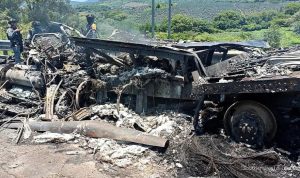
This military action followed a significant terror attack that occurred on April 26. On that date, an explosive device detonated on a passenger bus that was traveling along the Pan-American Highway in the highly volatile Cauca region of Colombia.
The blast tragically claimed the lives of 15 women and five men, as reported by The Associated Press. The incident sent shockwaves through the region and drew widespread condemnation.
While initial local reports indicated that 36 people had been injured, including several children, the Colombian military’s more recent update specified that 45 civilians sustained wounds in the explosion. This revision suggests a more severe impact than initially understood.
General Hugo López, the commander of Colombia’s armed forces, was quick to condemn the bus bombing, labeling it a “terrorist act.” His strong denouncement underscored the gravity of the situation and the military’s resolve to address such violence.
General López attributed the attack to dissident factions of the now-defunct Revolutionary Armed Forces of Colombia (FARC). He specifically pointed to the Jaime Martínez faction and the network associated with “Iván Mordisco,” a figure considered one of the country’s most wanted individuals.
The United Nations high commissioner for human rights had previously issued a plea to authorities. They urged for the “guarantee of justice for the victims,” emphasizing the importance of accountability and support for those affected by the violence.
The southwestern region of Colombia has increasingly become a contested area. It serves as a battleground for various illegal armed groups who are fiercely vying for control. Their primary interests lie in the areas where coca leaf cultivation is prevalent and in controlling crucial drug trafficking routes.
These routes are vital for transporting narcotics to markets in Central America and Europe, making the region a strategic and dangerous zone for criminal organizations and the Colombian authorities attempting to maintain order.