SouthernWorldwide.com – A parasitic fly known as the New World screwworm (NWS), which feeds on the flesh of warm-blooded animals, has been detected in South Texas.
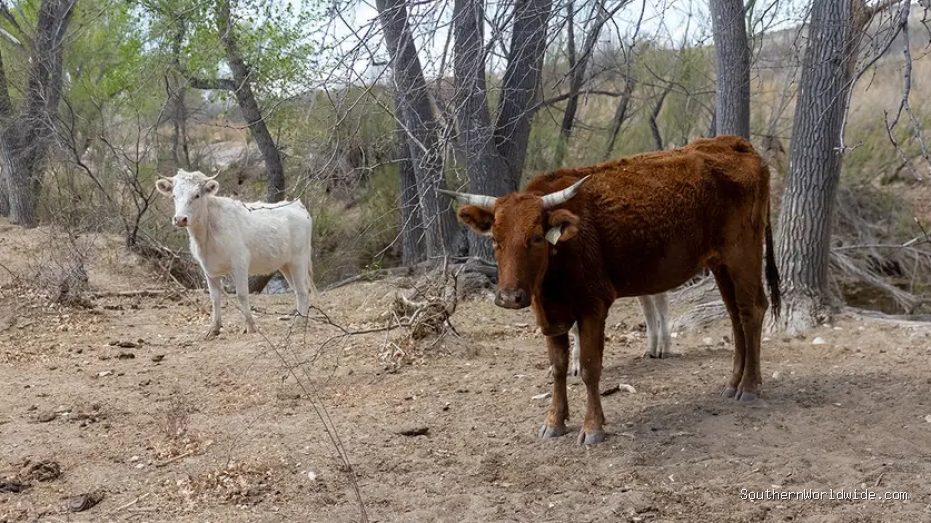
The United States Department of Agriculture’s (USDA) Animal and Plant Health Inspection Service (APHIS) confirmed on June 3 that larvae of the NWS were found in the umbilical area of a three-week-old calf in Zavala County, Texas.
As of June 11, federal officials had confirmed a total of six cases, according to a report by Fox7 Austin.
The USDA states that the NWS is a significant pest affecting livestock, pets, wildlife, and less commonly, humans and birds. The larvae, or maggots, burrow into the flesh of live animals, causing severe damage to livestock and leading to economic losses.
While screwworms do not render meat unsafe for consumption, they pose a threat of increasing beef prices, which are already at a historic high.
U.S. Secretary of Agriculture Brooke Rollins announced on May 11, 2025, the suspension of live cattle, horse, and bison imports through U.S. ports of entry along the southern border. This measure was implemented due to the continuous and rapid northward spread of the NWS in Mexico.
Dudley Hoskins, USDA under secretary for marketing and regulatory programs, noted that models had predicted the NWS would enter the U.S. in 2025. He credited the efforts of the Trump administration, along with industry, state, and local partners, for delaying its arrival.
Hoskins added that the USDA had made substantial investments in tools to eradicate the NWS since cases began increasing in Central America and Mexico. He expressed confidence that the United States, having successfully defeated this pest before, would do so again.
The USDA announced that an APHIS strike team is already on the ground in Texas. The agency has initiated a swift and effective response, which includes the release of sterile male flies and the establishment of a movement control zone to quarantine livestock.
Eradication efforts for the NWS by USDA scientists began in the 1920s and 1930s. One method employed was the Screwworm Adult Suppression System (SWASS), which used bait to lure flies to insecticides, killing them before they could reproduce. Since female flies reproduce only once, the release of sterile male flies was also a strategy to ensure that any mating would result in no offspring.
In 1966, Agricultural Research Magazine declared the screwworm eradicated from the United States.
Texas Agriculture Commissioner Sid Miller has voiced criticism regarding the USDA’s response to the current NWS outbreak.
Miller stated in a press release that for months, the screwworm had advanced rapidly through Mexico despite the USDA’s existing plan. He pointed out that even with billions of sterile flies dispersed by the USDA, the screwworm had progressed over 1,100 miles from southern Mexico to Texas, suggesting the USDA had overlooked a crucial component.
He added that the consequences of this oversight were now apparent with the arrival of the first screwworm case in Texas.
Miller claimed to have personally shared research and the SWASS bait formula with Secretary Rollins and her team on three separate occasions while the screwworm was moving north towards Texas.
He further asserted that instead of utilizing all available tools, the USDA had acted too slowly and relied solely on a partial solution that requires years to fully implement.
Miller urged President Trump to take control of the NWS response.
He implored the president to cut through bureaucracy, deploy SWASS immediately, and allocate all available federal resources to combat the threat before it escalated into a full-blown agricultural disaster.
Texas Land Commissioner Dawn Buckingham, who oversees over 13 million acres of state land, including substantial grazing and hunting leases managed by the Texas General Land Office, has offered full access to these lands. Her office sent a letter to Secretary Rollins and Texas Governor Greg Abbott to support the government’s response to the “active, escalating threat of the New World Screwworm.”
Buckingham stated that the Land Commission has offered access to properties for housing workers, cultivating sterile flies, setting up traps, and any other necessary support.
According to Buckingham, the Land Commission had met with South Texas ranchers “many months ago” after observing screwworm flies advancing through Central America and Mexico. She explained that these pests were slowly making their way back after being pushed to South America several decades prior.
“[Screwworms] come and go with the world population being so mobile,” Buckingham remarked. “It’s very easy for insects to travel, whether they jump on a fruit truck or they come on animals or whether they’ve infected a person. Diseases move much more quickly these days than they used to.”
“The good news is we’ve got medication to treat [screwworms], and we know how to stop the propagation of the insect, so we should be able to get it under pretty good control. It’s not reinventing the wheel. We fought them before. We’ll fight them successfully again.”