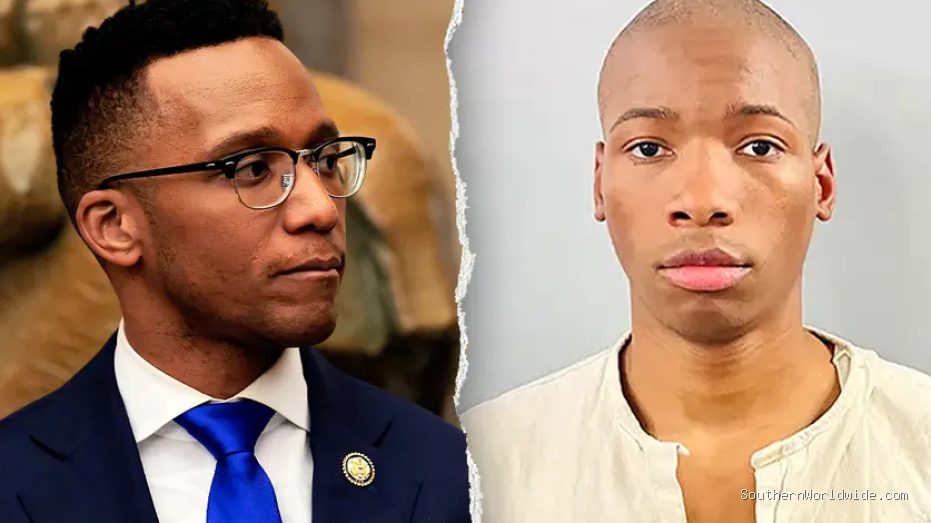
SouthernWorldwide.com – House Democrats are voicing significant concerns regarding the potential influence of race and jury selection in the Karmelo Anthony case, with several lawmakers asserting that the guilty verdict underscores the pervasive racism they believe is embedded within the criminal justice system.
Congressman Christian Menefee, a Democrat from Texas, expressed his dismay, calling the verdict a “travesty” that has ruined two lives. He specifically highlighted the composition of the jury, noting, “what struck me most is that you had an all-white jury.” Menefee further elaborated that “preemptive strikes were used in order to achieve an all-white jury.”
Following Anthony’s sentencing to 35 years in prison on Tuesday for the stabbing and killing of 17-year-old Austin Metcalf at a high school track event, numerous activists and Democratic lawmakers have come forward to label the trial as both unfair and racially motivated.
A significant point of contention among critics is the assertion that the jury was entirely composed of white individuals, which they argue contributed to the rejection of Anthony’s self-defense claim.
Menefee drew a parallel, stating, “Juries should represent the diversity of this country.” He questioned the fairness of the current situation by posing, “if a white kid was convicted of murder and it was an all-black jury that did the conviction, people would say this is patently unfair. So why should it be fair if it’s the other way around?”
Supporters of Anthony maintain that he acted in self-defense when he stabbed Metcalf, and consequently, they believe he did not receive a fair trial. Some activists and Democratic lawmakers are now calling for a thorough review of the case and encouraging Anthony to pursue an appeal.
Congressman Troy Carter, a Democrat from Louisiana, commented on the case, suggesting, “Here is a case where a young man certainly appears to have been being attacked and defended himself.”
Carter continued, emphasizing the broader implications: “It does bring in light the imbalance in our judicial system, as it relates to African Americans and people of color. And that’s a shame. So hopefully, there’ll be an opportunity for some appeal and some further discussion.”
Menefee articulated a recurring pattern, stating, “Case after case, after case you see that if it is a young black person, they’re not allowed to be fearful, they’re not allowed self-defense, they don’t get the same standard ground opportunities that other people get. But then other races do.”
While some lawmakers were more hesitant to directly attribute the trial’s outcome to racial bias, they expressed sympathy for Anthony and did not dismiss the possibility of further scrutiny of the evidence, even after a verdict had been reached.
Congressman Jonathan Jackson, a Democrat from Illinois, stressed the urgency of addressing the violence, saying, “We’ve got to stop this loss and the killing of these young children, number one.” He added, “First of all, they need to reopen it and all the evidence needs to come forward.”
Congressman Shomari Figures, a Democrat from Alabama, described the situation as “an unfortunate circumstance all the way around.”
He elaborated on the tragic nature of the case: “You have one young man who was killed. His family will never get to be with him again. You have another young man who, for all intents and purposes, thrown a lot of years of his life. A lot of the years of this life. If he does 35 years, he’ll be 50 — in his 50s — when he gets out. And it’s just totally unfortunate.”
Throughout their critiques of the verdict, several lawmakers framed the Karmelo Anthony case as a component of a larger, ongoing discourse concerning race, the validity of self-defense claims, and the equitable application of the law for minority groups.
Menefee concluded with a pointed observation: “The American justice system does not work equally for everybody.”