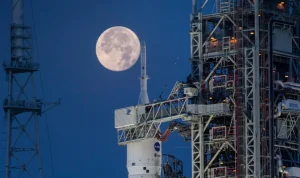
SouthernWorldwide.com – NASA is gearing up to reveal the names of the astronauts who will embark on the Artemis III mission, a monumental journey scheduled to launch in 2027.
This highly anticipated announcement is set to be made by NASA on Wednesday, marking a significant step forward in humanity’s return to the lunar surface.
The Artemis III mission holds particular significance as it is planned to land the first woman and the first person of color on the Moon, a historic milestone that underscores NASA’s commitment to diversity and inclusion in its space exploration endeavors.
The mission’s primary objective is to land astronauts on the lunar south pole, an area believed to hold substantial reserves of water ice.
This water ice is crucial for future long-term lunar habitation and could potentially be utilized for rocket fuel, making the south pole a strategic location for sustained human presence beyond Earth.
The selection of the Artemis III crew is a rigorous process, with astronauts chosen based on a wide range of criteria including their expertise, experience, physical and mental resilience, and their ability to work effectively as part of a team in a high-pressure environment.
These astronauts will undergo extensive training to prepare them for the unique challenges of lunar exploration, including operating in microgravity, conducting spacewalks on the lunar surface, and managing complex scientific experiments.
The Artemis program, named after the Greek goddess of the Moon and the twin sister of Apollo, aims to establish a sustainable human presence on the Moon and eventually serve as a stepping stone for missions to Mars.
Artemis III is the third mission in the Artemis program and the first to carry a crew to the lunar surface since the Apollo program concluded in 1972.
The mission will utilize the Space Launch System (SLS) rocket, NASA’s most powerful rocket ever built, and the Orion spacecraft, designed to carry astronauts on deep space missions.
A crucial component of the Artemis III mission is the Human Landing System (HLS), which will transport the astronauts from lunar orbit to the surface and back.
SpaceX’s Starship is currently slated to serve as the HLS for Artemis III, marking a significant collaboration between NASA and the private aerospace industry.
The selection of SpaceX’s Starship highlights NASA’s strategy of leveraging commercial partnerships to drive innovation and reduce the cost of space exploration.
The lunar south pole is of great interest due to the presence of water ice in permanently shadowed craters, which could be a vital resource for future astronauts.
The ice can be used for drinking water, breathable air, and as a component for rocket fuel, enabling longer stays and more ambitious exploration.
The Artemis III mission is expected to last approximately six days on the lunar surface, during which the astronauts will conduct scientific research, collect lunar samples, and deploy experiments.
The specific scientific objectives of the mission are still being finalized but are expected to focus on understanding the geology of the lunar south pole, searching for signs of past or present life, and assessing the feasibility of utilizing lunar resources.
The mission’s success hinges on the combined efforts of NASA, its international partners, and commercial companies like SpaceX.
This collaborative approach is essential for achieving the ambitious goals of the Artemis program and pushing the boundaries of human space exploration.
The Artemis III crew will not only be pioneers in lunar exploration but also ambassadors for a new era of spaceflight, one that is more inclusive, sustainable, and technologically advanced.
Their journey will be closely watched by people around the world, inspiring future generations of scientists, engineers, and explorers.
The announcement of the Artemis III astronauts is a pivotal moment, signaling NASA’s readiness to take the next giant leap in its quest to explore the cosmos.
The mission represents a significant investment in scientific discovery, technological advancement, and the future of human presence beyond Earth.
As the world awaits the names of these intrepid explorers, the Artemis III mission stands as a beacon of hope and a testament to human ingenuity and our enduring desire to reach for the stars.
The mission’s success could pave the way for a permanent lunar base and future human missions to Mars, opening up new frontiers for scientific research and human settlement.
The anticipation surrounding the Artemis III astronaut announcement is a clear indication of the public’s fascination with space exploration and the profound impact these missions have on our collective imagination.
NASA’s Artemis III mission is not just about returning to the Moon; it’s about establishing a sustainable presence that will enable further scientific discovery and prepare us for the even greater challenges of exploring Mars.
The astronauts selected for this mission will carry the hopes and dreams of a planet eager to once again set foot on another world.