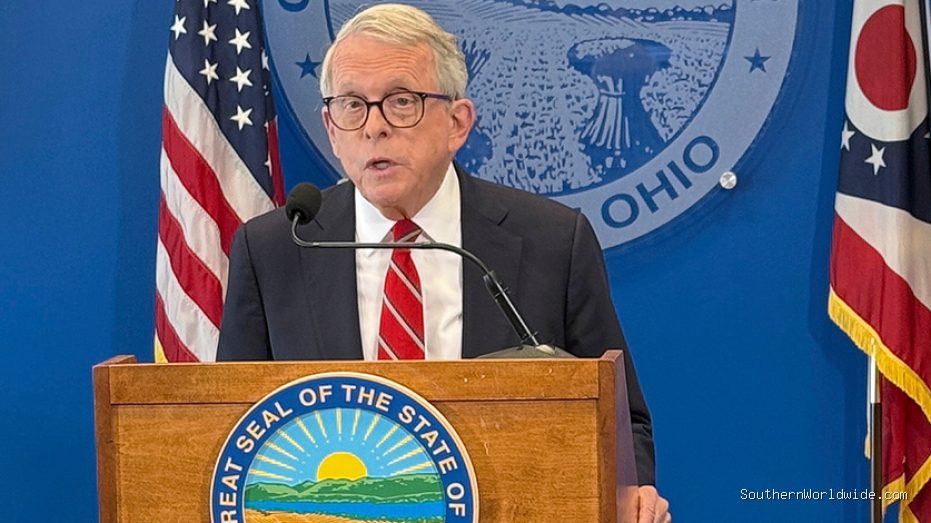
SouthernWorldwide.com – Ohio Governor Mike DeWine, a Republican, has announced his support for abolishing capital punishment in the state, marking a significant shift from his stance 45 years ago when he helped draft legislation to reinstate the death penalty in Ohio.
DeWine, who has previously postponed numerous executions during his governorship, cited data indicating that the death penalty does not effectively deter violent crime. He emphasized that the state should only take a life if there is clear evidence it protects the public by deterring future murders.
During a news conference, DeWine stated, “I do not believe that argument today can be successfully made, nor do I believe that there’s any chance in the future the facts that I’ve cited to support that belief will change. Therefore, I believe Ohio should abolish the death penalty.”
To support his position, DeWine presented charts and graphs illustrating a decline in both death sentences issued by courts and the number of executions carried out. The data also highlighted the extensive delays caused by legal appeals for inmates on death row.
The governor noted that condemned murderers are increasingly unlikely to be executed, with some dying of natural causes or suicide before their scheduled executions. He explained that even when a murderer is caught, convicted, and sentenced to death, the probability of actual execution remains low.
“In summary, each decade that the death penalty has been in effect, the chances of a murderer getting executed get more and more and more remote,” DeWine added.
He revealed that the last 10 individuals executed in Ohio had spent between 14 and 32 years on death row. Since the reinstatement of capital punishment in 1981 under a law co-authored by DeWine, 56 individuals sentenced to death have been executed, while 41 died from natural causes or suicide while awaiting execution. Additionally, 89 death sentences were overturned due to judicial actions, such as legal errors.
DeWine also drew attention to the prolonged suffering experienced by victims’ families due to these delays and the mental health toll on state employees involved in execution processes.
“I no longer believe the death penalty is a deterrent to murder,” DeWine declared. “The moral justification I had for voting for the death penalty simply no longer exists.”
As he is term-limited and cannot seek re-election in 2026, DeWine felt compelled to share his current views after 50 years of involvement with the death penalty issue, including his roles as a prosecutor, a member of the U.S. House and Senate, and Ohio’s attorney general. He stated that his opposition has become firmly established over the past year.
DeWine urged the state legislature to abolish the death penalty or allow residents to vote on the matter. However, Republican House Speaker Matt Huffman has indicated his opposition to such measures. Proponents of capital punishment argue that Ohio’s extended pause on executions has denied justice to victims’ families and diminished the deterrent effect of death sentences.
DeWine has not authorized any executions since taking office seven years ago, frequently citing the reluctance of pharmaceutical suppliers to provide lethal injection drugs. In response to similar issues faced by states, President Donald Trump ordered the U.S. Justice Department in January 2025 to assist states in resolving these drug procurement challenges.
The governor anticipates no further executions during his remaining term. According to the Ohio Department of Rehabilitation and Correction, Ohio currently has 30 executions scheduled over the next four years. The state has not carried out an execution since July 18, 2018, prior to DeWine’s governorship.
“The most important way to protect the public is to lock up violent criminals and to keep them out of society,” DeWine asserted. “That is a proven way of saving lives and protecting our citizens. Our money and energies are much better spent focusing on keeping these repeat violent offenders out of society.”
Nationwide, 27 states currently permit the death penalty, while 23 states and Washington, D.C., do not, according to the Death Penalty Information Center. Since 2019, three states have abolished capital punishment. Amid ongoing debates about lethal injection protocols, five states now authorize nitrogen hypoxia as an execution method.
At the federal level, former President Trump actively promoted the expansion of executions. During his presidency, 13 federal executions were carried out, a higher number than any president in modern history.