SouthernWorldwide.com – A recent video showcasing a robot soccer player named Booster T1 has sparked conversations about the increasing power and capabilities of humanoid robots.
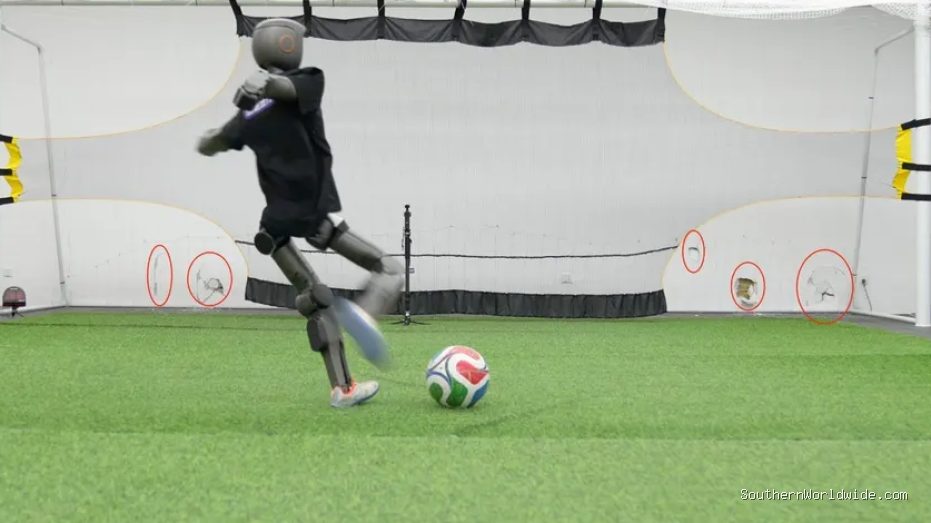
The robot, developed by Beijing-based Booster Robotics, demonstrated its kicking prowess by sending soccer balls with such force that they left visible dents and impact marks on a wall behind the goal. This display, shared on YouTube with the title “Try Stopping This Robot,” has captured public attention and raised questions about the safety implications of such powerful machines.
While the T1 is designed for research and development, its ability to generate significant force highlights the need for robust safety measures as humanoid robots become more integrated into various aspects of life.
Understanding the Booster T1 Robot
The Booster T1 is a humanoid robot standing approximately 3 feet, 10 inches tall and weighing around 66 pounds. It boasts between 23 to 41 degrees of freedom, allowing for a range of athletic movements including walking, turning, and balancing.
Booster states that the T1 can operate for about two hours on a single charge for walking and up to four hours while standing. The robot is designed to be adaptable, supporting open-source tools, software frameworks, and API interfaces, which simplifies the process for teams to train it for new tasks. Notably, over 50 robotics teams and research institutes are already utilizing the T1 platform.
Soccer as a Testing Ground for Robotics
The use of soccer as a testing environment for humanoid robots is strategic. The sport demands constant movement, balance adjustments, and rapid decision-making, all of which are crucial for robots that may eventually work alongside humans.
A robot that can learn to recover from a fall or adapt to a moving object in a dynamic environment like a soccer match can be invaluable in other settings such as warehouses, laboratories, or disaster zones. Robot soccer provides engineers with a challenging yet relevant scenario to test how these machines handle pressure and unpredictable situations.
Applications Beyond the Field
The Booster T1 is primarily intended for research and development purposes, serving as a platform for educational institutions, laboratories, and robotics teams. Developers can leverage the T1 to test software, train motion models, and develop novel robot behaviors.
Booster also provides RoboCup-related tools, including an open-source reinforcement learning framework and a demo system that covers essential aspects like perception, localization, and decision-making for robot competitions. This essentially positions the T1 as a versatile robotic body that developers can program and train for various complex tasks.
The wall-denting video serves as a powerful demonstration of the robot’s strength, balance, and control, showcasing its advanced capabilities.
Safety Concerns and Future Implications
The impressive strength of a robot capable of denting a wall raises important safety considerations. Malfunctions or unexpected movements from a powerful robot could pose a risk of injury to individuals in its vicinity.
While not all humanoid robots present such a danger, this incident underscores the critical need for stringent safety protocols before these machines are deployed in public spaces, homes, hospitals, or retail environments.
Essential safety measures include force limitations, emergency stop functionalities, controlled testing environments, and clear operational guidelines. The safety standards for a robot operating in a controlled lab setting differ significantly from those required for a robot interacting with the public.
The RoboCup Initiative and Long-Term Goals
The Booster T1 is part of the broader RoboCup initiative, an international robot soccer competition. However, RoboCup’s ambitions extend far beyond simple games; its ultimate goal is to develop fully autonomous humanoid robots capable of competing against human World Cup champions under official soccer rules.
This ambitious objective drives significant research and development in areas such as robot balance, field perception, movement reaction, and independent decision-making. Booster explicitly states that the T1 was developed with robot soccer and RoboCup standards in mind, offering tools to accelerate the creation of robot soccer demonstrations.
Therefore, while robot soccer may appear to be a sport, it plays a crucial role in advancing the capabilities of humanoid robots for a wide range of future applications.
The Broader Impact of Advanced Robotics
The progress demonstrated by robots like the Booster T1 has implications that reach far beyond the realm of robot soccer. Humanoid robots are increasingly exhibiting enhanced confidence in their movements, improved balance, faster recovery times, and greater physical force application.
This advancement holds the potential to assist with numerous practical tasks, including warehouse operations, elder care support, and disaster response efforts. However, the development of stronger robots also introduces new challenges and questions regarding safety oversight, regulatory frameworks, and accountability in the event of property damage or personal injury.
The Booster T1 video serves as a compelling example of why rigorous testing, transparency, and accountability are paramount in the next phase of robotics development.
A Call for Vigilance and Safety
The video of the Booster T1 robot kicking a soccer ball with enough force to dent a wall is both impressive and a cause for concern. It highlights the growing power of humanoid robots and underscores the critical need for companies to demonstrate their ability to control this power safely around people.
A robot playing soccer in a controlled laboratory environment is one scenario, but a robot operating in close proximity to players, workers, or bystanders presents a vastly different and more complex safety challenge. While robot soccer may seem like a game today, it is a clear indicator of the advanced capabilities that future machines will possess.
It is therefore essential to closely monitor the development of this technology and ensure that safety remains a top priority.
The increasing power of humanoid robots, as exemplified by the Booster T1, prompts a vital question: Does this progress inspire excitement for the future, or does it raise concerns about the safety of these machines in human environments? Share your thoughts and join the discussion at Cyberguy.com.