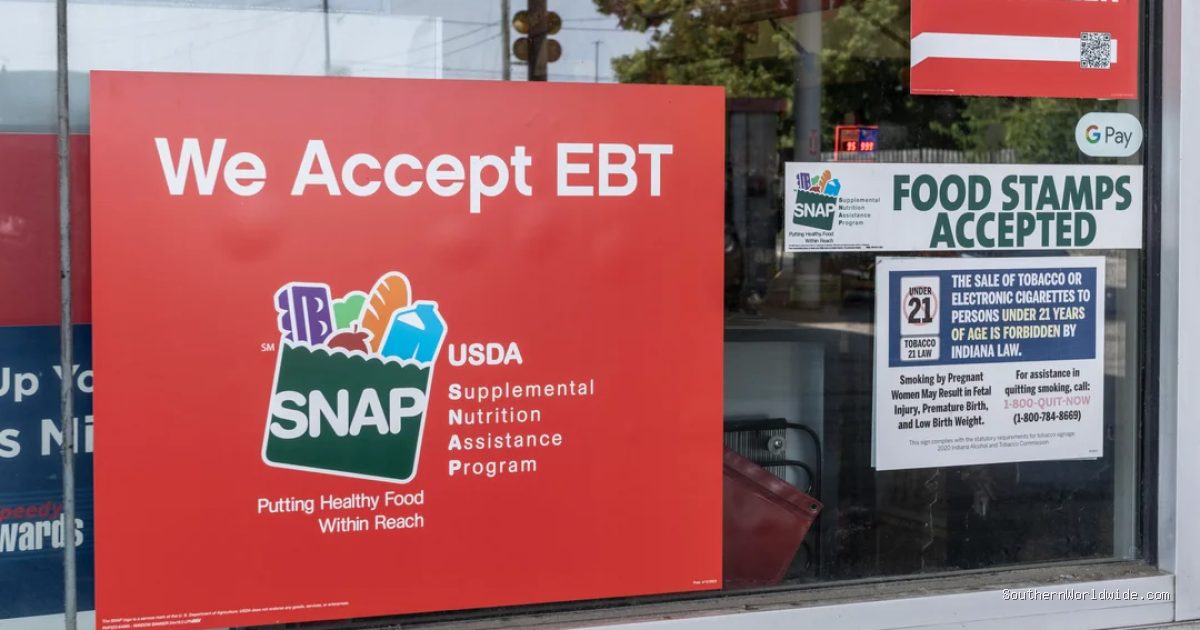
SouthernWorldwide.com – The Trump administration has asserted that the Supplemental Nutrition Assistance Program (SNAP), commonly known as food stamps, is plagued by fraud and waste, leading to substantial financial losses. However, anti-hunger advocates contend that this characterization is misleading and could jeopardize food assistance for millions of low-income families.
The Department of Agriculture reported on June 24 that the SNAP program’s payment error rate for fiscal year 2025 stood at 10.6%. This figure is nearly double the 6% threshold deemed acceptable under the Republicans’ “big, beautiful bill act” (OBBBA). The agency stated that this error rate translates to over $10 billion in improper SNAP payments nationwide for the past year.
In fiscal year 2025, SNAP provided $95.7 billion in benefits to American families. Consequently, payment errors accounted for approximately one-tenth of the program’s total expenditure.
Fraud or a Mistake?
The differing perspectives on the extent of fraud within the food stamp program hinge on the interpretation of the SNAP payment error rate. Payment errors occur when households receive either too much or too little in benefits, irrespective of whether intentional rule-breaking was involved. Experts generally agree that such over- and under-payments are typically unintentional.
In contrast, fraud typically involves deliberate deceit, such as exchanging benefits for cash or utilizing stolen Electronic Benefit Transfer (EBT) card information.
The Trump administration has used the payment error rate as evidence of waste within the program. However, the American Public Human Services Association (APHSA), which represents state and local human services agencies, notes that this metric does not encompass many prevalent forms of SNAP fraud, such as EBT card skimming or recipients illegally selling their benefits for cash.
A 2024 report from the Government Accountability Office (GAO) indicated that SNAP payment errors are primarily attributed to over- or under-payment issues, classifying food stamp fraud as a distinct, albeit related, concern.
Brian Jones, a SNAP quality control expert at APHSA, explained to CBS News that payment errors are “mostly unintentional because the policy is very complex, and there are a lot of reporting requirements” that households may not be fully aware of.
Republicans argue that reducing both payment errors and fraud would conserve taxpayer funds and ensure that benefits are exclusively provided to eligible recipients.
“Every dollar in this program is intended to help feed eligible individuals in need,” stated Rep. Tim Burchett, a Republican from Tennessee, during a House subcommittee hearing on “Combating Waste, Fraud, and Abuse in SNAP” on June 25. “That’s not where every dollar goes, not by a long shot.”
Anti-hunger advocates emphasize that while addressing fraud is important, erroneous food stamp payments largely stem from changes in recipients’ personal and financial circumstances, such as gaining or losing employment. Mistakes can also arise from administrative issues, like incomplete addresses or phone numbers.
“We should not confuse payment errors with fraud,” stated Gina Plata-Nino, SNAP director for the anti-hunger advocacy group Food Research & Action Center (FRAC), at the same hearing. “Fraud involves intentional wrongdoing — payment errors often involve complicated rules, changing work hours, missing paperwork, outdated systems or agency mistakes.”
Recouping Overpayments
Under federal law, SNAP recipients are required to repay any overpayments. States typically achieve this by reducing monthly payments until the owed amount is recouped.
“State and counties, those administering the program, should strive to have as low an error rate as possible because it is an indicator of strong administration of the program,” said Alexis Kuznick, policy director for APHSA. “States are working really hard to get their error rates much lower.”
It is important to acknowledge that actual SNAP fraud is indeed costly. The GAO previously cited data indicating that the program lost approximately $1 billion annually to fraud.
A USDA report released in May highlighted other potential fraudulent activities, including recipients using fictitious Social Security numbers and duplicate enrollments, which could account for an estimated $3 billion in annual improper payments. However, the report characterized these findings as potential issues rather than confirmed instances of fraud.
Ironically, Kuznick noted that states are being compelled to shift their focus from reducing, preventing, or responding to fraud towards quality control efforts to lower payment error rates, driven by the requirements of the OBBBA.
Potential Hit to State Budgets
The OBBBA has significantly increased the importance of the program’s payment error rate for SNAP, a program funded by the federal government but administered by U.S. states.
The new law mandates that states’ SNAP programs must maintain payment error rates below 6%. States whose food stamp programs exceed this threshold will be responsible for covering a larger portion of the program’s costs beginning in October 2027.
According to the USDA’s report from the previous week, only 10 states have SNAP payment error rates below the 6% benchmark, with South Dakota reporting the lowest at 2.5%. Alaska, conversely, has the highest payment error rate at 23%.
Under the OBBBA, states with SNAP payment error rates between 6% and 8% will be required to pay 5% of the benefit costs starting in late 2027. Those with error rates ranging from 8% to 10% will bear 10% of the benefit costs. States with error rates exceeding 10% will be responsible for 15% of the costs.
Collectively, states could face an additional $9 billion in SNAP spending, based on the most recent payment error rates released by the USDA, according to a new estimate from the Center on Budget and Policy Priorities (CBPP).
“States have never before had to put up a share of the benefit costs, and based on the 2025 data, almost half the states are facing a cost-sharing requirement that’s going to cost them $100 million or more in the first year of implementation,” Katie Bergh, a SNAP expert at CBPP, told CBS News.
This situation could necessitate states either increasing taxes or reducing spending in other budgetary areas, she explained.
“We may even see some states withdraw from the program entirely,” Bergh added, citing a survey by APHSA of all 50 state SNAP agencies, where 11% indicated that withdrawing from the food aid program was a potential risk due to anticipated higher costs.
States with SNAP payment error rates above 6% will have an additional year to reduce their errors and mitigate the financial impact on their budgets. However, states unable to lower their error rates may face difficult choices that could affect their residents, such as deciding between funding essential public services like law enforcement and education or providing food assistance.
Enrollment Decline
This financial pressure comes at a time when U.S. SNAP enrollment has significantly decreased since President Trump signed the OBBBA into law on July 4, 2025.
As of March, approximately 37 million people were enrolled in SNAP, according to the most recent data available from USDA figures. This represents a decline of nearly 5 million people compared to the previous year.
The substantial drop in SNAP enrollees is attributed to recent program changes implemented under the OBBBA, including a new work requirement for “able-bodied adults” aged 64 or younger. Previously, this regulation only applied to individuals aged 54 or younger. The updated regulation limits SNAP benefits to three months of aid every three years if individuals under 64 do not work, volunteer, or participate in job training for at least 80 hours per month.
Some advocates, including the National Governors Association, a bipartisan group representing the nation’s governors, and APHSA, are now urging lawmakers to postpone the revised state cost-sharing rules by two years.
“We have been working hard to educate and inform leaders around what the impacts will be to states,” and to request additional time for implementing changes, said Timothy Blute, chief policy officer at the National Governors Association. “Governors and states care deeply about program integrity and are working tirelessly to lower their error rates.”
Without sufficient time to rectify payment errors, many states are likely to confront challenging decisions once the cost-sharing provisions take effect, Kuznick stated.
“If an individual state can’t pay its share, what happens then? Those are the sorts of things that we have not encountered yet,” she said. “We know how critical food security is to people’s livelihoods and their ability to focus in school. You could see a widespread impact in terms of wellness outcomes overall.”