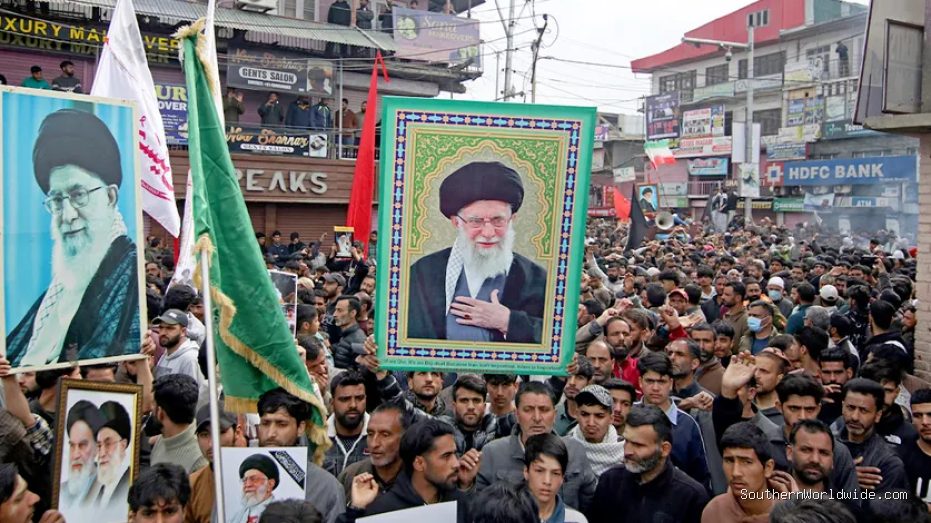
SouthernWorldwide.com – Tehran is gearing up for the July 9 burial of Supreme Leader Ali Khamenei, a ceremony scheduled more than four months after his death. Authorities are mobilizing the Basij militia and implementing extensive security measures in anticipation of a funeral expected to draw a “historic” number of attendees.
The significant delay in the funeral proceedings has sparked questions regarding the preservation of Khamenei’s remains. Analysts note that Islamic tradition generally advocates for prompt burial and discourages chemical embalming.
MOJTABA KHAMENEI USING ‘BIN LADEN TEMPLATE’ TO SURVIVE, LEARNED FROM ABBOTTABAD: ANALYST
However, Shia law does permit delayed burials and preservation through refrigeration in exceptional circumstances. Experts suggest that obtaining a clerical exemption for a Supreme Leader would be straightforward.
Iran’s forensic morgues are equipped to hold bodies for extended periods, meaning four months in freezing conditions is not unprecedented. This practice falls within established “religious and legal standards,” according to one analyst.
The operation that led to Khamenei’s death, referred to as “Operation Epic Fury,” commenced on February 28. This involved a targeted U.S. strike that resulted in Khamenei’s death at his Tehran compound. He had been the leader of the Islamic Republic for 36 years.
The nature of the strike raises concerns about the condition of the remains. Khamenei was reportedly killed by a bunker-penetration strike, and other casualties from the same incident were recovered weeks later and identified through DNA. This suggests that the body presented may not be fully intact.
A regime that possesses an intact body would typically not repeatedly shift burial sites, delay the funeral, and only confirm the burial date shortly before the event. The current circumstances suggest that while the remains might have been preserved, they may not be suitable for public display.
WAVE OF ATTACKS ON IRAN’S IRGC RAISES QUESTIONS ABOUT RENEWED KURDISH INSURGENCY
In light of this, Iranian authorities are framing the funeral as both a final farewell to their leader and a demonstration of national strength, rallying under the slogan “We Must Avenge.”
According to Iranian state media, Yaqoub Soleimani, the deputy for cultural and educational affairs at the Martyrs Foundation and a key organizer of the funeral, stated on Wednesday that the ceremony would be conducted “with full grandeur.”
Soleimani anticipates that an attendance of 1 million people would elevate the event to a “historical occasion” and a “national epic in the memory of the Islamic Republic of Iran.”
The schedule includes public viewings on Saturday and Sunday in Tehran. A major funeral procession is planned for July 6, with local authorities estimating that between 15 million and 20 million people could participate.
An additional procession is slated for the following day in Qom, a city considered one of the holiest in Shiite Islam.
The reported figures for attendance—up to 20 million mourners in Tehran, 35 million nationwide, representation from over 90 countries, and 14,000 credentialed journalists—are not merely logistical details. They serve as a strategic message.
Tehran is reportedly investing heavily to project an image of continuity and strength, particularly as these aspects are in question following recent conflicts. This message is intended to reassure both domestic and international audiences.
IRAN’S UNPRECEDENTED ‘WHOLE-REGIME’ DELEGATION AT US DEAL TALKS SIGNALS ONE GOAL: EXPERT
Furthermore, reports indicate that Tehran is orchestrating a substantial security operation for the funeral.
The involvement of the Basij and the IRGC in managing the funeral is considered a significant aspect of the narrative, rather than a minor detail.
The Basij is reportedly handling logistical arrangements, including the conversion of highways into parking areas, assigning specific provinces to each Tehran district, and declaring five public holidays. The IRGC is responsible for crowd control measures.
This extensive mobilization, disguised as a funeral, is noteworthy. The same apparatus responsible for organizing this week’s displays of grief is also the one that suppressed protests in January and denied funerals to the families of those killed during those events. This parallel should be noted by observers.
While senior Iraqi officials are expected to attend the funeral, representation from other major global powers is anticipated to be limited.
Despite a personal invitation from Iranian President Masoud Pezeshkian to Indian Prime Minister Narendra Modi, India is reportedly sending a lower-level official delegation instead.
Reports from June 30 also confirmed that Georgian President Mikheil Kavelashvili will attend the ceremony.
The absence of top leaders from major powers at the funeral is a significant observation. For a regime that claims to lead a regional axis from Beirut to Sanaa, the level of regional attendance at the funeral of its founder-successor highlights its isolation, despite the outward display of pageantry.
For Washington, this event offers a valuable insight: the conflict has seemingly diminished the reach of Tehran’s axis, making it more regional than the regime typically portrays.