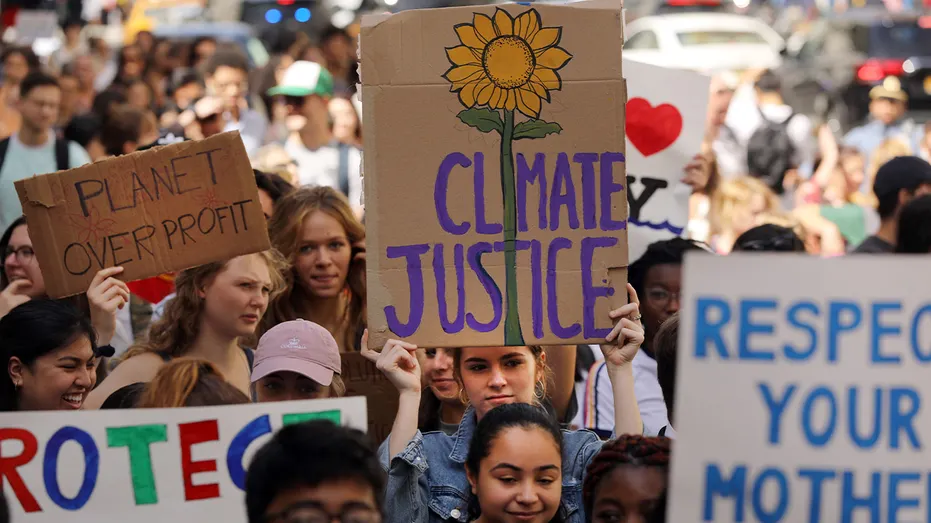
SouthernWorldwide.com – For a significant portion of the author’s life, warnings about climate change leading to planetary destruction have been a constant from experts, educators, politicians, and activists. However, a recent article in The New York Times suggests a shift, indicating that the intensity of climate alarmism may be subsiding.
The headline, “Democrats Do Not Have To Campaign On Climate Change Anymore,” as featured in The New York Times, highlights an argument by author Matt Huber that voters are becoming disengaged from the topic. The author posits that this is because climate change has become the most financially burdensome deception in human history.
The author recalls experiencing different climate predictions throughout their life. In elementary school, there were warnings of an impending ice age. By high school, the focus shifted to global warming, presented as an imminent threat to humanity. Once adulthood was reached and global warming failed to materialize as predicted, the term “climate change” became the vague descriptor for an inevitable catastrophe.
The article references a statement made in 2018 by Rep. Alexandria Ocasio-Cortez, D-N.Y., who suggested that humanity had only 12 years to address the climate crisis before facing dire consequences. Despite the expenditure of trillions of dollars by governments and businesses globally, and despite every prediction made by alarmists proving inaccurate, the author claims that these efforts have not yielded the promised results.
Miami, a city often cited in discussions of rising sea levels, is noted by the author as not being underwater, implying a discrepancy between predictions and reality.
Beyond the financial implications, the author argues that climate alarmism has hindered progress in other areas. They question the potential cost of gasoline today if oil exploration had been prioritized over the perceived urgency to transition to electric cars. The author implies that the push for electric vehicles by “next Tuesday” has had economic repercussions.
The author asserts that nearly every aspect of daily life has been made more expensive due to what they describe as the “cult of climate” and its persistent pronouncements of impending doom. They draw a parallel between the fear instilled in young people by climate change narratives and the fear experienced by previous generations during nuclear bomb drills, suggesting that youth have been led to believe they might be the last generation of humans.
Reports of young adults expressing reluctance to have children due to concerns about the world ending are mentioned. The author dismisses climate change as a valid reason for such decisions, contrasting it with other potential factors like participation in travel sports.
After five decades of what the author characterizes as “hysteria,” the author expresses surprise that The New York Times, a publication that has consistently voiced concerns about climate change, is now suggesting it may not be as significant an issue as previously portrayed.
Even Greta Thunberg, whose public persona was largely built around advocating for climate action, is mentioned as having shifted her focus to other issues, implying a change in the climate activism landscape.
The author describes climate alarmism as a remarkably successful “apocalyptic hoax.” They contrast its long duration with the shorter period of focus on overpopulation concerns in the 1960s, attributing the decades of “insanity” to what they call Al Gore’s “unhinged predictions.”
While acknowledging the general desire to be environmentally responsible, the author criticizes performative actions like paper straws that quickly degrade or cars with automatic shut-off features as “meaningless gestures.” These are described as costly and ultimately ineffective actions.
The debate surrounding climate change, according to the author, has often involved a conflict between prioritizing nature on a grand scale versus prioritizing human well-being. The author highlights that affordable energy is crucial for lifting people out of poverty, a point that is often at odds with the concerns of climate alarmists.
The author characterizes the climate debate on the political left as having become almost religious, with environmentalist slogans replacing prayers and financial contributions replacing tithes. This perspective, the author argues, transformed the issue from a scientific one to a moral imperative, where dissenters were deemed morally deficient.
The author criticizes American climate policies and public attitudes as illogical, pointing out that the U.S. imposes strict emission controls while other nations are perceived as contributing significantly more to carbon dioxide emissions without similar restrictions.
In agreement with The New York Times’ recent stance, the author concludes that the era of climate alarmism should end. They argue against burdening future generations with the emotional and economic consequences of what they perceive as fabricated climate disasters.
Baca juga di sini: 2026 College Football Futures: SEC Championship Contenders
The author expresses confidence that Americans possess the intelligence to discern that, contrary to what the “looney Left” may suggest, the end of the world is not imminent.