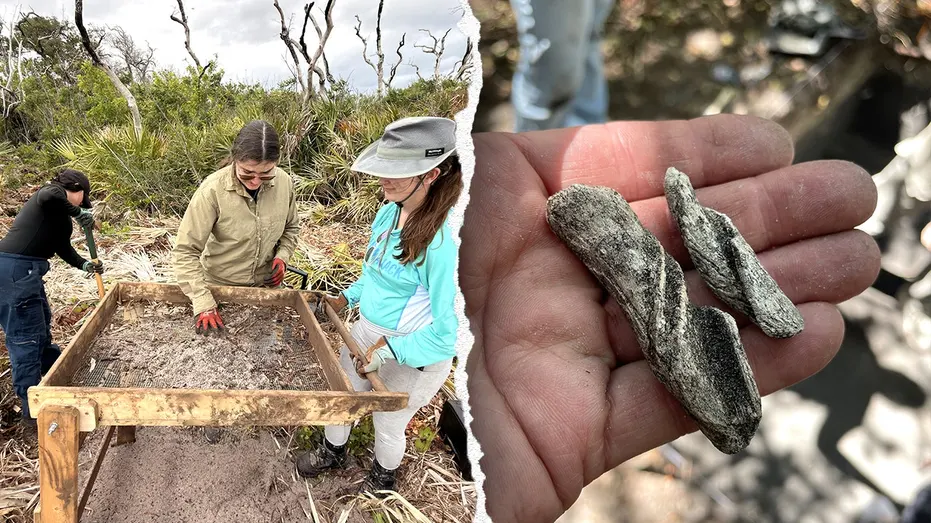
SouthernWorldwide.com – Students from the University of Central Florida are unearthing relics of the past at a location often associated with the future: Cape Canaveral Space Force Station.
The current excavation is taking place at the DeSoto site, situated along the Atlantic coast of Florida. This site offers a glimpse into the Malabar II Period, which spanned from approximately 900 to 1565 A.D.
The area is characterized by black earth midden deposits, indicating layers of ancient refuse left behind by inhabitants. These middens serve as a repository for the discarded items from daily activities.
Contrary to farming, the Indigenous people in this region primarily utilized local resources. However, evidence suggests that some individuals had access to ground corn, a crop cultivated by Indigenous peoples in North Florida.
Their diet was rich in seafood, with remains of shark, fish, clams, and other local species discovered within the midden. Researchers have identified the refuse from numerous meals, noting that turtles, shark, black drum, and coquina clams were part of the ancient menu.
The findings also suggest the use of seasonings, indicating that ancient peoples, much like today, enhanced their food with spices. The excavation has yielded significant discoveries this year at the DeSoto site.
Among these finds are a complete vertebral column of a shark, likely consumed by the Native Americans, and an enigmatic object, possibly a fossil or a whale bone, found near the shark remains. This unidentified object has presented a puzzle to the researchers.
Read more : New Zealand Rugby League Player Dies at 30 After 'Unsurvivable' Injury in Season Opener
Archaeologists are eager to determine the nature of this peculiar item. The site has also yielded hundreds of pottery sherds and the remnants of at least one hearth, a place where food was likely prepared and cooked.
Further analysis, including radiocarbon dating at an external laboratory, is required for some of the collected samples. The recovered tools include conch shell hammers and shark tooth knives, which were instrumental in food preparation.
The discovered remains provide insights into the dietary choices of the Indigenous people, highlighting a focus on shark consumption while indicating minimal evidence of dolphin hunting.
These findings suggest that for centuries, Native Americans relied heavily on locally sourced food and maintained connections with other tribes. The Indigenous communities of Cape Canaveral lived in relatively dense settlements and subsisted entirely on food obtained from their immediate surroundings.
Remarkably, they sustained this lifestyle for thousands of years without imposing the environmental stress that modern societies have generated in a much shorter timeframe. The community was well-integrated and far from isolated, demonstrating a balanced approach to resource utilization.
The archaeological evidence points to an abundance and variety of food sources, sufficient time for pottery production when necessary, and opportunities for travel and interaction with people from distant regions. This suggests a lifestyle that was likely comfortable and situated along the beachfront.
Ultimately, the excavations underscore the coexistence of the past and the present. Cape Canaveral stands as a unique location where the future of space exploration is literally built upon and intertwined with ancient Native American landscapes, illustrating the enduring presence of history.