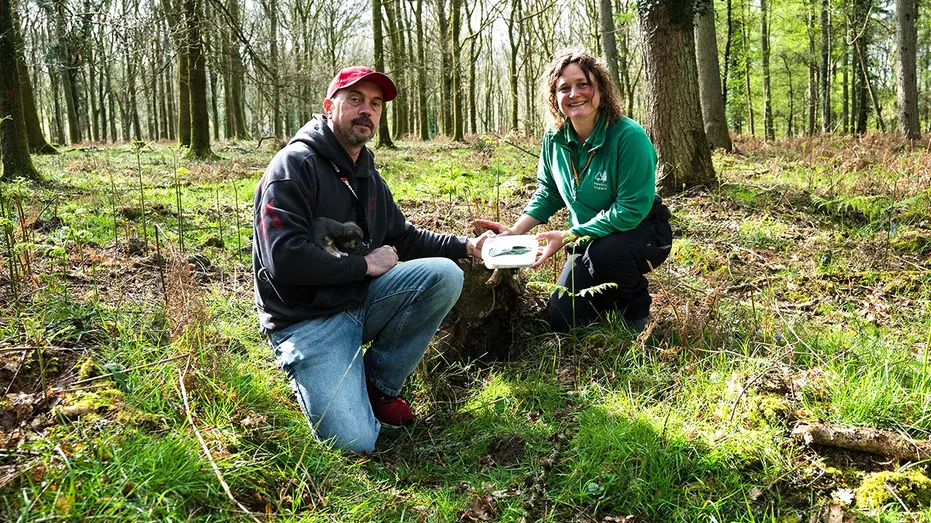
SouthernWorldwide.com – A routine walk in a forest led to an extraordinary discovery for a dog walker, who stumbled upon an ancient axe head believed to be 3,000 years old.
The artifact was found by John, a dog walker, in the historic Forest of Dean, located in western Gloucestershire, England, near the Welsh border.
This ancient woodland, known for its mature trees and dense foliage, is where John spotted the axe. It was nestled amongst the roots of a fallen tree in a wooded area close to Brierley.
The discovery was officially announced by Forestry England, the government agency responsible for managing the nation’s public forests.
Following the find, the axe was promptly reported to Forestry England, who manage the woodland where it was discovered.
The object was then handed over for cataloging and further examination by experts.
Experts have dated the axe to the Middle Bronze Age, a period in Britain that spanned approximately 1500 to 1200 B.C.
This dating suggests the tool is at least three millennia old.
Read more : Bruno Fernandes Outshines Cristiano Ronaldo in New Manchester United Achievement
Kayleigh Spring, an object conservator at the Wiltshire and Swindon History Centre, identified the artifact as a palstave axe.
Palstave axes were characterized by a loop on the side, designed to securely fasten the axe head to a wooden handle.
Spring explained that the axe is likely made from bronze, an alloy primarily composed of copper and tin.
She further noted that this type of tool was originally created using molds.
The craftsmanship of the axe indicates a more advanced stage of Bronze Age metalworking. Spring pointed out that early Bronze Age molds were typically simple hollowed stones.
However, by the Middle Bronze Age, the development of two-part molds allowed for the creation of more intricate designs, such as the one seen on this axe.
Spring detailed the conservation process, stating that after confirming the absence of chloride ions, soil and corrosion were meticulously removed under magnification. An application of Incralac was then used to protect the pitted blade and minimize future corrosion, particularly for display purposes.
Following its analysis, the ancient axe was transferred to the Dean Heritage Centre, a museum situated in Soudley, Gloucestershire.
Leoni Dawson, a community ranger for Forestry England, expressed that such finds offer a profound connection to the people who inhabited and worked these lands in ancient times.
Dawson remarked on the remarkable nature of tools surviving for thousands of years, hidden beneath the earth.
She further described the Forest of Dean as one of England’s largest ancient forests, a landscape shaped by centuries of history, industry, and natural splendor.
Dawson acknowledged that while rare, discoveries like this are not unprecedented in the area.
This incident is not the only recent instance of dog walkers making historical discoveries in the United Kingdom.
In Scotland, two dog walkers recently uncovered “distinct markings” on a beach in Angus, which were later identified as 2,000-year-old footprints.
Although the footprints were eventually eroded by the sea, archaeologists managed to create detailed 3D models and physical casts before they were lost.