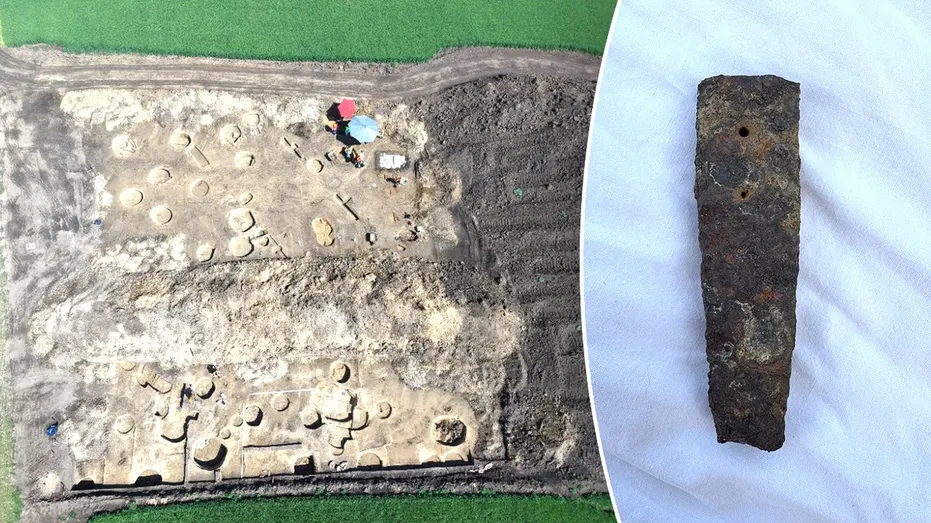
SouthernWorldwide.com – Archaeologists in Central Europe have unearthed a significant ancient site containing over 1,000 artifacts, unearthed in anticipation of railway construction. Among the remarkable finds is a rare Roman-era tool specifically designed for the production of metal wire.
The discovery was formally announced in an April press release issued by the Archaeological Center Olomouc (ACO), a prominent research institution based in the Czech Republic. These extensive excavations took place along a stretch of land approximately three-quarters of a mile long.
This particular area is slated to become a segment of a new high-speed railway line connecting two Czech towns, Nezamyslice and Kojetín, situated within the picturesque Haná River valley. The unearthed artifacts represent a broad chronological span, from the Early Bronze Age right through to the Roman era.
Excavation work was meticulously conducted over a period spanning from April to October of 2025. Nikola Jandová, a spokesperson for ACO, stated that the site is considered to be “among exceptionally rich settlement complexes in this part of the Haná region.”
Evidence of two distinct Bronze Age cultures, the Věteřov and Urnfield cultures, were identified. Furthermore, the site also yielded traces of the Iron Age La Tène culture, indicating continuous human habitation and activity over millennia.
Read more : Richard Childress Racing Retires No. 8 Car, Reserves It for Kyle Busch's Son
The earliest known settlement at this location dates back to the Věteřov culture. During this period, archaeologists discovered the remains of wooden dwellings. The Věteřov culture inhabited the area approximately between 1800 and 1500 B.C., while the Urnfield culture was present from roughly 1300 to 800 B.C.
The press release detailed that following destructive fires that occurred at the site, fragments of wall plaster survived. These fragments, preserved as reddened fired clay, are commonly known as daub. Some of these daub fragments exhibit smoothed surfaces with visible traces of external decoration.
Other fragments uniquely preserve impressions of wattle on their inner sides, offering a glimpse into construction techniques. Archaeologist Pavel Moš commented that the intricate details of the houses were remarkably preserved within the daub, with some surface finishing traces still discernible.
In addition to structural remains, excavators discovered two Věteřov graves. One of these graves contained the remains of both an adult and a child, which are slated for further detailed analysis. The Urnfield culture remains included four graves, and notably, one grave contained six human skulls.
These skulls were found deliberately placed side by side within the fill of the excavated feature. The site also yielded fragments of crucibles and stone molds, tools that were essential for crafting bronze objects. A small collection of bronze artifacts was also found, including axes, pins, a bracelet, and a knife.
These specific finds are dated to the transition period between the end of the Bronze Age and the Early Iron Age. They strongly suggest the presence of a specialized workshop dedicated to bronze metallurgy in the area. Archaeologists also uncovered a lime kiln, likely utilized by Germanic tribes during the Roman era.
The lime kiln was probably used for wall finishing or pottery decoration, with its usage estimated to be between the first and fourth centuries A.D. However, the most extraordinary artifact to emerge from the excavations was identified as a Roman drawplate.
This specialized tool was used for the process of drawing and thinning metal wire. The discovery of such a drawplate is considered exceptionally rare within the Central European archaeological context. Although the drawplate is in a relatively well-preserved state, archaeologist Pavel Moš noted the presence of corrosion residues within its perforations.
He also pointed out that traces of drawn metal wires might still be preserved within these openings. To gain further insight, the drawplate will undergo spectrometric analysis to precisely determine the material of the wire that was processed. Moš speculated that this wire could have been utilized in the production of chain mail, a type of protective armor.
All unearthed artifacts will now proceed to comprehensive laboratory analysis and preservation treatments. The results of these detailed studies are anticipated to be released incrementally over time. This latest significant discovery by ACO archaeologists follows a similar notable find made by the same team in the Czech Republic.
Last year, officials announced the discovery of multiple military graves unearthed during highway construction. The oldest of these graves was identified as dating back to the Battle of Žďár in 1745, which occurred during the Second Silesian War, underscoring the rich historical layers present in the region.