SouthernWorldwide.com – While the capital city of Kyiv faces significant Russian attacks, another Ukrainian city is striving to maintain normalcy amidst the ongoing conflict.
Four years into Russia’s war, the western Ukrainian city of Lviv is attempting to achieve something seemingly impossible: how to live a normal life while surrounded by death.
At 11:30 a.m. each day, the city comes to a standstill.
Vehicles halt in the middle of roads, and pedestrians pause on sidewalks. In the city center, beneath the imposing clock tower of city hall, people bow their heads in silent respect as another military funeral procession makes its way through the streets.
“This happens one to five times a day,” a local resident shares softly.
The war often feels distant from Lviv, until its reality abruptly intrudes.
The city, home to approximately one million people, is situated near the Polish border, hundreds of miles from the intense front lines in eastern Ukraine. Despite this distance, Russian drones and missiles continue to strike the city. Air raid sirens punctuate coffee breaks and children’s soccer matches, while funeral processions sometimes interrupt wedding celebrations. Entire neighborhoods exist in a state of flux, oscillating between moments of beauty and profound grief.
Andriy Sadovyi, who has been the mayor of Lviv for nearly two decades, save for a brief presidential candidacy, leads the city. From his office overlooking the historic center, he proudly gestures towards a terrace where he has hosted international leaders and celebrities, including actor Tom Cruise. At one point, a well-fed cat gracefully leaps onto his desk.
“This is my deputy,” Sadovyi jokes, explaining that the cat has become an unofficial city mascot. “He’s tough like a Ukrainian.”
However, beneath the lightheartedness lies a deep weariness. Sadovyi recognized early in the war that Lviv held a unique responsibility. Its proximity to Europe allowed it to remain functional, yet it was close enough to the war to grasp the gravity of the situation.
His response was the initiative he terms the “Unbroken” project: a comprehensive rehabilitation and innovation effort designed to aid Ukraine’s physical and psychological recovery.
The city established rehabilitation centers to assist wounded soldiers and civilians from across the nation, providing care for amputees, burn victims, and trauma patients. Sadovyi states that the municipality has also allocated 20% of its budget to support defense technology companies developing military solutions for the war effort.
“Every family in this city has been impacted by the war,” he asserts. “We must be strong. We must survive. I am building what is necessary for that.”
Yet, survival in Lviv extends beyond weaponry and medical facilities. It also involves encouraging people to persevere and maintain their will to live.
“People are afraid to come here,” Sadovyi admits. “But we need them to come.”
One of the city’s most recent undertakings embodies this spirit. The facility, a hybrid of a school, shooting range, and patriotic training center, was conceived to prepare civilians for a country where war has become an ingrained part of daily existence.
Inside a classroom, dozens of teenage girls attentively listen as instructors impart essential survival skills. Upstairs, at the indoor shooting range, instructor Vitaliy proudly displays an array of American-made firearms, including AR-15 style rifles and pistols.
“It’s not as large as ranges in the United States,” he says with a hint of apology.
Read more : New Study: Popular Fruit May Offer Skin Protection from Sun
Adorning the wall is a tattered image of Soviet founder Vladimir Lenin, riddled with bullet holes from target practice.
Vitaliy chuckles when asked about posters of Russian President Vladimir Putin.
“We ran out,” he jokes. “They’re too popular. We can’t keep them.”
On the terrace outside, two wounded veterans engage in archery practice.
One, who lost both legs in the war, navigates in a wheelchair. Another relies on a cane. Both have found purpose and competitive spirit through rehabilitation programs that incorporate sports.
One veteran proudly recounts winning a silver medal in a national competition. The other recently secured a gold medal and is now preparing for an international championship. Neither wishes to dwell on their experiences during combat.
Their current therapy is found in sport.
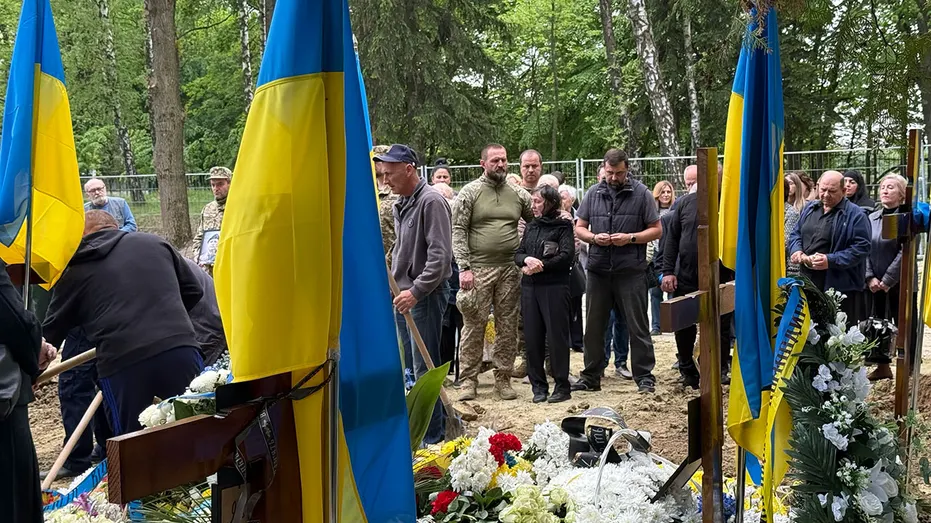
A short distance away, another funeral commences. A military convoy carrying the body of a 32-year-old soldier proceeds slowly through the city center before reaching the cemetery.
The city’s military cemetery filled so rapidly that officials were compelled to open a new burial ground only weeks ago. Already, rows of fresh graves stretch across the hillside, marked by blue-and-yellow flags and photographs of young men and women smiling from a time before the war.
The grieving brother at the funeral shares that the fallen soldier never had the opportunity to start his own family.
Around him, families kneel beside the freshly turned earth.
And yet, life continues.
Children attend school. Mothers hurry to their jobs. Cafés remain bustling with patrons. Street musicians perform in the historic town square.
That same evening, inside the Lviv Theater of Opera and Ballet, hundreds gather for the “Miss Lviv” beauty pageant.
Young women adorned in shimmering gowns strike poses under the bright stage lights as music fills the theater. The audience is predominantly female, as many of the men remaining in the city are engaged in defense industries or hold exemptions from military service.
The contrast feels almost surreal, especially just hours after attending a military burial.
However, for many residents, events like these are a form of defiance.
“We are trying to keep life going,” the reigning Miss Lviv states backstage before crowning her successor. “I want the war to stop.”
One of her friends elaborates on the significance of such gatherings.
“These are difficult times,” she remarks. “Doing normal things like this gives us a reason to dress up and enjoy ourselves.”
No one here any longer believes that peace can be achieved within 24 hours. Yet, many still hold onto the hope that influential figures and nations can help bring the war to an end.
As evening descends, air raid sirens once again pierce the city’s atmosphere.
At outdoor cafés, people initially show little reaction.
Parents continue to watch their children play near fountains. Young couples finish their drinks on restaurant terraces. Residents wait to ascertain whether the threat is limited to drones or involves actual missiles before deciding whether to seek refuge in one of the numerous shelters scattered throughout the city.
The massive Russian assault between Saturday and Sunday was described by a Lviv native as “the worst and most devastating Russian attack on the capital since the beginning of the large-scale invasion.”
Even his own family members in Kyiv, he noted, are now contemplating a temporary departure from the city because “it becomes unbearable to stay.”
In Lviv, residents consistently emphasize the need to remind the world that the war is escalating, not subsiding. Calls have been made for significant actions to pressure the Russian president and for Western countries to supply additional air defense systems capable of intercepting ballistic missiles and drones targeting civilians.
Criticism has also been leveled against international bodies for their perceived failure to halt the war, with arguments that the veto power held by certain nations has rendered key councils effectively paralyzed.
On the overnight train departing Lviv, the majority of passengers are women. Border guards meticulously question the few men aboard, ensuring they are not attempting to evade mandatory military service.
The exhaustion is palpable across the city. Nevertheless, Sadovyi remains optimistic.
“This city will have a great future,” he declares with conviction.
He believes the world will eventually visit Lviv not only for reconstruction but also to learn.
“To learn how to be unbroken,” he concludes.
Because, he warns, what has happened to Ukraine could potentially occur elsewhere.