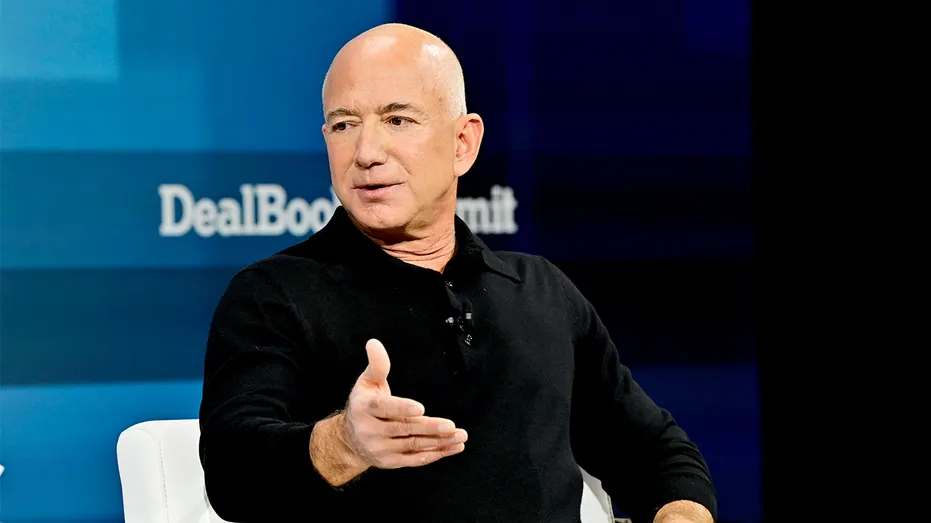
SouthernWorldwide.com – Billionaire Jeff Bezos has ignited a significant debate within America’s financial discourse with his recent suggestion that the lower half of income earners in the United States should pay no federal income tax.
This proposal, which advocates for zero federal income tax rather than reduced rates or temporary relief, has resonated with a substantial portion of the American populace.
The sentiment among many is a questioning of their own tax obligations, reflecting a feeling of financial strain and a perception of an unbalanced system.
This sentiment is amplified by the feeling of being financially overburdened, as if constantly striving without making significant progress.
Bezos highlighted that the bottom 50% of earners contribute a minimal percentage of the total federal income tax revenue, a stark contrast to top earners.
It has been noted that many lower-income Americans already pay little to no federal income tax due to various deductions and credits.
Therefore, Bezos’s proposition can be viewed not just as a tax reduction, but as a potential psychological shift in how work and income are perceived in the country.
The core of his suggestion seems to question whether work should yield more tangible financial benefits for individuals.
This idea carries considerable political weight and could significantly alter public perception and policy discussions.
Imagine a scenario where a nurse earning $75,000 annually could retain several thousand extra dollars each year.
This could provide much-needed financial relief and potentially offer an alternative to concepts like universal basic income.
In a nation as prosperous as the United States, a pertinent question arises: is it equitable to place financial pressure on those who are just managing to get by?
However, the conversation takes a more complex turn when considering who will ultimately bear the financial responsibility for government operations.
The issue of government expenditure, often compared to unchecked spending by a teenager with a parent’s credit card, is a significant concern.
Baca juga di sini: Caitlin Clark Expected to Play Against Valkyries After Back Injury
If a substantial portion of the population ceases to pay federal income taxes, one of three outcomes is likely.
Either the wealthy will face significantly higher tax burdens, government spending will be drastically reduced, or the nation will resort to further borrowing and money printing.
The adage “two out of three ain’t bad” may not apply here, as the implications of these choices are profound.
In the political landscape, elected officials often find it challenging to cut spending, as such expenditures can be a means to secure votes.
Historically, the tendency has been to accumulate national debt, a trend that is becoming increasingly concerning.
The United States is already grappling with a national debt exceeding $39 trillion, a figure projected to surpass $40 trillion before the end of the year.
The interest payments alone represent a substantial portion of the federal budget, a situation that is fiscally unsustainable.
This financial strategy is akin to using a temporary solution that masks a worsening underlying problem, and both major political parties are perceived as being less than transparent with the public on this issue.
The left often suggests that billionaires alone can perpetually fund the modern welfare state, a notion that is not economically feasible.
Conversely, the right tends to imply that tax cuts inherently generate their own revenue, which is not always the case.
The reality of the situation is more complex and less palatable.
The United States faces a significant spending addiction, coupled with a tax code that is notoriously difficult to comprehend.
This complexity is a primary reason why Bezos’s remarks have resonated so deeply with the public.
A significant number of Americans feel that the current system no longer adequately rewards productive contributions and hard work.
As the nation approaches its 250th anniversary, the question of whether to continue incentivizing hard work, productivity, and capitalism is paramount.
Individuals are generally more amenable to paying taxes when they perceive the system to be fair and equitable.
However, strong emotional opposition arises when there is a feeling that the rules of the game are rigged against them, which is the current sentiment for many.
This discussion also brings to light a potential shift in the American tax structure, moving from an income-tax-based system towards one focused on consumption.
In essence, this means increasing taxes on spending while reducing the tax burden on work, potentially through mechanisms like a flat tax or a value-added tax (VAT).
Ideas such as national sales taxes, VAT taxes, luxury taxes, and other “consumption-based” taxation models are gaining traction across the political spectrum.
This trend is partly driven by the ongoing influence of AI, automation, and globalization, which are continually reshaping the nature of work, making the taxation of labor increasingly challenging from a political standpoint.
Before embracing the idea of “zero taxes,” it is crucial for Americans to consider a fundamental question.
The choice lies between adopting Scandinavian-style taxes with Scandinavian-style social benefits, or maintaining American-style taxes with American-style individual freedoms.
Ultimately, economic realities and mathematical principles cannot be ignored indefinitely.
As a proponent of capitalism, the desire to preserve its principles remains strong.
While Jeff Bezos may have initiated this conversation, the core of the matter extends beyond a simple dichotomy between billionaires and workers.
The fundamental question is whether the United States possesses the collective will and understanding to finance the nation it aspires to be in the coming centuries.