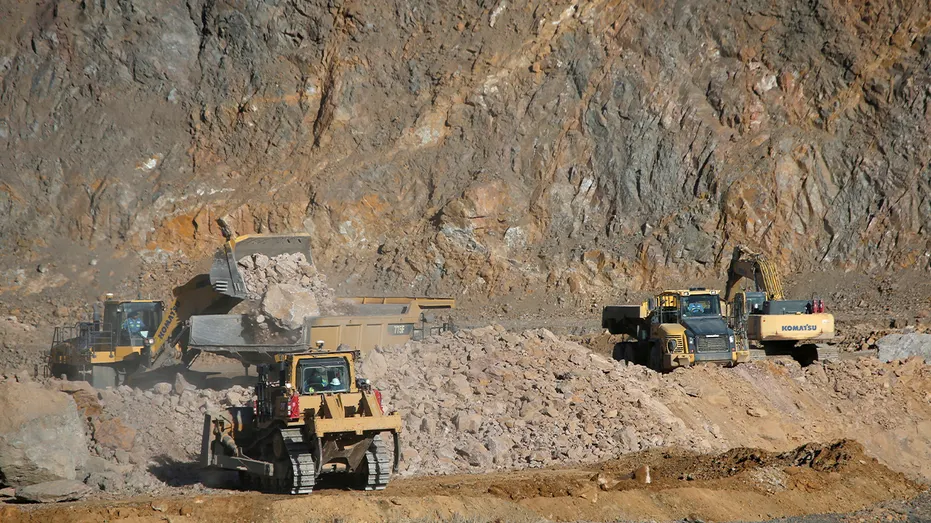
SouthernWorldwide.com – The world’s reliance on China for crucial rare earth elements, particularly heavy rare earths, presents a significant and growing danger that the West has yet to fully comprehend.
These elements are indispensable for modern technology, powering everything from hybrid and electric vehicles (EVs) to advanced aircraft and precision weaponry.
For over a decade, China has maintained a near-monopoly on the global supply of these critical materials. Last year, Beijing took a decisive step by restricting access for Western defense companies, a move that signals a permanent shift in its export policy.
It is highly unlikely that China will reverse this decision for any industry in the West. Western leaders often misinterpret China’s export restrictions as mere bargaining chips, expecting to leverage them for concessions at international summits.
This perspective fundamentally misunderstands China’s long-term strategy. Beijing is systematically executing a comprehensive economic and military plan aimed at ceasing the export of raw rare earth materials altogether.
Instead, China intends to supply the West with finished products – such as Chinese-made EVs, wind turbines, and robots – that are manufactured using these essential elements like dysprosium and terbium.
This approach is strategically sound from China’s perspective. By keeping the entire supply chain, from mining to magnet production to manufacturing, within its borders, China ensures domestic job creation and economic stability at every stage.
For the Chinese Communist Party, maintaining high employment and minimizing internal dissent are paramount objectives. Furthermore, denying Western militaries access to these critical inputs in the event of a conflict over Taiwan offers a significant strategic advantage.
Baca juga di sini: Trump's Energy Plans Could End US Involvement in Middle East Turmoil
The economic rationale behind China’s strategy is what Western policymakers must fully grasp. Exporting a kilogram of dysprosium as a raw powder generates only a few hundred dollars for China and employs a limited number of miners.
However, incorporating that same kilogram into the motor of an electric car contributes to the production of a high-value $40,000 vehicle rolling off a Chinese assembly line.
This process supports millions of Chinese jobs, spanning from mining and smelting to magnet manufacturing and automotive assembly. When this is multiplied across the millions of vehicles China is projected to export this year, alongside its wind turbines, drones, MRI machines, and industrial robots, the economic benefit becomes immense.
Beijing has explicitly stated this ambition in its “Made in China 2025” blueprint: to dominate the entire value chain, from raw materials to finished goods.
Global markets are already reflecting this strategic shift. This month, dysprosium oxide was priced at approximately $270 per kilogram in China, while in Europe, the same material commanded $1,100 – more than four times the price.
Terbium exhibits a similar pattern, trading at $1,145 per kilogram in China compared to $4,250 in Europe. Last fall, Beijing quietly halted terbium sales to private investors to prioritize its domestic factories, a clear indication of resource hoarding rather than typical export behavior.
The underlying reality is that China is facing a dwindling supply of the heavy rare earths it once possessed in abundance. Despite holding about a third of the world’s total rare earth reserves, its deposits of the heavier varieties, crucial for high-performance magnets, have been declining for over a decade.
To compensate for this shortfall, China has become reliant on imports from war-torn Myanmar, and even these sources are showing signs of depletion. Every kilogram of dysprosium Beijing exports represents a further reduction in its finite reserves.
The strategic implications are directly tied to the chemical properties of these elements. A small amount of dysprosium or terbium, often less than 1% by weight, when alloyed into permanent magnets used in EV motors, enables them to withstand engine heat without losing magnetic strength.
These same magnets are vital for steering cruise missiles, directing fighter jet radar systems, and powering the silent propulsion of American submarines. Without these two elements, modern weaponry and nearly every EV on the road would experience significant degradation or complete failure.
China’s actions are not intended as a punitive measure against the West; rather, it represents a colder, more enduring strategy: a calculated decision that exporting raw materials is an inefficient business model.
The evolving licensing regulations, extraterritorial reach, and intermittent export suspensions are not isolated incidents. They are indicative of Beijing’s deliberate effort to reduce raw material exports while simultaneously increasing its output of finished goods manufactured from these same critical atoms.
President Donald Trump recognized the trajectory of this situation. His administration actively pursued the development of mine-to-manufacturer supply chains within the United States, including early Pentagon investments in the domestic scandium supply chain.
Europe must similarly accelerate its efforts in this direction. Any strategy that assumes continued access to Chinese heavy rare earths, even with permits, is based on a supply chain that basic economics dictates will diminish and eventually disappear.
The Pentagon’s planned 2027 ban on Chinese magnets in American weapon systems, coupled with the emergence of new mine and magnet projects on both sides of the Atlantic, are not acts of protectionism.
They represent a belated but necessary acknowledgment that the world’s most critical supply chain is being systematically dismantled from beneath us.
The remaining question is whether the West can successfully establish its own robust supply chains in time, or if it will continue to wait for an opening that Beijing has every strategic incentive to keep permanently closed.