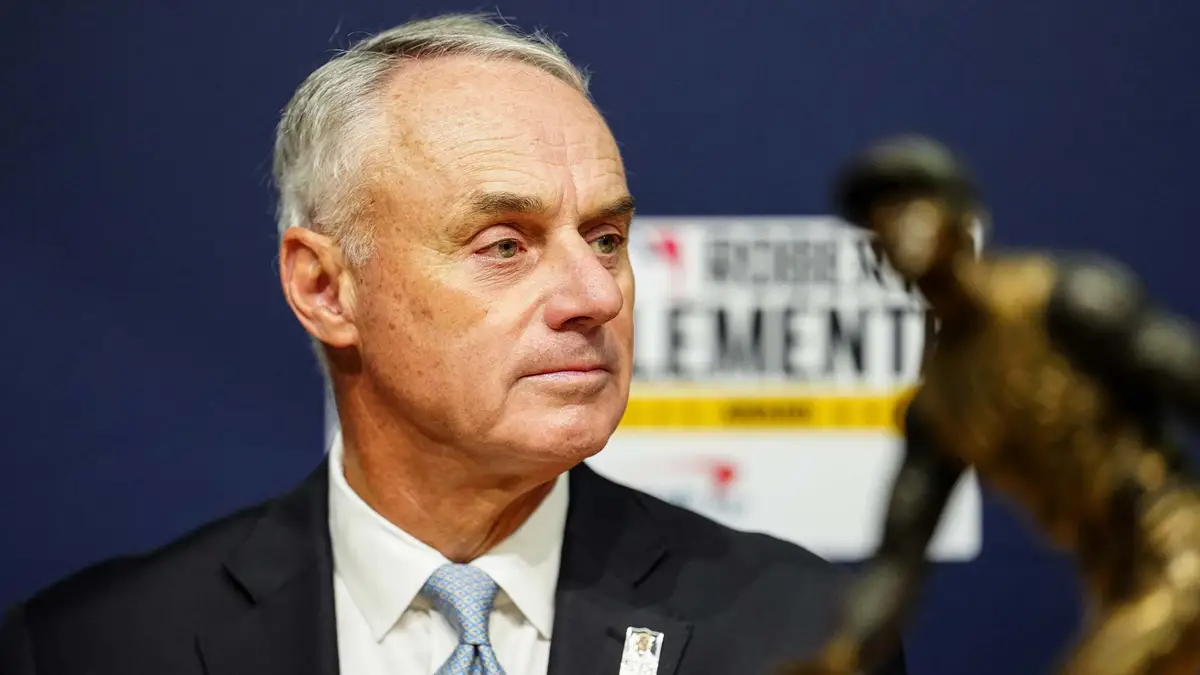
SouthernWorldwide.com – Baseball Commissioner Rob Manfred has expressed concerns that the owners’ proposal for a salary cap could potentially trigger a work stoppage similar to the one experienced in 1994, which led to the cancellation of the World Series. He stated that this proposal is necessary because management has determined that the existing luxury tax system, in place since 2003, is no longer effective.
Owners presented their first salary cap proposal last week since 1994, a year marked by a 7 1/2-month strike that resulted in the cancellation of the World Series for the first time in nine decades. Manfred, who was a junior lawyer on the owners’ bargaining team during those negotiations, acknowledged the potential for a repeat of history.
Players have declared their unwavering opposition to a salary cap, vowing to resist it for as long as necessary. When asked about the possibility of a recurrence of the 1994-95 events, Manfred responded with a candid “Of course I do.”
“We are open to any ideas that are presented, but we require a realistic framework that addresses the fans’ concerns regarding competitive balance. We simply cannot ignore the fact that financial penalties have not achieved this objective for us,” he stated during a news conference on Wednesday, amidst an owners’ meeting.
The current luxury tax system was implemented by baseball owners and players at the start of the 2003 season. Subsequent agreements have seen increases in tax rates and the addition of surcharges.
“We have made significant efforts through several rounds of bargaining to utilize a competitive balance tax to address competitive concerns, and at times, one must admit failure,” Manfred remarked.
In recent years, an increasing number of teams have been willing to exceed the tax thresholds. A record nine teams paid the penalty in both 2024 and 2025, with the Dodgers alone facing a bill of $169.4 million. The total tax collected surged from $78.5 million in 2022 to $222.8 million the following year, then to $311.3 million in 2024, and $402.6 million last year.
“We never envisioned the CBT as a revenue-generating mechanism,” Manfred explained. “And as you observe more and more tax being paid, it becomes evident that it is not the kind of deterrent that would effectively address the issue of competitive balance.”
Baseball’s five-year collective bargaining agreement, ratified in March 2022 after a 99-day lockout, is set to expire on December 1. It is anticipated that management will implement a lockout, which would halt all free-agent signings and trades.
Manfred declined to comment publicly on whether management believes a work stoppage would be a worthwhile cost to secure a salary cap.
“I will not speculate about work stoppages,” he said. “I believe that the proposal we have put forth provides a basis for constructive dialogue and exchange with the MLBPA on how we can address the foremost concern of our fans, which is the lack of competitive balance in the game.”
MLB’s proposal outlines a spending limit of $245.3 million for 2027, incorporating figures for luxury tax payrolls that include $20.1 million for benefits and the pre-arbitration bonus pool. It would also establish a payroll floor of $171.2 million, compelling certain teams to increase their spending. This year, the Dodgers had a payroll of $415.2 million on opening day, while the Miami Marlins had the lowest at $81.8 million.
“The players are intelligent individuals,” Manfred stated. “I believe they understand that payroll represents a significant advantage for certain clubs and that clubs with higher payrolls tend to win more often than those with lower payrolls.”
Notably, no small-market team has won the World Series since the Kansas City Royals in 2015.
“Teams that experience periods of non-competitiveness, particularly prolonged ones, not only see lower revenues but also recover more slowly once they regain competitiveness,” Manfred observed.
MLB’s proposal includes a 50-50 split with players on defined revenue and an escrow system where a portion of salaries would be held back, to be repaid to the league if the players’ share in a given year exceeds 50%.
“If their proposal had been in effect in 2026 with current amateur entry figures, players would have lost over half a billion dollars,” stated union head Bruce Meyer in a press release.
Manfred indicated that MLB has not yet presented a proposal regarding players signing initial professional contracts.
Players have requested an expansion of free agency and salary arbitration rights, an increase in luxury tax thresholds, and a near doubling of the major league minimum salary, along with an enhancement of revenue sharing.
Baseball has experienced nine work stoppages since 1972, the most recent being the 99-day lockout that slightly delayed the start of the 2022 season.
The NFL has operated with a salary cap since 1994, the NBA since the 1984-85 season, and the NHL since 2005-06.
MLB will not consider the potential addition of two expansion teams until a new collective bargaining agreement is in place. Groups from various cities, including Charlotte, North Carolina; Montreal; Nashville, Tennessee; Portland, Oregon; Sacramento, California; and Salt Lake City, have expressed interest.
“We have made it clear to all the cities that have expressed interest that this is a post-labor topic,” Manfred commented.
Manfred expressed his hope that the union will agree to a decision regarding the participation of major leaguers in the 2028 Los Angeles Olympics prior to reaching a labor agreement.
“It is my impression that they are considering this on a separate track,” he said. “I hope that is the case because we cannot wait until we have a collective bargaining agreement to make a commitment on this particular matter.”
Union head Bruce Meyer has indicated that a work stoppage leading to the cancellation of regular-season games could jeopardize Olympic plans.
MLB’s proposal involves pooling and equally distributing local broadcast revenue, contingent on agreement to a salary cap. MLB is planning to negotiate new national broadcast contracts for the 2029 season.
“There will certainly be more national games. This is our foremost priority in terms of expanding our reach going forward,” Manfred stated. “How the inventory of games beyond those national broadcasts is monetized will depend on the market.”
Amidst the decline of regional sports networks, MLB is currently producing and distributing local broadcasts for 14 teams this season. Manfred noted that local media revenue has seen a “significant decline.”
“Certainly, the form of revenue sharing in the proposal was influenced by developments in the media market and where we believe we need to be in order to extract maximum revenue from the current media environment,” Manfred explained. “We require greater control over rights.”
Owners have not yet approved the proposed sale of the San Diego Padres from the Seidler family to an investor group led by Kwanza Jones and José E. Feliciano. The deal was announced on May 2, with an enterprise value of a baseball-record $3.9 billion, and some original investors are expected to remain in the ownership group.
“We are not ready for a vote today,” Manfred said. “It will likely take place at some point this summer.”
Manfred expressed satisfaction with the Tampa Bay Rays’ progress in obtaining government approvals for a new ballpark in Tampa, situated near the spring training facility of the New York Yankees.
“They need to finalize definitive documents. My understanding is that they are on a timeline around mid-July for that,” he said. “We are hopeful that they will overcome the next hurdle.”
Reporting by the Associated Press.