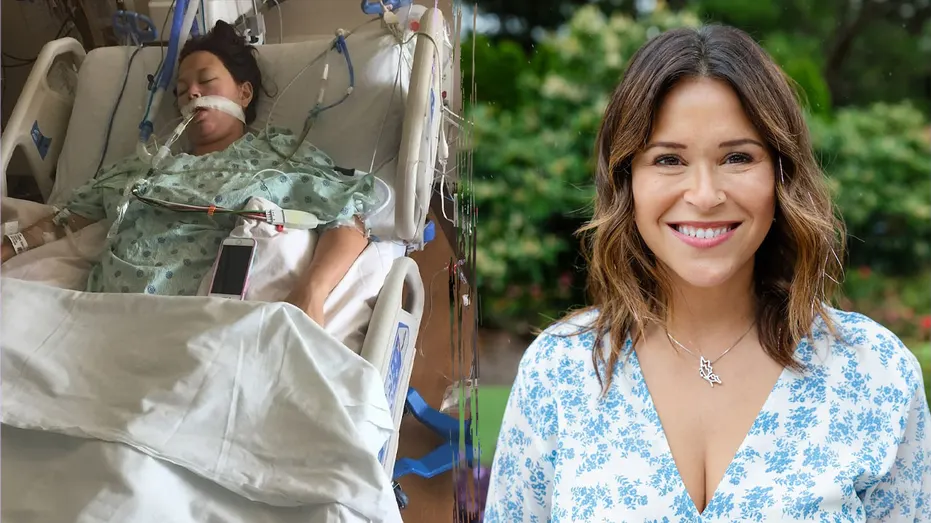
SouthernWorldwide.com – Following the tragic death of NASCAR star Kyle Busch from sepsis, a mother from Virginia Beach who narrowly escaped the same fate is sharing her harrowing experience to raise awareness about the deadly condition.
In 2015, Audrey Wiggins, then a healthy 31-year-old, initially believed she was suffering from the flu. However, her condition rapidly deteriorated into a severe case of sepsis, leading to a 10-day stay in the Intensive Care Unit, including five days in a medically induced coma.
Now fully recovered, Wiggins, who is married to professional golfer Marc Leishman, is committed to educating the public about sepsis through her nonprofit organization, the Begin Again Foundation. She has also authored a children’s book designed to help families recognize the warning signs of this condition.
Wiggins’ ordeal began one evening while she was caring for her young sons, aged 19 months and 3 years old, during her husband’s travel. She started feeling unwell.
As days passed, her symptoms worsened. Her fever escalated, and she developed severe stomach problems.
“At one point, I genuinely felt like I was losing my mind because my right elbow and left big toe started to ache – it was the most peculiar sensation. I hadn’t sustained any injury,” she recounted. “I was utterly bewildered by what was happening.”
When Wiggins became too weak to manage her sons and began experiencing nosebleeds, a friend urged her to seek medical attention.
At an urgent care facility, Wiggins’ temperature and heart rate were alarmingly high, and her blood pressure was dangerously low. She was subsequently transported by ambulance to the emergency room.
Wiggins noted that while hospitals have made significant strides in sepsis awareness and recognition today, this was not the case in 2015.
“It took an extended period to diagnose what was wrong with me,” she stated, adding that medical professionals initially suspected autoimmune diseases.
“They continued to run various tests. Eventually, I was admitted, and I remained in the ICU for a total of 10 days, with five of those days spent in a medically induced coma.”
The sepsis eventually progressed to acute respiratory distress syndrome.
“I vividly recall the struggle to breathe,” Wiggins shared. “That was by far the most terrifying aspect. It reached a point where I had to pause after every single word to catch my breath, feeling as though I was merely sipping air.”
She later learned that at one point, there was a significant possibility she might not awaken from the coma.
“When I finally regained consciousness, the process of relearning basic functions like walking was considerable, along with managing at-home physical therapy and dealing with a PICC line (peripherally inserted central catheter),” Wiggins explained.
The initial year of her recovery was exceptionally challenging. “My immune system was so compromised that I was constantly ill,” she said.
Today, Wiggins reports being healthy, although her memory is not as sharp as it once was, and she experiences fatigue more frequently.
The precise origin of her sepsis remains undetermined, but she speculates it might be linked to a recent IUD removal.
“I was diagnosed with toxic shock syndrome, but I also had tonsillitis, strep throat, a urinary tract infection, and pneumonia,” she stated. “I was an extremely unwell individual.”
In severe instances, an infection can enter the bloodstream, triggering sepsis, a widespread and life-threatening inflammatory response.
Wiggins illustrated this response with an analogy: “Instead of your body deploying elite special forces, it unleashes the entire U.S. Armed Forces.”
As sepsis progresses, it can lead to a dangerous drop in blood pressure and impede the delivery of oxygen to the body’s tissues, potentially causing lactic acidosis—a perilous accumulation of lactic acid in the bloodstream.
Organ failure, particularly of the kidneys, is a significant risk, as noted by medical experts.
“The kidneys fail, toxins build up, blood pressure plummets, fever rises, and the lungs fail—a condition known as ARDS,” explained one physician.
ARDS, or acute respiratory distress syndrome, occurs when inflammation causes fluid to accumulate in the lungs, hindering the bloodstream’s ability to receive oxygen.
According to the CDC, common warning signs of sepsis include high fever, confusion, rapid breathing, extreme weakness, low blood pressure, a fast heart rate, and bluish or mottled skin. Patients may also feel excessively cold and experience severe pain, Wiggins added.
After her hospital discharge, Wiggins was struck by the general lack of awareness surrounding sepsis, which motivated her to establish the Begin Again Foundation.
“I had never heard of sepsis, and I realized that was why I nearly died,” she shared. “If I had been aware of the symptoms and what to watch for, I would have sought treatment much sooner.”
The substantial medical expenses, encompassing everything from home healthcare to antibiotics and mobility aids, were also a shock. “I learned that sepsis incurs the highest hospitalization costs,” Wiggins remarked. “I remember thinking, ‘What if we hadn’t had the financial means to cover this?'”
“In times of financial hardship, if I can help alleviate that burden, even in the smallest way, allowing individuals to focus more on recovery, it is my greatest passion and honor to continue doing so. This remains the primary objective of the organization.”
Wiggins’ children’s book, “Katie Koala’s Biggest Bite,” tells the story of a young girl who sustains an injury and falls ill, prompting her mother to seek prompt medical attention, thereby catching sepsis before it becomes life-threatening.
“My aspiration for this book is for it to be held by both children and their parents, and that through reading this narrative, they will gain an understanding of what sepsis is and the symptoms to be vigilant for,” she expressed.
“I have encountered numerous accounts of parents who did seek medical help, who took their child to the doctor, only to be told it was merely a viral infection.”
Wiggins suggests that the simplest yet most crucial action parents can take is to ask their doctor: “Could this be sepsis?”
“Merely posing that question can guide them toward ordering different lab panels or examining the symptoms from a new perspective,” she added.
Wiggins pointed out that for every hour sepsis goes untreated, the mortality rate increases by as much as 8%.
“Time is unequivocally the most critical factor, and obtaining prompt treatment can even prevent hospitalization altogether.”
One of the most vital pieces of information people should be aware of, according to Wiggins, is that sepsis can arise from any type of infection.
“While respiratory infections, UTIs, and kidney stones are the most common culprits, it can also stem from a minor cut, strep throat, or even the flu,” she cautioned.