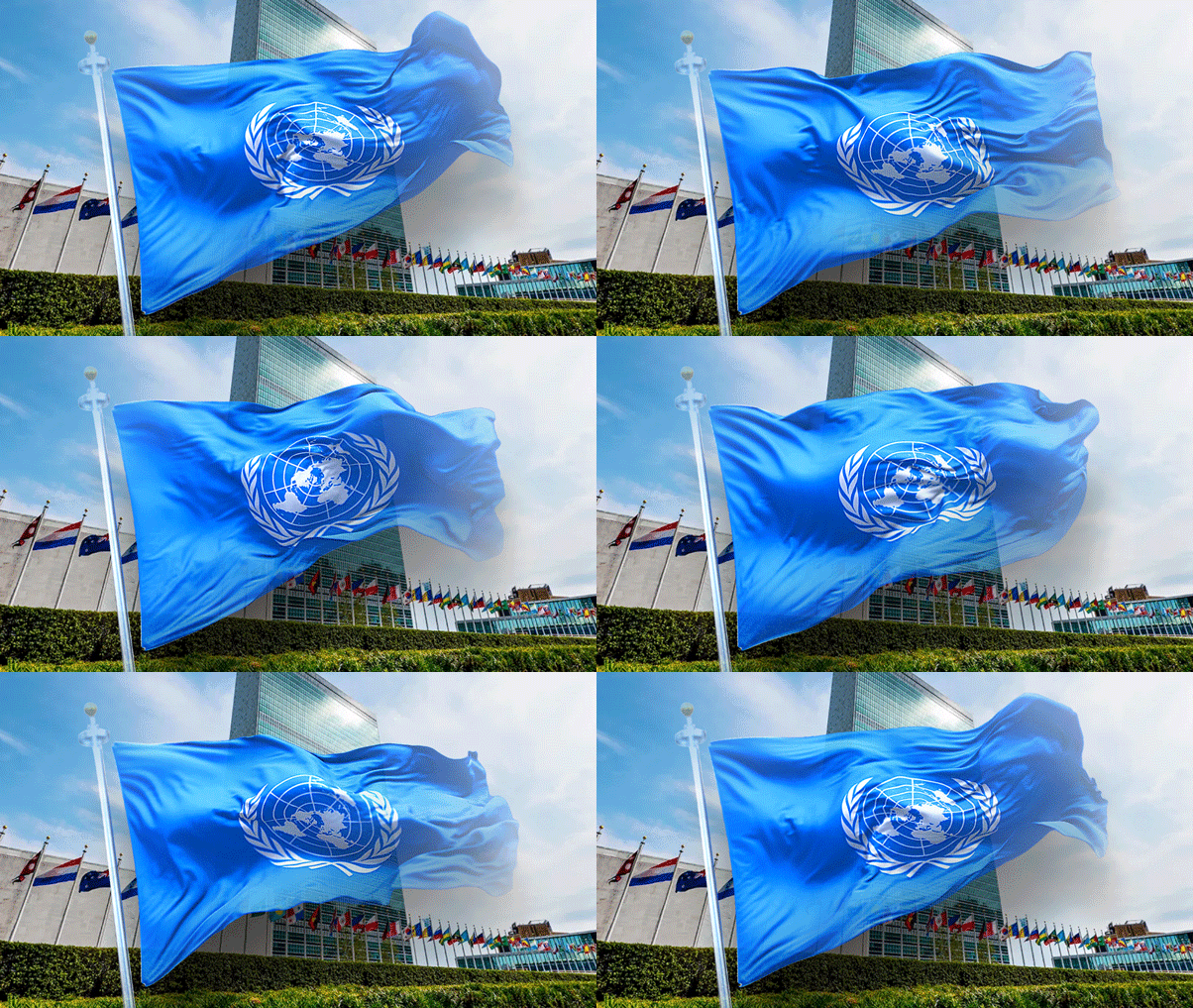
SouthernWorldwide.com – When Jeff Bartos appeared before the Senate Foreign Relations Committee in 2025 for his confirmation hearing, he was warned that the job he was seeking might not exist.
The Pennsylvania businessman, former political candidate, and endurance athlete had been nominated by President Donald Trump to serve as U.S. ambassador for United Nations Management and Reform. This title has long sounded aspirational in a building famous for its bureaucracy.
During his confirmation hearing, Bartos recalled being met with skepticism. Lawmakers told him, “UN reform? That’s an oxymoron if I’ve ever heard one.”
Less than a year later, Bartos believes the impossible is beginning to happen. The effort comes at a pivotal moment for the United Nations, with stakes extending well beyond budgets.
As the UN confronts a cash crunch, prepares to choose its next secretary-general, and faces growing scrutiny from the administration, the debate over reform has become a battle for the institution’s future. It’s a question of whether it remains on its current course or undergoes its most significant restructuring in decades.
Secretary-General António Guterres has repeatedly warned of a growing liquidity crisis. The organization struggles with delayed member-state payments, including billions owed by the United States. Simultaneously, the Trump administration has made it clear that future funding and support will be increasingly tied to reforms.
Bartos argues that this pressure is already yielding results. Sitting at the UN headquarters, he points to what he calls historic achievements: approximately $570 million cut from the UN’s regular budget and 2,900 positions eliminated through negotiations among all 193 member states.
“Again, never happened before in 80 years,” Bartos stated. “$570 million cut to the regular budget, approximately 3,000 posts cut. Unanimity. That’s by consensus. All 193 countries had to come together.”
For Bartos, this achievement is particularly striking because many diplomats viewed meaningful reform as impossible. He recalled telling Senate Foreign Relations Committee Chairman Jim Risch months after his confirmation, “I promised you we wouldn’t let you down.”
These reforms represent only what Bartos describes as a “down payment.” The next phase is already underway. As member states negotiate peacekeeping budgets for the coming year, the administration is pushing to reduce spending, streamline missions, and eliminate programs it believes no longer serve their intended purpose.
One example, Bartos explained, involves changing how the UN reimburses countries that contribute equipment to peacekeeping missions. Previously, reimbursement was largely based on whether equipment was present.
“The methodology that the UN used to reimburse troop-contributing countries for equipment was: ‘Is it there?'” Bartos said. The United States pushed for a simple change: “You get reimbursed when the equipment is put into action to do work.”
This reform could save roughly $30 million annually, according to U.S. estimates. For Bartos, however, the dollar figure matters less than what it represents.
“It’s a culture change,” he emphasized. “Being efficient, being respectful of every dollar, thinking about the taxpayers who fund all this.” That mindset is driving the administration’s next major targets: employee compensation and pensions.
Bartos argues that the UN’s pension system and benefits structure consume resources that could otherwise be directed toward humanitarian operations. Not everyone at the United Nations agrees with Bartos’ assessment. UN officials argue that many of the reforms predate the Trump administration and were already being pursued under Secretary-General António Guterres.
The UN80 initiative is Guterres’ flagship reform effort, aimed at cutting duplication, reviewing mandates, and making the UN system more efficient. Still, Bartos argues the pace and scope of reform changed dramatically once the United States began applying pressure through budget negotiations and funding discussions.
The debate unfolds as the organization faces mounting financial pressure. A spokesperson for Guterres stated that the Secretary-General remains deeply concerned about ongoing liquidity challenges caused by delayed payments from member states, including the United States. “Unlike a government, the UN cannot borrow or print money,” the spokesperson warned, noting the organization is expected to execute programs with funds it has not yet received while also returning unused funds at the end of the year.
Earlier in 2026, Guterres urged member states to either pay their assessed contributions in full and on time or overhaul the UN’s financial rules to prevent what he described as the risk of financial collapse. The reforms are occurring as the UN begins preparing for one of the most consequential transitions in years: the search for a successor to Guterres, whose term expires at the end of 2026.
According to Bartos, reform has become a central topic in discussions with prospective candidates. The administration hopes the next secretary-general will embrace efforts to reduce bureaucracy and return the institution to what Bartos repeatedly describes as a “back-to-basics” approach. The challenge, he acknowledges, is enormous.
Yet Bartos insists the experience has prepared him in unexpected ways. Before entering government, he completed two Ironman triathlons while balancing work and family life. “It’s discipline, planning, prioritization,” he said. “It’s not dissimilar to budget negotiations.”
The comparison may sound unusual, but it reflects how Bartos views the job: not as a sprint, but as an endurance race requiring patience, persistence, and long-term thinking. The mission also carries a personal dimension.
After two unsuccessful statewide campaigns in Pennsylvania—first as the Republican nominee for lieutenant governor in 2018 and later as a candidate in the state’s 2022 Republican Senate primary—Bartos said he had largely stepped away from politics. He returned to public service following the Oct. 7, 2023, Hamas attacks on Israel.
Bartos recalled his wife urging him to get involved: “You’ve spent your life working on these issues. You need to do something.” He ultimately joined efforts to help elect Trump and later accepted the UN role. Now, after tackling what many considered the first impossible mission—reforming the United Nations—Bartos is preparing for what may prove an even harder challenge.
Bartos said he was recently tasked by U.S. Ambassador to the UN Mike Waltz with helping lead efforts to combat what the administration views as entrenched anti-Israel bias across the UN system, including agencies, special rapporteurs, and investigative bodies. The debate intensified following the publication of the UN secretary-general’s annual report on conflict-related sexual violence, which added Israeli security forces to the report’s blacklist of parties credibly suspected of patterns of sexual violence in armed conflict. Israel rejected the allegations and announced it would suspend engagement with Secretary-General António Guterres’ office.
“The UN was built in the wake of World War II and the Holocaust, and yet, remarkably, it continues to be weaponized against the Jewish people and Israel,” Waltz stated. “Whether it’s a UN official regularly referencing Israel as a ‘stain on humanity’ and attacking American companies for doing business with Israel, or reports that spread misinformation and propaganda, this antisemitism is completely unacceptable.”
“It’s been over a year since the secretary general signed off on an ‘action plan’ to fight antisemitism at the institution — it would be nice if the institution actually used it,” he added. Bartos argues that anti-Israel bias has become embedded across multiple UN bodies and says the administration is working to dismantle what he calls that infrastructure through diplomacy, funding decisions, and engagement with the next generation of UN leadership.
“There is not a day that goes by that we’re not working on that,” Bartos said. The United Nations rejects accusations that it has ignored antisemitism within its ranks. A spokesperson for Guterres also disputed suggestions that the Secretary-General directly controls some of the UN bodies most frequently criticized by Israel and its supporters.
“The UN mechanisms that you allude to, including human rights mechanisms, are created by and accountable to Member States,” the spokesperson stated. “The Secretary-General has no authority over them.” “It is very important for Member States to actively engage in these mechanisms if they have concerns about their content and tone,” the spokesperson added.
“The UN is at a decision point,” Bartos concluded. Whether the institution changes enough to satisfy its largest financial contributor remains one of the most consequential questions facing the organization—and the man charged with answering it insists the work is only beginning.