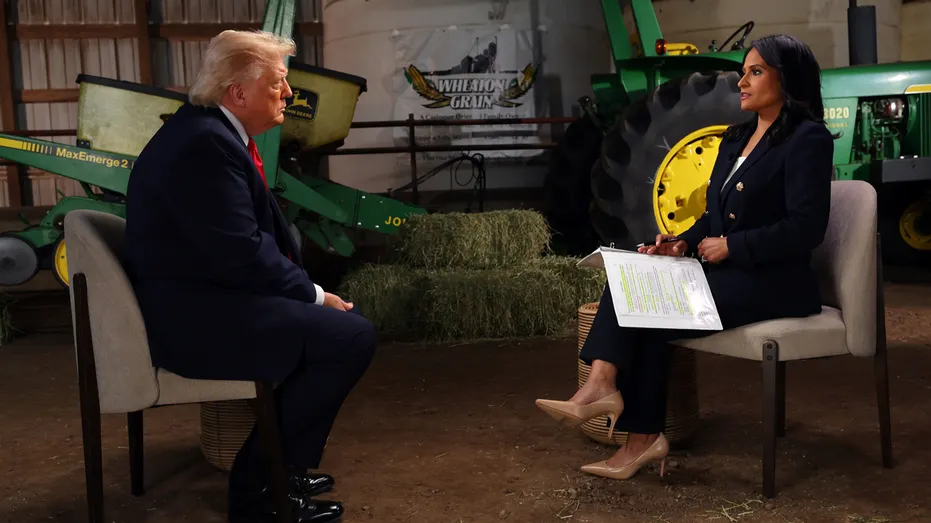
SouthernWorldwide.com – The recent interview between Donald Trump and NBC’s Kristen Welker has sparked considerable discussion, with headlines suggesting Trump “stormed” out of the session. However, the reality of the exchange was more nuanced.
Second-guessing interview tactics is common, especially when dealing with a politician like the former president, who has a knack for dominating such encounters. The inherent tension in interviewing any political figure, particularly one with Trump’s style, requires split-second decisions from the interviewer.
Having conducted multiple interviews with Trump, including a high-stakes session just before an election at his own invitation, provides a unique perspective on these dynamics. The interview concluded with Trump leveling accusations of dishonesty at Welker and NBC’s “Meet the Press,” labeling them as “crooked.”
Trump’s parting words, “You’re crooked, your press is crooked, And ‘Meet the Press’ is crooked,” followed by his assertion, “To be fair, I’m not crooked,” set a combative tone. Welker’s response, “Really? Well, you play right into their hands then. You’re either crooked or you’re stupid,” escalated the confrontation.
The interview ended with Trump stating, “Sorry. Let’s call it quits because I’ve had enough. Thank you, darling. Have a good time.” The author notes that Trump has never referred to them as “darling,” suggesting a pattern in how he addresses certain women.
Trump’s remarks extended beyond Welker, as he also criticized CNN’s Kaitlan Collins, calling her “beautiful” but noting her lack of a smile and “hatred in her eyes.” He also broadly accused ABC, CBS, and CNN of being crooked.
The situation presents a challenging, almost no-win scenario for interviewers. Despite thorough preparation and a list of questions, it’s impossible to cover every topic. Critics often point out questions that were not asked, regardless of the interview’s breadth.
The author’s approach emphasizes allowing the interviewee to speak while interjecting to prevent filibustering and to conduct real-time fact-checking when possible. However, the author suggests Welker may have fallen into a trap by interrupting Trump too frequently, making it appear as if she were debating him rather than interviewing him.
There were instances where Welker’s persistence yielded significant exchanges. When questioning Trump about a $1.8 billion “anti-weaponization” fund, which even some Republican members of Congress have denounced, the following dialogue occurred:
WELKER: Just to be very clear, are you backing off the fund completely, as your acting Attorney General Todd Blanche has said, or are you looking for another avenue to revive the fund?
TRUMP: So let me explain what the fund is. People have been hurt so badly by radical left lunatics that worked for the Biden administration and Sleepy Joe. They’re vicious. They’re violent, what they did to people. And, of course, they went after me more than anybody else. They raided Mar-a-Lago and all the other things. But people have been badly hurt. They’ve committed suicide. They’ve lost their jobs. They’ve lost their families. They’ve lost their wives. They’ve lost everything. They’ve lost everything over a fake weaponization of government. Now, let me just tell you—
WELKER: So are you looking for a way to revive it?
TRUMP: I wouldn’t be inclined to say so, but I have to see it. I can tell you this: 97% of those people, you look at them, the FBI or whoever it was, cause you had a lot of crooked cops, you had dirty cops. Comey was a dirty cop. A guy like Bolton was a dirty cop.
WELKER: But there is no evidence that people who—
TRUMP: Wait a minute. You think Comey was a straight cop?
WELKER: We had 170 people who pleaded guilty to assaulting police officers.
TRUMP: Comey was a dirty cop.
Welker countered, “But the people who assaulted police officers,” to which Trump responded, “I don’t know what’s going to happen with the weaponization fund. I love the idea, because people like you, the fake dirty press, the crooked press, people like stupid Biden, he’s not smart enough to know what’s going on, but people that surrounded him, surrounded his beautiful Resolute Desk in the Oval Office, what they did to the lives of people, they destroyed people. They sent people to jail who did nothing wrong.”
Welker interjected again, stating, “Just to be very clear, there’s no evidence of what you’re saying.” Trump retorted, “There’s a lot of evidence. Listen to me… There’s tremendous evidence. There’s nothing but evidence.” Welker then pointed out, “Well, it’s not been presented in a court of law.”
Trump then proclaimed, “The election was rigged. It was a dirty election. And it’s happening again right now in California.” When asked if he had evidence, Trump replied, “All I have to do is look.” Welker pressed, “But that’s not evidence.”
The exchange continued with Welker stating, “Well, it’s not been presented in a court of law,” and Trump declaring, “The election was rigged.” Welker’s final assertion was, “There’s no evidence of that, sir.”
The author suggests that Welker may have felt pressured to challenge Trump at every turn due to concerns about facing media criticism for going too easy on him.
The final six minutes of the interview devolved into a rapid-fire exchange of interruptions. Trump insisted, “There’s a lot of evidence,” while Welker attempted to steer the conversation, saying, “Let me ask about Todd Blanche.” Trump continued to assert, “There’s tremendous evidence. There’s nothing but evidence.” Welker reiterated, “Well, it’s not been presented in a court of law,” as Trump stated, “The election was rigged. It was a dirty election.”
Trump then added, “And it’s happening again right now in California,” to which Welker responded, “— you’ve never presented evidence –”
The author believes that viewers are intelligent enough to recognize when a guest is evading questions or changing the subject, often influenced by partisan leanings. The need for constant reiteration is questioned, suggesting Welker could have addressed these points with viewers after the interview.
The interview, conducted in a Wisconsin barn, lasted about an hour, covering topics such as Iran, nuclear issues, the economy, gas prices, and struggling farmers. The conversation was interrupted by rain.
When asked about his campaign pledge to end foreign wars, Trump insisted, “I didn’t guarantee no war. Why would I have built the strongest military in the world?” The author points to a specific instance from a 2024 campaign rally in Pennsylvania where Trump stated, “Under Trump, we will have no more wars, no more disruptions, and we will have prosperity and peace for all,” suggesting this could have been included as an on-camera tag.
Regardless of the interview’s outcome, it undeniably generated significant news, which should be a positive for Kristen Welker and NBC.