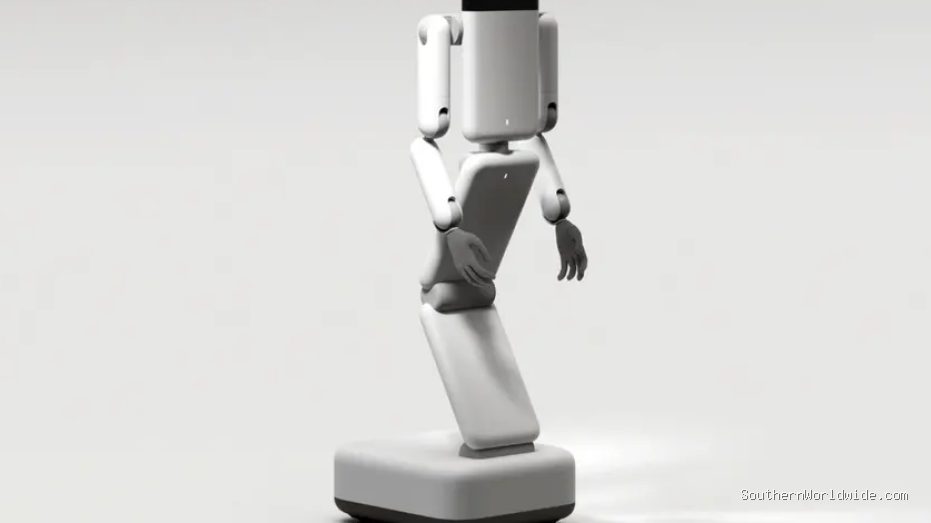
SouthernWorldwide.com – The current landscape of robotics is heavily dominated by a familiar aesthetic: two legs, a face-like head, and a body designed to mimic human form. However, Genesis AI is charting a different course with its inaugural general-purpose robot, Eno. Instead of replicating the ubiquitous humanoid design, the company has opted for a wheeled robot that prioritizes functionality and work efficiency. This strategic choice could significantly enhance Eno’s real-world applicability.
Genesis AI states that Eno integrates its comprehensive full-stack hardware platform with GENE, the company’s proprietary AI brain specifically engineered for robotics. This signifies Genesis AI’s intention for Eno to possess advanced reasoning capabilities, enabling it to adapt to changing circumstances and perform tasks that extend beyond mere pre-programmed actions.
In essence, Genesis aims for Eno to transcend the role of a mere instruction-follower. The company envisions a robot that can comprehend tasks and independently devise the most effective methods for their completion.
A WHEELED ROBOT MAY BEAT HUMANOIDS INTO YOUR HOME
A significant number of robotics companies appear to be fixated on a singular objective: creating machines that resemble humans. This focus is understandable, given that our built environments—homes, offices, hospitals, and factories—were originally conceived with human inhabitants in mind. However, the inclusion of legs introduces considerable challenges, escalating costs, complexity, and potential failure points.
This is precisely why Eno’s wheeled base presents a distinct advantage. Genesis AI has indicated that industrial clients specifically requested wheeled locomotion, underscoring the primary concerns of businesses. They are seeking robots capable of reliable navigation within a workspace to accomplish tasks efficiently. For environments such as warehouses, laboratories, and factories, wheels offer a practical solution, especially on typically flat surfaces with predictable routes. The utility of such a robot is not diminished by its inability to ascend stairs.
Eno is mounted on this wheeled base, featuring a tower-like body constructed from articulated panels. This design allows for adjustable height and reach as required, and it can also be compactly folded when not in use.
While the wheels draw attention for deviating from the humanoid trend, the robot’s hands will ultimately determine its success. Genesis AI asserts that Eno is equipped with proprietary dexterous robotic hands, meticulously designed to emulate the form and function of human hands. This capability is crucial for interacting with tools, doors, handles, buttons, and other everyday objects engineered for human use. A robot that can navigate a workspace must also possess the ability to grasp, twist, lift, press, and sort objects with precision. Without proficient manipulation, the robot risks becoming merely a mobile camera with appendages.
Genesis AI recently unveiled GENE-26.5, its advanced robotics foundation model system. The company claims this system supports sophisticated physical manipulation, including tasks such as cooking, laboratory pipetting, multi-object grasping, and even solving a Rubik’s Cube.
One optional feature on Eno has the potential to significantly enhance the experience for individuals working alongside it: a display screen that provides real-time visualization of the robot’s internal processes and actions.
Consider the implications: if a robot is operating in your proximity, reaching for objects, or altering its course autonomously, it is natural to desire some insight into its intended next move.
This is where the cognitive interface could prove invaluable. It could clearly indicate whether Eno is plotting a course, awaiting human passage, or preparing to retrieve an object.
Providing visibility into Eno’s impending actions could reduce uncertainty and make the robot feel less imposing in shared environments.
THE NEW ROBOT THAT COULD MAKE CHORES A THING OF THE PAST
Genesis AI has announced that Eno is slated for deployment with industrial customers by the close of 2026. The initial rollout is expected to concentrate on sectors such as manufacturing, logistics, and laboratories. This phased approach is logical, as industrial settings typically offer more defined tasks, streamlined workflows, and more controlled conditions compared to domestic environments.
Following this initial phase, Genesis AI intends to introduce Eno into service industries, including hotels and hospitals. Applications for home and outdoor use are anticipated at a later stage.
This timeline also serves to manage expectations realistically. A robot capable of assisting on a production line is likely to become available considerably sooner than one that can safely manage household chores like laundry, dishes, pets, children, and general clutter. Homes are inherently chaotic, whereas factories strive for order.
The term “general-purpose robot” might sound straightforward, but its realization is exceptionally challenging. A factory robot can reliably perform the same task repeatedly, such as welding a specific component thousands of times. A robotic vacuum can map a room and navigate around furniture. A delivery robot can follow a predetermined route.
A truly general-purpose robot must possess capabilities beyond mere task repetition. It needs to comprehend a goal, assess its surroundings, utilize tools, and recover from unforeseen issues. Genesis AI asserts that GENE is engineered precisely for these complex demands. The company states that this model endows Eno with memory, reasoning abilities, and the capacity to plan and execute multi-step tasks over extended periods.
Genesis AI also boasts high-profile support for its robotic endeavor. Eric Schmidt, former CEO of Google and an investor in Genesis AI, commented, “What Genesis is building with Eno is a fundamentally new model for extending human capability through advanced robotics.” Schmidt further elaborated, “The combination of agentic intelligence, intuitive interaction, and the ability to operate alongside people in the physical world creates a system that can help individuals and organizations accomplish more. The breakthrough is not replacing human expertise, but amplifying it—making advanced robotics genuinely useful, accessible, and scalable across industries. That is how we will unlock one of the largest economic opportunities of the AI era.”
Eno emerges at a pivotal moment when robotics companies are striving to demonstrate that machines can perform a wider array of tasks in the physical world with reduced human oversight. While some companies are investing in humanoid designs, Genesis AI is betting on the premise that practical utility will ultimately outweigh human-like aesthetics.
This strategic decision could resonate strongly with businesses. If a wheeled robot proves to be more cost-effective, less prone to malfunction, and superior in performance on flat surfaces, it may indeed surpass humanoids in numerous practical scenarios. The critical qualifier here is “if.” Genesis AI still faces the imperative task of proving Eno’s reliability in real-world operational settings. Demonstrations may showcase potential, but actual deployments will reveal the true performance metrics.
BMW PUTS HUMANOID ROBOTS TO WORK BUILDING EVS
For the majority of consumers, Eno is unlikely to appear in their living rooms in the immediate future. It is far more probable that this type of robot will be encountered in a professional capacity before it finds its way into domestic environments. Robots like Eno could first be deployed in factories, warehouses, laboratories, hospitals, or hotels, potentially influencing manufacturing processes, supply chain logistics, and how businesses address labor shortages.
This development also raises pertinent questions regarding accountability when a robot makes an erroneous decision, the extent to which workers should have visibility into a robot’s operations, and the types of data a workplace robot collects while interacting with people.
While the proposed screen interface could foster trust, it does not resolve all concerns. A robot capable of sophisticated task reasoning still necessitates clearly defined operational boundaries, robust safety protocols, and continuous human supervision. The broader implication for consumers is that the future of home robotics may not involve a metallic human walking through the kitchen. Instead, it might manifest as a compact, wheeled machine equipped with highly capable manipulators.
Take my quiz: How safe is your online security?
Think your devices and data are truly protected? Take this quick quiz to see where your digital habits stand. From passwords to Wi-Fi settings, you’ll get a personalized breakdown of what you’re doing right and what needs improvement. Take my Quiz here: CyberGuy.com.
What I find compelling about Eno is its apparent lack of obsession with human resemblance. It bypasses the complexities of legs and artificial faces to directly address a more fundamental question: can this machine actually assist people in accomplishing their work? This is where Eno becomes particularly interesting. While a wheeled robot may not possess the visual allure of a humanoid, it could prove far more practical in the environments where robots are most likely to be introduced initially. Consider factories, laboratories, warehouses, and hospitals. Naturally, Genesis AI must still demonstrate Eno’s capability to perform reliably in real-world conditions. A demonstration can illustrate potential, but a bustling workplace, complete with human interaction, tools, confined spaces, and unexpected challenges, presents a far more rigorous test.
Nevertheless, this development might signal the future trajectory of domestic robotics. The first truly indispensable robot in your life may not arrive on two legs but rather roll in on wheels, ready to commence work immediately.
Would you feel comfortable working alongside a robot that displays its thought process, or would this increase your apprehension? Please share your views by contacting us at CyberGuy.com.