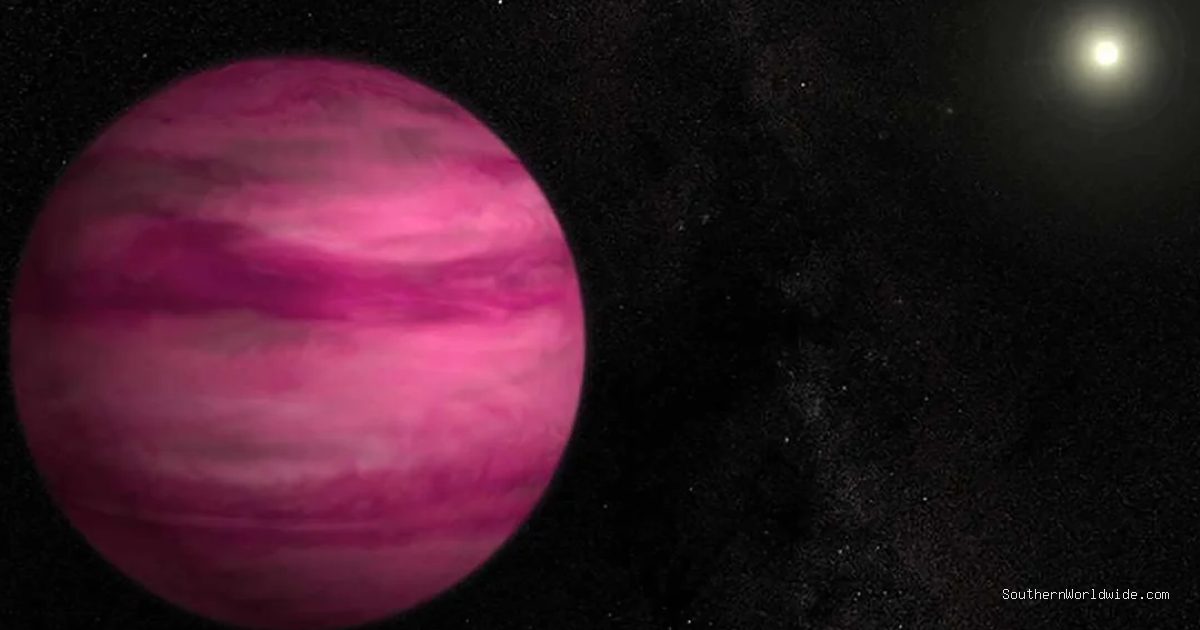
SouthernWorldwide.com – Researchers have made a groundbreaking discovery about the “Pink Planet,” GJ504b, revealing that its atmosphere is unexpectedly composed of salty clouds. This finding was made possible by the advanced capabilities of the James Webb Space Telescope.
A team of astronomers, led by Northwestern University, utilized the James Webb Space Telescope to observe GJ504b. Their detailed analysis uncovered a unique atmospheric composition, characterized by salt clouds, which had not been previously detected in such environments. The comprehensive findings of this study were officially published on Thursday in The Astronomical Journal.
The celestial object, colloquially known as the “Pink Planet,” was first identified in 2013. Scientists classify it not as a planet, but as a “planetary-mass companion.” This designation suggests it could be a large exoplanet or a small brown dwarf that is in orbit around a star, according to information provided by Northwestern University.
GJ504b orbits a star similar to our Sun, situated at a distance of 57 light-years from Earth. Its temperature is recorded at 550 degrees Fahrenheit. While this temperature is considered hot by terrestrial standards, it is remarkably cool for a giant planet. Typically, exoplanets register temperatures ranging from 1,000 to 2,000 degrees Fahrenheit, as indicated by the university.
“We were very surprised, because people have theorized that salt clouds might exist in the atmospheres of companions at these temperatures of, say, 500 to 700 degrees Fahrenheit, but people in general just don’t observe any kind of signatures of clouds in such temperatures, so we were very surprised,” Aneesh Baburaj, the lead researcher of the study, shared with CBS News.
The planetary-mass companion is estimated to possess a mass approximately 25 times that of Jupiter. Its age is calculated to be between 2.5 billion and 4 billion years old. This significant age is a contributing factor to its relatively lower temperature, as giant planets tend to cool down over time, as explained by Baburaj.
Baburaj, who holds a postdoctoral associate position at Northwestern’s Center for Interdisciplinary Exploration and Research in Astrophysics, further elaborated that GJ504b’s low temperature has presented considerable challenges for astronomers attempting to study it from Earth. Despite numerous attempts by research groups globally to observe its light, these efforts had been unsuccessful.
However, the deployment of the Webb telescope dramatically changed this scenario. The research team was able to conduct a successful observation of GJ504b in just two hours. This efficiency highlights the advanced observational capabilities of the new telescope.
The James Webb Space Telescope excels at capturing infrared images, which are beyond the spectrum of human vision. It also analyzes spectra, a process that disperses light to reveal its chemical composition, akin to a fingerprint. This allows scientists to identify the specific elements and molecules present in celestial objects.
Following the capture of GJ504b’s faint light, the researchers meticulously processed this data. They generated a light “fingerprint” that provided critical insights into the atmospheric elements and molecules. The analysis confirmed the presence of water vapor, methane, carbon dioxide, ammonia, and other compounds.
Crucially, the research team found that their observational data only aligned with theoretical models when they incorporated the presence of salt clouds. This strongly suggests that these salt clouds were significantly influencing the light signals detected by the telescope.
“We were really, really amazed by how easy it was to detect with James Webb, as opposed to like it had been close to impossible from the ground,” Baburaj conveyed to CBS News, emphasizing the telescope’s superior performance.
He provided an analogy to explain the significance of salt clouds in planetary atmospheres. On Earth, clouds are primarily composed of water. In the atmosphere of Jupiter, clouds are made of ammonia. For much hotter celestial bodies, clouds can consist of silicates. However, in environments that are too warm for water or ammonia clouds and too cool for silicate clouds, salt clouds can form as a viable alternative.
Baburaj expressed his optimism about future research possibilities, stating that the enhanced power of the Webb telescope will enable the detection of even colder atmospheric conditions. This capability will open up new avenues for studying a wider range of celestial objects.
“We will be able to detect colder and colder objects, and a lot of these objects might have these higher metal-to-hydrogen ratios compared to our sun,” he concluded, highlighting the telescope’s potential to uncover more about the composition of distant worlds.