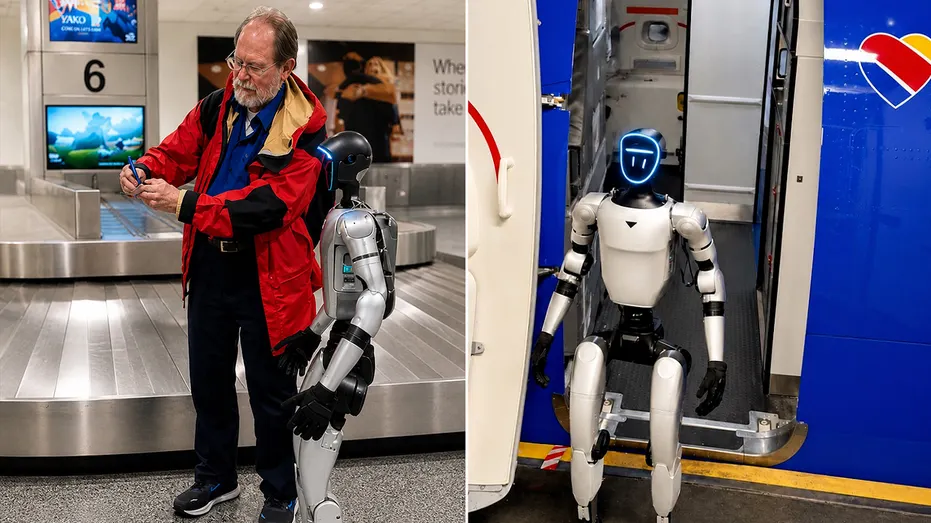
SouthernWorldwide.com – A Southwest Airlines flight experienced an unusual delay of approximately one hour due to the presence of a humanoid robot on board.
The robot, named Bebop and weighing 75 pounds, was scheduled to travel from Oakland, California, to San Diego. Before its flight, Bebop attracted attention at the gate by dancing for onlookers.
Eily Ben-Abraham, an employee of Elite Event Robotics, which rents out interactive robots for events, stated that many people took videos and allowed their children to interact with Bebop.
The flight delay was caused by an issue with the robot’s battery, which exceeded the airline’s regulations. The situation arose when the robot and its carrying case surpassed the airline’s 100-pound carry-on limit.
As a solution, the robot’s handler inquired if Bebop could occupy its own seat. This request was approved, and the robot was registered as an inanimate object occupying a purchased seat.
However, after boarding, airline staff raised concerns regarding the robot’s battery, leading to the delay. Ben-Abraham was instructed by airline personnel to remove the battery.
He was then told to contact the confiscation department. This was a departure from Bebop’s earlier successful transport on a flight from Dallas to Oakland.
To ensure Bebop could reach its intended event in Chicago later that weekend, the battery’s transportation became a logistical challenge. A family member in California drove five hours north to send the battery overnight to a Chicago hotel.
Read more : Bron Breakker's Biggest Win Since Main Roster Call-Up at Backlash
Southwest Airlines confirmed that a customer had purchased a seat for a device whose lithium battery exceeded the maximum allowable size. Consequently, the customer was asked to remove the battery.
The airline emphasized its appreciation for the flight crew’s professionalism in managing the situation, prioritizing the safety of its customers and employees.
Elite Event Robotics shared their experience on Instagram, noting the delay but deeming it “worth the wait.” They expressed that Bebop remained the “main attraction wherever he lands.”
Lithium batteries are subject to strict regulations on flights due to fire risks, with limitations on their size and transport methods, as per the Transportation Security Administration (TSA).
Online reactions to the incident varied, with some expressing confusion and others finding humor in the situation. Some commenters questioned the planning behind the robot’s transport, while others debated whether a robot should be classified as a passenger.
One user remarked that the robot should be considered “freight” rather than a passenger. Fox News Digital has previously reported on airlines exploring robotic technology for aspects of air travel, such as baggage handling.
Japan Airlines, for instance, has been testing humanoid robots to assist with luggage at Tokyo’s Haneda Airport, though initial demonstrations indicated the technology still has limitations.