SouthernWorldwide.com – A groundbreaking discovery near Nassau, The Bahamas, has potentially unearthed the first shipwrecks directly linked to the infamous pirates who once called the area home.
Filmmakers and archaeologists involved in the New Providence Pirates Expedition, in collaboration with Wreckwatch TV, announced in early June the discovery of six shipwrecks. Notably, three of these wrecks are believed to date back to the Golden Age of Piracy.
Researchers emphasized the significance of this find, stating, “Until now, not one of their ships has ever come to light in their home waters.” This discovery marks a pivotal moment in understanding the material culture of these historical figures.
The Golden Age of Piracy, a period spanning from the 1650s to the 1730s, saw pirates actively operating across the Caribbean and along various global trade routes. The Bahamas, and specifically Nassau, rose to prominence as a pirate hub in the late 17th century.
At its zenith, the port of Nassau was home to an estimated 1,000 pirates and sailors, highlighting its central role in the piratical economy of the era.
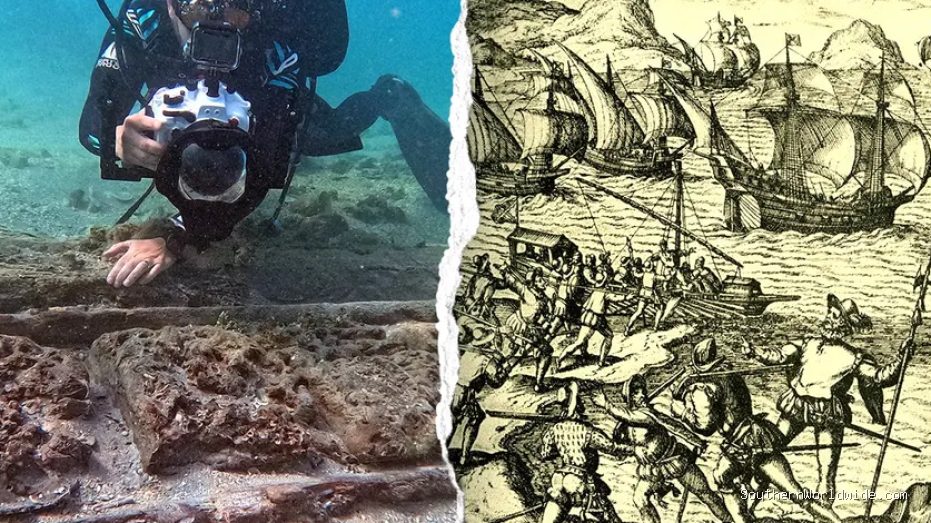
Evidence from one of the discovered wrecks strongly supports its connection to piracy. Among the findings were iron cannons, lead musket balls, and a sword sharpener – artifacts consistent with the tools and armaments of pirates during that period.
The team also recovered structural elements such as hull planks and rigging, along with remnants of the ship’s cargo. These included glass bottles and bricks, suggesting the ship’s galley and provisions.
At a separate wreck site, divers identified clay tobacco pipes bearing the royal crest of England. This discovery indicates that the vessel was likely an English trading ship from the 1740s.
The preservation of this trading vessel, despite significant damage from urban construction, was described as a “miracle” by the research team. The presence of wine in glass bottles and ornate smoking pipes offers a rare glimpse into Nassau’s transition from a pirate haven to a legitimate trading port.
Michael Pateman, a co-director of the project, highlighted the exceptional underwater conditions that aided the investigation. “Crystal-clear visibility” at one site allowed researchers to clearly identify key features of an armed wreck.
“The whole wreck was laid out before us,” Pateman stated. “The ship was heavily armed, especially with swivel guns, the cannon of choice for pirates. Slotted onto deck rails, these anti-personnel weapons raked devastating fire on enemy crews.”
Regarding another wreck, Kingsley, a member of the expedition, pointed to a combination of artifacts and structural evidence as strong indicators of a pirate vessel. The presence of an iron swivel gun, lead musket balls, and a sword sharpener were particularly compelling.
“The absence of cargo like pottery and the narrow width of the ballast mound all point toward a wrecked sloop, the small and swift pirate ‘hot wheels’ of choice,” he explained.
A significant find was a large, burned wooden hull discovered in Nassau Harbor. This wreck has sparked speculation that it could be linked to Henry Avery, one of history’s most notorious pirates.
Kingsley noted that the ship’s wooden treenails suggest it was constructed in the late 1600s or early 1700s. However, he stressed that further scientific research is required to definitively identify the wreck.
“All we can say for sure is right place, right date, right size,” Kingsley commented. “The ship needs a lot more science before we can prove that.”
The researchers also shed light on the motivations behind piracy, noting that many individuals turned to it to escape the harsh conditions and meager pay found in the Royal Navy and merchant fleets.
“Piracy offered rebels a chance to escape whipping, poor food and worse on navy warships and to earn up to 1,000% more than sailing on regular merchant vessels,” the statement read. This offered a stark contrast to the often brutal realities of maritime service.
Pateman eloquently summarized the allure of the pirate life: “It might have been a short life, but for a brief period of mayhem, sailors found freedom and wealth unmatched anywhere on earth. That escape was the pirate dream.”
The expedition’s findings are being documented by Wreckwatch TV for an upcoming documentary series, promising to bring these historical discoveries to a wider audience.
Kingsley expressed his ambition to map the entire harbor using an underwater drone, particularly focusing on “the more dangerous areas.”
“We’re certain more secrets are hiding there,” Kingsley stated, underscoring the vast potential for future discoveries.
He outlined the next steps for the identified wrecks, stating, “The cannon wreck needs recording with multibeam or 3D photography. The wooden hull needs digging to crack its full story and look for cargo and small finds to fine-tune its date.”
Kingsley concluded by emphasizing the collaborative aspect of the project and its broader implications: “There’s so much unfulfilled potential, all the while collaborating with Bahamian custodians to help them protect their sunken history.”