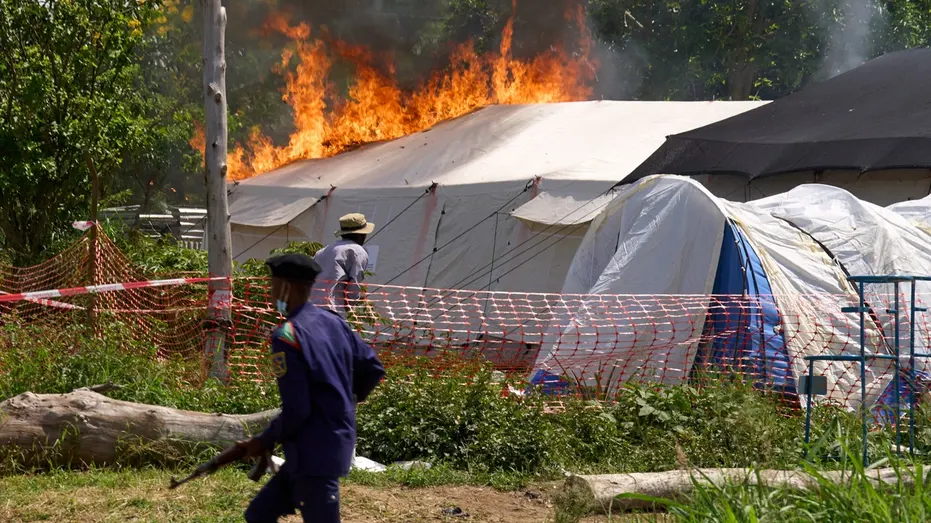
SouthernWorldwide.com – An Ebola treatment center in eastern Congo was set ablaze on Thursday following a confrontation between angry residents and authorities. The dispute reportedly stemmed from the residents’ attempt to retrieve the body of a suspected Ebola victim.
Rwampara Hospital became the site of the incident. According to a witness, local youths attempted to take the body of a friend they believed had died from Ebola. The situation escalated when police intervened.
“The police intervened to try to calm the situation, but unfortunately they were unsuccessful,” a local student named Alexis Burata, who was present, told The Associated Press. “The young people ended up setting fire to the center. That’s the situation.”
Reports from the AP indicate that individuals forced their way into the center and set fire to items within. A reporter also observed what appeared to be the body of at least one suspected Ebola victim being burned inside the facility.
The Alliance for International Medical Action (ALIMA), an organization involved in the response, confirmed that two tents used for treating Ebola patients were set on fire at the hospital. ALIMA stated that six individuals were undergoing treatment for Ebola at the center at the time of the incident.
Read more : Retirees' Top 5 Financial Worries
Patrick Muyaya, a government spokesperson for the Democratic Republic of the Congo, assured the public that medical care was continuing as normal. He confirmed that all six patients were accounted for and safe.
Muyaya called for calm and strongly condemned any acts of violence directed at healthcare facilities and medical personnel. He emphasized the importance of respecting the work being done to combat the outbreak.
Deputy Senior Commissioner Jean Claude Mukendi, who heads the public security department in Ituri Province, suggested that those responsible for setting the tents on fire did not fully understand the established protocols for handling Ebola burials. These protocols are crucial for preventing further spread of the virus.
The incident highlights the persistent tensions between health officials striving to implement strict containment measures for Ebola and local customs related to funerals and burial rites. These cultural practices can sometimes conflict with public health directives.
“His family, friends, and other young people wanted to take his body home for a funeral even though the instructions from the authorities during this Ebola virus outbreak are clear,” Mukendi explained. “All bodies must be buried according to the regulations.”
In its statement, ALIMA also condemned the dissemination of “incorrect or unconfirmed information on social media and the internet.” The organization warned that such misinformation could foster fear and mistrust towards health facilities, hindering vital response efforts.
This violent confrontation occurs as Congolese health officials report a significant number of cases and deaths. Across two provinces in the Democratic Republic of the Congo, there have been 160 suspected deaths and 671 suspected Ebola cases. The United Nations also noted that neighboring Uganda had recorded two cases, including one fatality.
The World Health Organization (WHO) officially declared the outbreak a public health emergency on Sunday. In response, the United States issued an urgent travel warning for the Democratic Republic of the Congo shortly thereafter.
Earlier this week, WHO Director-General Tedros Adhanom Ghebreyesus expressed his “deep concern about the scale and speed of the epidemic.” This sentiment underscores the gravity of the ongoing situation.
Officials have identified the outbreak as being caused by the Bundibugyo strain of the Ebola virus. This particular variant is considered rarer, and existing vaccines may not be as effective against it. This poses an additional challenge to containment efforts.
To support national authorities in their response, the WHO has approved nearly $4 million in emergency funding. This financial aid is crucial for bolstering resources and operational capacity in the affected regions.