SouthernWorldwide.com – Football rivalries often have clear, understandable roots. Local derbies like Liverpool versus Everton or Boca Juniors versus River Plate are born from geographical proximity and a territorial dispute, creating an intense, enduring animosity between neighbors.
However, on the international stage, rivalries can be forged by more profound historical, cultural, and political events, capable of spanning generations. The Clásico del Pacífico between Chile and Peru, for instance, traces its origins back to a 19th-century war. As a testament to this deep-seated resentment, Peruvians reportedly use the term “Chalaca” instead of “Chilena” when referring to a bicycle kick, refusing to attribute the acrobatic move to a Chilean inventor and instead crediting it to Afro-Peruvians from an unrecorded era.
While these examples illustrate the common threads that bind football rivalries, there is one that transcends others in its depth and complexity. It is a rivalry steeped in war, social and cultural animosity between two continents and distinct ways of life, yet it has also produced some of the most dramatic and memorable moments in World Cup history.
This is the fierce and delicate rivalry between Argentina and England, a contest born from years of rancor and marked by the emergence of legendary figures from moments of intense action.
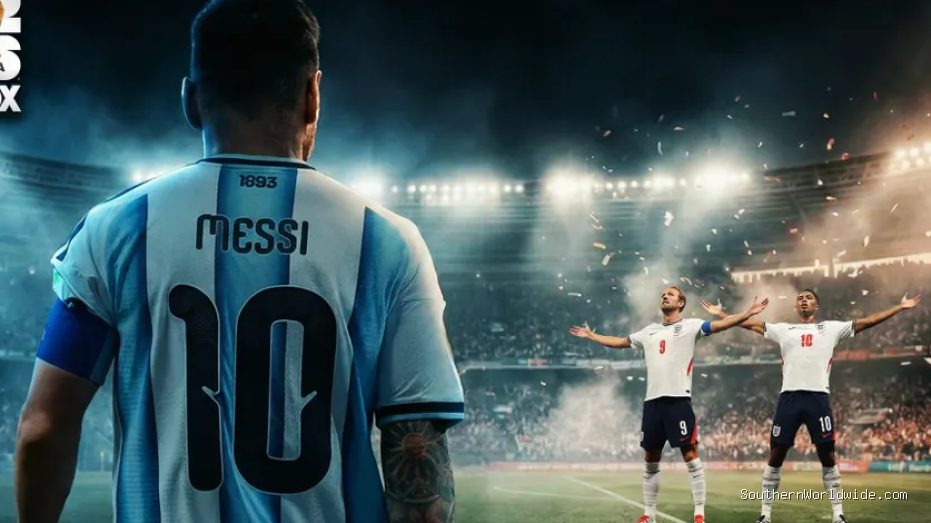
The upcoming match between Argentina and England is unlike any other. Following their respective victories over Switzerland and Norway, both nations are set to meet in a highly anticipated semifinal clash. The fact that this will be Lionel Messi’s first-ever encounter against England is a remarkable footnote to a game laden with historical significance.
This fixture is a confrontation steeped in history, with roots tracing back to 1962, but its animosity truly ignited four years later, in 1966, when the foundations of this passionate rivalry were laid.
The 1966 World Cup, hosted by England, saw the Three Lions lift the trophy for the only time in their history. In the quarter-final against Argentina, the match was characterized by its sheer physicality. Argentina’s captain, Antonio Rattín, who sadly passed away this month at the age of 89, was controversially sent off in the first half for two offenses within three minutes. The intensity of the game was such that England’s manager, Alf Ramsey, famously branded the Argentinian players as “animals” and prohibited his team from swapping shirts with their opponents after the match.
This fixture is also credited with being a catalyst for the introduction of yellow and red cards, a measure deemed necessary to curb the escalating heat and unsporting behavior in football matches.
However, the intensity of the rivalry was far from quelled.
The 1986 World Cup in Mexico witnessed the brilliance of Diego Maradona, but more significantly, it saw another quarter-final showdown between Argentina and England. This match occurred in the shadow of the Falklands War, an event that deeply impacted both nations, and for Argentina, it marked the fall of a military government and the subsequent re-establishment of democracy in 1983. The conflict, a catastrophic event far beyond the realm of sport, cast a long and significant shadow over the encounter.
The 1986 match is eternally remembered for Maradona’s infamous “Hand of God” goal. In the 51st minute, with the score still goalless, the diminutive Maradona outjumped England’s goalkeeper, Peter Shilton, and used his hand to punch the ball into the net. Despite fervent protests from the English team, the goal stood. Maradona went on to score a second goal just four minutes later, a mesmerizing piece of skill widely regarded as one of the greatest goals ever scored.
Maradona and Argentina went on to win the World Cup, and the star later admitted to the handball, acknowledging it as an act of symbolic revenge for the fallen soldiers of the Falklands. This cemented his status as an Argentine hero and a deeply reviled figure in England.
Following this pivotal World Cup moment, it became evident that the rivalry had transcended the sport itself, evolving into a matter of profound national significance. While the meaning might differ for each nation, the intensity of the competition continued to escalate, culminating in another dramatic chapter 12 years later with the emergence of David Beckham.
In 1998, at the World Cup in France, England’s golden boy, David Beckham, faced Argentina in the round of 16. This match remains a vivid memory for many, including the author, who recalls watching it in a pub. In a moment of perceived madness, Beckham was sent off in the 48th minute after retaliating to a challenge from Diego Simeone. This incident, brilliantly executed by Simeone, crushed the hopes of England fans, who had already witnessed a spectacular goal from an 18-year-old Michael Owen.
The aftermath saw Beckham vilified in the English press, and England’s World Cup campaign ended in a penalty shootout defeat. For Argentina, however, it represented another instance of revenge, redemption, and historical atonement.
Four years later, in the group stage of the 2002 World Cup in Japan, Beckham found a measure of personal salvation. He scored a penalty, awarded after a foul by Mauricio Pochettino on Michael Owen, securing a crucial victory for England. The Three Lions would go on to reach the quarter-finals before being eliminated by a brilliant Brazilian team, featuring Ronaldinho.
And so, 24 years later, the rivalry returns to the grandest stage. While many younger fans may not have direct memories of this historical conflict, they are certain to understand its significance by Wednesday.
Argentinian fans and the team have reignited their passionate anthem, “La Cuarta Estrella” (The Fourth Star), which has become synonymous with this current squad. The lyrics powerfully evoke the nation’s pride and historical grievances:
Por Malvinas, por El Diego (“For the Falkland Islands, for Diego”),Por la última de Leo (“For Leo’s last one”),Argentina quiero verte bicampeón (“Argentina, I want to see you back-to-back champion”).
There’s a strong argument to be made that this rivalry holds greater significance for Argentina, stemming from past losses and the deep-seated emotional tapestry of the nation, shaped by historical injustices. The team itself embodies this emotion, channeling it into their pursuit of victory.
However, the current England side is equally charged with fire and venom. They have already navigated formidable hostility and extreme conditions, from defeating Mexico at the Azteca to enduring the heat and humidity of Miami against Erling Haaland’s Norway. They understand the magnitude of the challenge, the stakes involved, and the formidable nature of Argentina, the defending champions, who, despite showing some vulnerabilities, are still a force to be reckoned with for a reason.
Lionel Scaloni, the Argentinian coach, is attempting to downplay the historical and emotional connotations of the rivalry, but he is well aware that such sentiments cannot be easily silenced.
Then there is Messi himself, poised to face England at the international level for the very first time. The greatest player the game has ever seen, carrying the hopes of his nation, with the spirits of Maradona, Rattín, and other departed heroes watching from above. As he continues his final World Cup campaign, he now faces the biggest and most emotionally charged battle of all: a match against England.
It is also noteworthy that Messi will be facing his Inter Miami manager, David Beckham, who will be watching from the stands.
Prior to the match, it is likely that both will wish each other well, recognizing the shared commonalities between their nations. Both Argentina and England share a love for iconic music from bands like Oasis and The Beatles, a deep-seated loyalty in football, and an appreciation for both beauty and battle within the game. This shared respect is as potent as the historical enmities that have brought them to this point.
But be certain of this: on Wednesday in Atlanta, as both teams stand on the pitch, ready to fight for every ball, every tackle, and every effort towards victory, Argentina and England will remind us why football is so much more than fleeting social media highlights or glamorous celebrity appearances from luxury suites.
The England versus Argentina fixture is a compelling blend of love and hate, of fallen heroes and newly discovered saviors. It is a confrontation that bridges the present with the past, both eternally linked by memories of pain and sacrifice. This is a match where one appreciates the present thanks to the guardians who paved the way. It is also a contest of fierce competition, fueled by the hope of carrying the nation’s identity with pride, running through their veins, and never forgetting that this profound rivalry exists only because they have each other.