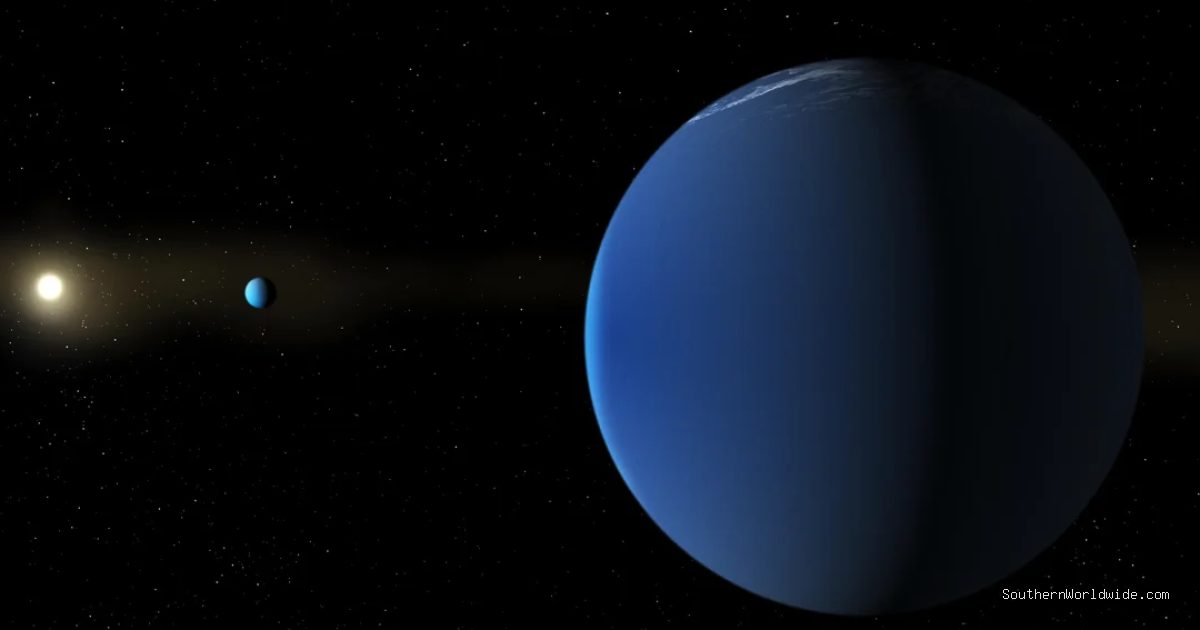
SouthernWorldwide.com – Astronomers have discovered two colossal planets that possess a density lighter than cotton candy, positioning them as the most massive exoplanets with a density lower than this sugary confection.
These two exceptionally light celestial bodies orbit a star located 1,110 light-years away. Their discovery marks them as the lightest known planets of their considerable size.
George Dransfield from the University of Oxford described the planets’ densities as being “comparable to a nice blob of shaving foam, fresh from the can.” Her team published their findings on Wednesday in the esteemed journal, Monthly Notices of the Royal Astronomical Society.
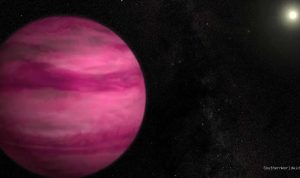
Dransfield speculates that these airy, ethereal worlds might appear white or blue, depending on the atmospheric conditions, rather than the pink hues associated with cotton candy. The planets are believed to be primarily composed of hydrogen and helium, though further observations by NASA’s Webb Space Telescope are required for definitive confirmation of their chemical composition.
These two unusually puffy planets were detected by NASA’s Tess satellite over the last decade. They are situated in the southern constellation Volans, which is named after the flying fish. The researchers utilized ground-based telescopes to meticulously study the planets’ orbital paths, enabling them to calculate their densities from a vast distance of 1,110 light-years. For perspective, one light-year is equivalent to nearly 6 trillion miles.
In 2024, scientists had previously identified a “super-puff” planet approximately 1,200 light-years from Earth, which they referred to as a “cosmic mystery.”
In stark contrast, Jupiter is approximately 35 times denser than these newly discovered lightweight planets.
The two newly identified planets also exhibit remarkably long orbital periods. One planet completes its orbit around its host star in 139 days, while the other takes 232 days, according to a NASA news release.
Super-puffs are considered a rare phenomenon in the universe. It is theorized that they form within the gas and dust disk surrounding a young star, where the proportion of gas significantly outweighs dust. Over time, these planets are believed to shed a substantial amount of their mass, becoming even less dense.
“The primary reason these planets are intriguing to study is that we did not anticipate their existence at all,” stated Jon Jenkins, the science lead for the Science Processing Operations Center at NASA’s Ames Research Center. “They present a puzzle that we need to solve regarding the formation of giant planets like Jupiter and these super-puffs.”
NASA’s current catalog of exoplanets, worlds beyond our solar system, contains nearly 6,300 confirmed discoveries. Dransfield notes that fewer than 40 of these are classified as super-puffs.
“Ultimately, by studying exotic systems that contain rare types of planets, we contribute additional pieces to the complex puzzle of planet formation and deepen our understanding of our place within the cosmos,” she concluded.