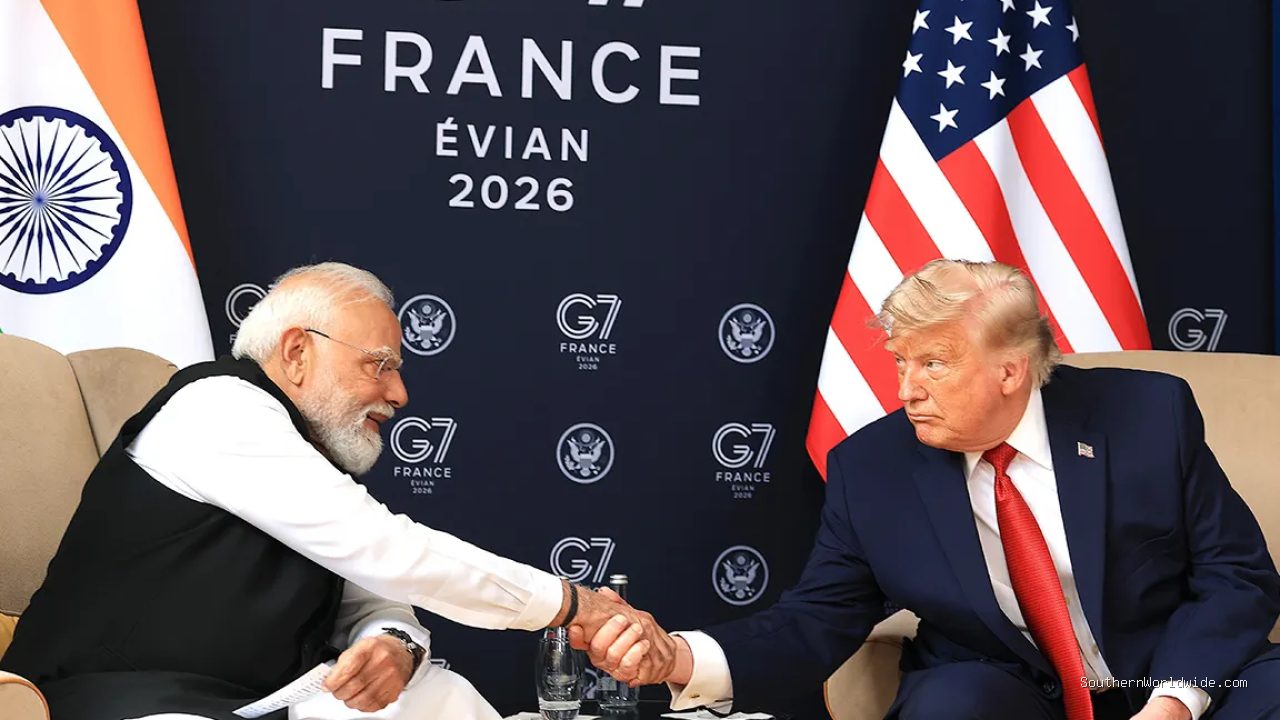
SouthernWorldwide.com – President Donald Trump and Indian Prime Minister Narendra Modi recently met at the G7 summit in France, marking their first encounter since February 2025. This meeting, however, saw Modi greet Trump with a handshake and a smile, a departure from his usual warm bear hugs.
The two leaders later held a bilateral meeting, which was described as a cordial discussion. This meeting occurred against a backdrop of escalating tensions between India and Pakistan, and a shifting diplomatic landscape where Pakistan has been quietly enhancing its international standing.
For a considerable period, India had been actively working to build an international consensus against Pakistan, portraying it as an isolated and destabilizing nation. Prime Minister Modi had even confidently stated that India had succeeded in isolating Pakistan and intended to intensify these efforts.
However, over the past decade, Pakistan has undergone a significant transformation, emerging as a crucial player in both regional and global politics. This shift has complicated India’s long-standing campaign to isolate its nuclear-armed rival.
While Modi initially attempted to engage Pakistan, his government’s policy eventually solidified around the principle that “terror and talks cannot coexist.” This hardline stance contrasted with earlier approaches.
Historically, India has enjoyed a favored position in Washington, with U.S. presidents from Trump, Biden, Obama, and George W. Bush all making visits to India during their tenures. Modi had cultivated a strong personal rapport with President Trump during his first term, being one of the first world leaders to visit the White House after Trump’s inauguration.
However, this relationship has faced strain in the past year. Concurrently, Islamabad has been steadily regaining its credibility on the international stage. A significant turning point occurred in May 2025 when President Trump announced a ceasefire between India and Pakistan, following a conflict over India-administered Kashmir that was the most severe in decades.
Pakistan promptly commended Trump for his role in ending the dispute and even nominated him for a Nobel Peace Prize. India, however, contested this narrative, asserting that the ceasefire was a result of direct bilateral negotiations with Pakistan.
India’s reaction underscored its deep-seated aversion to third-party intervention in what it considers a purely bilateral matter. This divergence in perspectives led to further friction in the months that followed.
President Trump imposed significant tariffs on India, among the highest levied on any major economy. Simultaneously, U.S. sanctions on Russian oil created challenges for India, which is heavily reliant on energy imports. Disputes over H-1B visas further strained the relationship. Analysts suggest that Trump’s “America First” policy increasingly overshadowed the friendship Modi had fostered during Trump’s initial presidency.
One expert noted that Trump’s claim of personally ending the May 2025 clash significantly displeased India. The subsequent tariffs were seen as another setback, while Pakistan adeptly capitalized on the situation, leaving India in a difficult position. Relations further deteriorated following the conflict with Iran.
India found itself indirectly impacted by the strategic consequences of the Iran war, facing economic pressures and growing energy concerns. The situation was further exacerbated by a U.S. strike that resulted in the deaths of three Indian seafarers, who were the only civilian mariners confirmed killed during the U.S. blockade, sparking widespread outrage in India.
New Delhi promptly summoned the U.S. Chargé d’Affaires, Jason Meeks, to express its profound concern over the renewed attacks and to highlight that its citizens were becoming casualties in a conflict that did not directly involve them. India also voiced concerns about the broader humanitarian, economic, and energy implications of the conflict, which were anticipated to persist despite the eventual agreement.
Throughout this period, Pakistan was steadily increasing its diplomatic visibility. It found itself in the unique position of seeking favor in Washington while simultaneously maintaining strong ties with China, Iran, and the Gulf states. This balancing act allowed Pakistan to enhance its regional influence.
The regional dynamics have been significantly reshaped by the competing strategies of these two rivals. India has strengthened its strategic partnership with the U.S. through alliances like the Quad, which includes Australia and Japan. It has also expanded cooperation with various South Asian states, including a developing relationship with Afghanistan.
In contrast, Pakistan’s growing regional relevance has been evident in its fortified ties with China, improved relations with regional partners such as Bangladesh, and expanded security cooperation with Gulf nations. This multifaceted approach has bolstered Pakistan’s diplomatic standing.
Furthermore, President Trump, who had previously accused Pakistan of “deceit and lies” during his first term, has since repeatedly praised its leadership. In June 2025, Trump invited Pakistan’s army chief, Asim Munir, to the White House for a high-profile lunch meeting.
Munir was the first Pakistani military chief, who was not also the president, to be hosted by a U.S. president. This occurred after he had led the war effort against India earlier that year. Trump described Munir as his “favorite Field Marshal” and an “exceptional human being,” highlighting a significant shift in U.S.-Pakistan relations.
The strengthening of this relationship has been reflected in various trade deals and, more recently, in Pakistan’s role as a key mediator in restoring diplomacy between the U.S. and Iran. This mediation effort was particularly noteworthy given the historical tensions between the two nations.
An analyst commented that while India attempted to make Pakistan an international pariah, Pakistan managed to gain favor with Trump through a combination of tangible cooperation with the U.S. and effusive praise for the president. This led to Trump elevating figures like Field Marshal Asim Munir and Prime Minister Shehbaz Sharif as heroes.
Meanwhile, India has maintained close ties with Israel and has generally adopted a more measured diplomatic approach. On June 15, following the agreement with Iran, Modi released a statement expressing India’s hope that the understanding would help restore peace and stability in the region and ensure freedom of navigation and commerce.
One observer praised Pakistan’s efforts in ending the conflict with Iran, stating, “Hats off to Pakistan. They worked really hard to bring this awfully disruptive war with Iran to an end.” The observer added that India missed an opportunity by not seeking to be a problem-solver like Pakistan, given its traditionally strong relations with Tehran.
Despite these developments, analysts caution that the geopolitical landscape is rapidly evolving. There is no guarantee that Pakistan’s current advantageous position will endure, and the tide could still turn in India’s favor. India is actively working to reassert its position and demonstrate to the U.S. that it remains a dependable partner.
The recent visit of Marco Rubio to India, his first since assuming the role of Trump’s top diplomat, was widely seen as an effort to reset bilateral ties. The meeting between Trump and Modi at the G7 summit also represented a significant step in this direction.
Trump praised Modi, describing him as “calm, cool and totally killer,” and indicated his intention to visit India in the future. India has been actively seeking a visit from Trump, potentially as part of a broader multilateral meeting involving Japan and Australia. Trump also affirmed that the United States would defend India, stating, “If anybody attacks that man, we’re going to be there. Now, if there’s a new leader, I’m not sure about it.”