SouthernWorldwide.com – The comprehensive nature of Iran’s delegation at the initial technical discussions with the United States in Switzerland on Sunday highlighted what an expert described as Tehran’s non-negotiable demand for “immediate cash flow” and substantial financial concessions from the outset.
The arrival of the Iranian team at Bürgenstock followed closely on the heels of a significant memorandum of understanding (MOU) signed by President Donald Trump and Iranian President Masoud Pezeshkian. This development, coupled with the subsequent cancellation of follow-up talks, has fueled regional uncertainty.
“Tehran arrived as if this were the moment to collect,” stated Mohammed, director of the Program on Extremism at George Washington University.
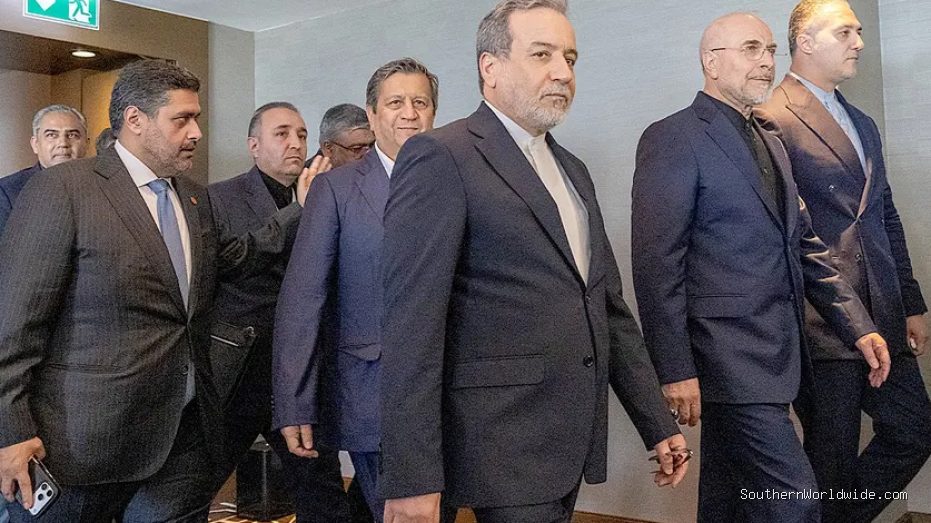
Iranian state media confirmed that Tehran had dispatched a delegation representing the entire regime structure. This group was led by chief negotiator Mohammad Baqer Qalibaf and Foreign Minister Abbas Araghchi.
Their team comprised key figures from the security, legal, and financial sectors. This included Abdolnaser Hemmati, the governor of the Central Bank of Iran, who headed the economic committee. Ali Bagheri Kani, deputy secretary of Iran’s Supreme National Security Council, and Kazem Gharibabadi, Iran’s deputy foreign minister for legal affairs, were also present, alongside senior state oil and energy officials.
Mohammed pointed out that Iran deliberately opted for a broad delegation, rather than a strictly diplomatic one, to safeguard its domestic leverage.
“Iran has not only sent diplomats; it has sent the foreign ministry, the security state, the central bank, legal affairs and oil,” he explained. “This is a whole-regime delegation built around implementation, money, leverage and red lines.”
Araghchi, according to Mohammed, serves as the diplomatic face of the delegation. Bagheri Kani’s inclusion signifies the Supreme National Security Council’s direct involvement, indicating that the security establishment is overseeing the process and “protecting the regime’s red lines.”
The presence of Iran’s top financial and energy officials further underscores Tehran’s primary objective: immediate financial liquidity, “energy leverage,” and control over maritime operations, the expert noted.
“Hemmati’s presence on Sunday was one of the clearest signals. You do not send the central bank governor to a symbolic meeting. You send him when the question is money: frozen assets, sanctions relief, banking channels, usable currency and how quickly Iran can turn promises on paper into cash it can actually spend,” Mohammed elaborated.
“The oil official is another major signal. If oil is in the room, Hormuz is in the room. For an American policymaker, that means maritime security and energy leverage.”
Gharibabadi’s participation, Mohammed suggested, pointed directly to a potential legal dispute concerning verification and the precise wording of any agreement, possibly intended to enable Iran to circumvent future enforcement measures.
The U.S. delegation includes Vice President JD Vance, and is primarily led by U.S. Special Envoy for Peace Missions Steve Witkoff and former senior White House advisor Jared Kushner.
Vance had previously indicated that Washington was optimistic about making progress on both the nuclear issue and the escalating Lebanon ceasefire crisis during their time in Switzerland.
On Sunday, he conveyed that President Trump had expressed a desire to “turn over a new leaf” to fundamentally alter the U.S. relationship with Iran, and that the ongoing talks in Switzerland would provide a platform for both sides to work towards resolving outstanding issues.
In stark contrast, Iran International reported that hardline lawmaker Mahmoud Nabavian read excerpts he claimed were top-secret letters from Supreme Leader Mojtaba Khamenei on Iranian state television.
He alleged that the Supreme Leader opposed nuclear negotiations, demanded compensation from Washington, and insisted on Iran’s control over the Strait of Hormuz before the live broadcast was abruptly terminated.
The differing compositions of the two delegations, Mohammed observed, clearly illustrate the divergent approaches each nation is bringing to the negotiating table.
“Iran is not only negotiating substance, but negotiating the terms under which it can later avoid pressure,” Mohammed cautioned. “If the money comes first and the concessions come later, Tehran will not interpret that as compromise. It will interpret it as victory.”
“If Washington gives Iran cash, oil access and legal protection while Iran keeps Hormuz, proxies, missiles and nuclear options alive, then America has not bought peace. It has financed Iran’s next phase,” Mohammed suggested.
“This delegation is not designed to end Iran’s leverage. It is designed to collect the benefits of the pause, preserve the regime’s pressure points and carry them into the next round.”
On Sunday, the talks between Iran and the U.S. were temporarily paused, though not concluded, as reported by Reuters.