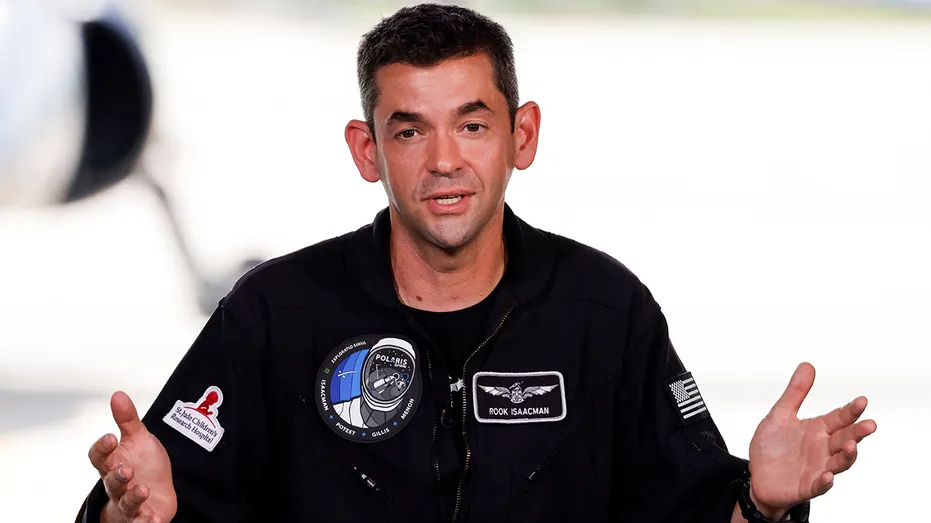
SouthernWorldwide.com – NASA Administrator Jared Isaacman has stated that the successful execution of the Artemis II mission, currently in progress, would not have been possible without the initiative of President Trump.
Isaacman elaborated on the mission’s advancements, the crucial role of technology in its current success, and President Trump’s significant contributions to the Artemis program in a recent interview.
“To be absolutely clear, we would not be at this juncture with Artemis II if it weren’t for President Trump,” Isaacman told Fox News Digital. “And we certainly wouldn’t have a viable pathway now to return to the lunar surface and establish a lasting presence.”
“On my first day in office during President Trump’s second term, he provided us with a national space policy. This policy mandated our return to the moon with regularity, the construction of a lunar base, and the development of advanced technologies like nuclear power and propulsion, all with the ultimate goal of enabling American astronauts to set foot on Mars someday,” Isaacman added.
The Artemis II mission, which launched from Cape Canaveral, Florida, last week, is set to take humans farther from Earth than ever before in history.
The mission’s objective is to orbit the moon and then return to Earth, with an expected landing in San Diego this week.
“Within the next approximately 24 hours, they will pass behind the far side of the moon. At that point, these four astronauts will have traveled further from Earth than any humans in history, reaching a distance of about 250,000 miles,” Isaacman explained. “We are thoroughly testing all aspects of the spacecraft, including its manual control systems.”
Isaacman reported that the spacecraft is “performing better than we anticipated” prior to launch. He also noted that the astronauts will soon commence their return journey to Earth after completing their trajectory over the far side of the moon.
Read more : Drone delivers two pizzas quickly
The NASA administrator drew parallels between Artemis II and the successful Apollo programs of the 1960s and 1970s, which saw humanity land on the moon. He highlighted the substantial advancements in technological capabilities available to NASA today.
“The comparison is not even close,” Isaacman stated. “The operator consoles and flight controllers now have multiple screens and significant computing power at their disposal. While there is undoubtedly a vast support system at NASA for this mission, it doesn’t require the hundreds of thousands of personnel that were involved in the enormous endeavor of the Apollo era.”
“This is why, as we pick up where Apollo 17 left off with this mission,” Isaacman continued, “our aim is not merely to return to the moon to plant the flag and leave footprints. Instead, we intend to establish a permanent presence, building a lunar base that will transform the moon’s south pole into a proving ground for the scientific and technological capabilities we will need to master.”
“This will eventually allow us to send astronauts to Mars and bring them back home to share their experiences.”
The 43-year-old billionaire was sworn in as NASA administrator in December. A lifelong enthusiast of space exploration, Isaacman previously commanded the inaugural commercial spacewalk in September 2024.
When asked about the personal significance of this mission, Isaacman attributed the space agency’s successes, both current and future, to the dedication of the NASA workforce and his support team.
While Isaacman was quick to acknowledge his team, he also emphasized the importance of looking ahead to the Artemis III mission. This mission, slated for mid-2027, is designed to test docking capabilities in preparation for an eventual attempt to return humans to the lunar surface in 2028.
“For everyone else, we need to start working on Artemis III,” Isaacman elaborated. “Looking back at the Apollo era, Apollo 10’s astronauts were orbiting the moon just miles above the surface. Two months later, Apollo 11 launched, and Neil and Buzz walked on the moon. This demonstrates the necessity for us to be capable of executing multiple world-changing missions in close succession.”