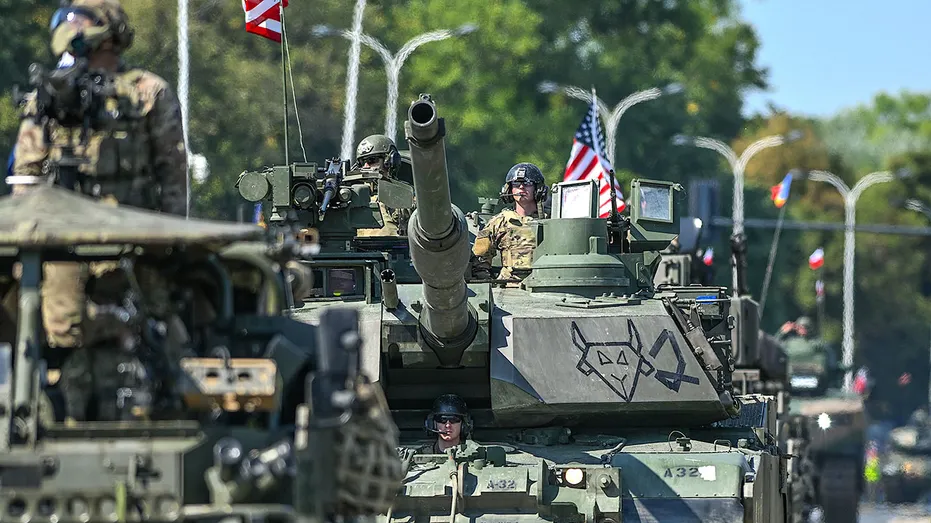
SouthernWorldwide.com – Poland is seeking answers from U.S. officials regarding the Pentagon’s recent decision to cancel a planned rotation of an armored brigade of U.S. Army soldiers. This move has caused concern in Warsaw, one of Washington’s staunchest NATO allies, despite assurances that the overall number of U.S. troops in Poland will remain consistent.
Polish officials have emphasized that Warsaw considers itself a “model ally” within NATO and anticipates continued expansion of military cooperation with the United States.
The Pentagon’s decision to halt the rotation of approximately 4,000 U.S. Army troops to Poland, which was part of a routine nine-month NATO force rotation, has generated unease in Warsaw and criticism from members of the U.S. Congress. The affected unit was the 2nd Armored Brigade Combat Team, 1st Cavalry Division.
Typically, around 10,000 U.S. troops are stationed in Poland, with most serving on rotational deployments that last several months. Given that the U.S. military presence in Poland is heavily reliant on these recurring rotations, the cancellation of the brigade deployment has raised significant concerns.
It remains unclear whether the cancellation of this brigade rotation will result in a permanent decrease in U.S. forces stationed in Poland.
Reference was made to recent assurances from President Donald Trump to Poland’s president-elect. Trump stated in September 2025, “We’ll be staying in Poland. We’re very much aligned with Poland. We’ll put more there if they want.”
The Pentagon indicated that the decision was made following consultations with U.S. European Command (EUCOM), the body responsible for leading U.S. military operations in Europe.
This development has drawn bipartisan criticism on Capitol Hill, as Poland is regarded as a critical frontline state against Russia. War Secretary Pete Hegseth had previously lauded Poland as a “model ally.”
During a visit to Warsaw in February 2025, Hegseth remarked, “The level of partnership — just to underscore here — is unmatched in Europe.”
Rep. Don Bacon, R-Neb., described the canceled brigade rotation as “a slap in the face to Poland” during a House Armed Services Committee (HASC) hearing. HASC Chairman Mike Rogers added that lawmakers had not been adequately consulted on the matter.
Since Russia’s invasion of Ukraine in 2022, Poland has become a vital military and logistics hub for NATO. The country hosts rotational U.S. forces and serves as a crucial staging point for military aid being sent eastward.
President Trump has frequently voiced threats to reduce U.S. support for NATO allies he believes are not investing sufficiently in defense. He has also urged European nations to take on greater responsibility for their own security. However, Poland leads all NATO countries in defense spending as a percentage of its GDP, allocating 4.8%.
Marcin Bosacki, Poland’s Deputy Foreign Minister, acknowledged on Friday that there was frustration in Poland regarding the communication surrounding this decision. Nevertheless, he stressed that Warsaw has received assurances that the U.S. does not intend to reduce its military presence in the country.
“It should have been communicated better,” Bosacki stated during a meeting with reporters in Warsaw. “We’re still awaiting some answers.”
“But we take U.S. reassurance that U.S. doesn’t plan to reduce neither of the number nor the capabilities of the U.S. troops in Poland,” he added.
Read more : Teenager finds ancient coin, baffling archaeologists about its origin
Bosacki expressed Poland’s expectation that troop rotations will continue and that the total number of U.S. troops in the country will remain around 10,000. He also highlighted Warsaw’s commitment to further strengthening the military partnership.
The halted rotation in Poland occurs within a broader context of the Trump administration’s efforts to scale back the U.S. military footprint in Europe and encourage NATO allies to assume more responsibility for conventional defense.
The Pentagon has announced plans to withdraw approximately 5,000 U.S. troops from Germany. Earlier in 2026, the Army concluded a rotational deployment of the 101st Airborne Division in Romania and other eastern flank locations, bringing force levels in Europe closer to pre-Ukraine war figures.
Despite concerns over the canceled troop rotation, Zalewski indicated that the primary objective of the delegation’s meetings in Washington would be discussions on the future structure of NATO and defense cooperation between the United States and Europe.
These discussions are expected to address, in part, the Trump administration’s “NATO 3.0” initiative. This Pentagon-backed strategy aims to increase European allies’ responsibility for conventional defense in Europe, allowing the United States to redirect more military focus toward China and the Indo-Pacific. The strategy emphasizes increased European defense spending, force readiness, and defense industrial capacity, while reducing long-term American reliance on large troop deployments across the continent.
Zalewski described Poland as a “model ally” due to its substantial defense spending, military modernization, and close security partnership with Washington.
Concurrently, he cautioned that Poland and other eastern NATO members face continuous pressure from Russia through cyberattacks, sabotage, and disinformation campaigns. Officials in Poland increasingly view these actions as part of a broader hybrid war targeting the alliance.
In recent years, Polish officials have attributed cyberattacks on government institutions and critical infrastructure to Russian-linked actors. Authorities have also investigated suspected Russian sabotage plots involving arson attempts and surveillance operations within Poland. Warsaw has further accused Moscow of orchestrating online disinformation campaigns designed to erode public trust, diminish support for Ukraine, and sow division among NATO allies.
“Poland and the Eastern NATO flank states are (in) a certain kind of hybrid war,” Zalewski stated. “We are constantly under attack by Russian cyber forces. There are a lot of acts of sabotage in Poland.”
He noted that Poland has also experienced incursions into its airspace by Russian drones and has been subjected to “huge disinformation coming from Moscow” aimed at undermining trust in authorities and fracturing NATO allies.
Zalewski argued that these hybrid threats have become particularly perilous since Russia’s annexation of Crimea in 2014, as they are engineered to weaken NATO internally without provoking direct military conflict.
He also expressed skepticism regarding efforts to improve relations between Washington and Moscow, asserting that Russia continues to perceive the United States and NATO as its primary adversaries. Zalewski warned that Moscow’s long-term objective is to dismantle Western alliances and create divisions between the United States and frontline NATO states like Poland.
“Yes, there are some ideas in the United States that it is possible to find a way between Russia and the United States,” Zalewski remarked. “But it’s only just a game played by Moscow.”
“As a matter of fact, since the beginning of the 20th century, for this Russian elite governing the country after the Russian Revolution, the United States has been the biggest enemy,” he added. “And as a matter of fact, the most visible emotion that they have to America — is just hate.”