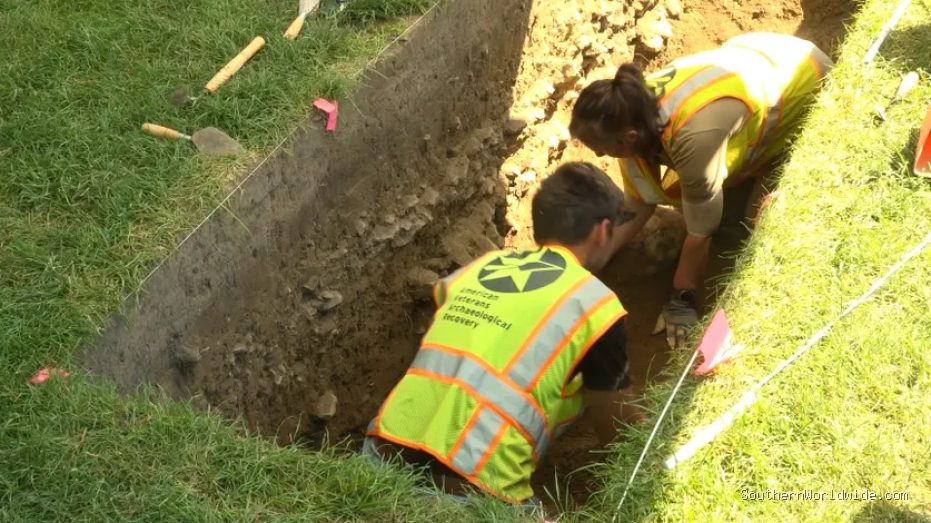
SouthernWorldwide.com – Artifacts unseen for 251 years are being unearthed at the Bunker Hill Monument in Charlestown, Massachusetts, precisely as the nation approaches its 250th anniversary.
This undertaking marks one of the initial archaeological excavations at the site of the pivotal battle that occurred on June 17, 1775.
The teams are focused on gaining a deeper understanding of the earthen fortification, known as the redoubt. This structure was a rudimentary dirt fort constructed by colonial soldiers overnight before the engagement commenced.
“We were aware the fortification existed here, but its precise location has eluded identification for all these years,” stated Lauryn Sharp, Project Archaeologist for the City of Boston. “Even with the monument’s construction, there was no concrete evidence of the redoubt’s actual position. This excavation is the first step in reintroducing this crucial information into the historical narrative.”
Through this dig, researchers hope to uncover more clues about the Battle of Bunker Hill, a conflict renowned as the bloodiest single day of the Revolutionary War.
During their search for the redoubt, archaeologists have already discovered artifacts dating back 251 years.
“We’ve found two English gun flints, one French gun flint, and two musket balls that are consistent with British origin,” reported Joel Bohy, a historian and specialist in material culture. “This project has yielded significant success, revealing new insights into the battle that were previously unknown.”
Bohy was meticulously examining a musket ball recovered from one of two trenches.
“While I haven’t weighed it yet, it might be from a provincial gun. This suggests materials from both sides were present in this single trench,” Bohy explained. “You can observe it struck the ground with moderate force, and it also has a more pronounced sprue than usual, indicating its molding process.”
Among the discoveries on site were objects potentially unrelated to the battle, such as a men’s curling iron.
“We’ve also found 18th-century ceramics and pipe stems,” Bohy added.
The excavation is being spearheaded by the City of Boston’s archaeology program in collaboration with American Veterans Archaeological Recovery (AVAR). AVAR plays a vital role in assisting veterans in transitioning to careers in professional archaeology.
The non-profit organization specializes in the study of battlefields and conflict sites, both within the United States and internationally.
“As a veteran, having served, it provides a deeper emotional understanding of real-life experiences, what conflict and combat entail, and the process of following orders,” shared Dr. Stephen Humphreys, CEO of American Veterans Archaeological Recovery.
Humphreys emphasized the project’s significance from both a military and historical perspective.
“However, archaeology offers a more intimate glimpse into the genuine experiences of the ordinary soldiers on the ground. This is something my crew inherently understands from their own service,” Humphreys noted. “For many of the individuals who fought in this battle, little remains of them beyond perhaps a musket ball, a gun flint, or a button.”
The teams underscore that while the artifacts are undeniably fascinating and exciting discoveries, it is crucial to remember the profound impact this history has had on real families.
“Exactly 251 years ago, next week, many men from both sides fought and perished here. Therefore, as much as we celebrate these findings, we must also acknowledge the human dimension of this event,” Bohy stated.
The artifacts unearthed during the dig will undergo laboratory examination and will eventually be incorporated into a digital database.
“We often believe we possess a comprehensive understanding of history through books and other sources. However, when we excavate the ground and can potentially pinpoint the location of the redoubt walls, and then find objects emerging from the earth, history becomes far more tangible and three-dimensional,” Bohy remarked.
The City of Boston had initially planned for the project to conclude after two weeks, but an extension is now being considered. Meanwhile, a contingent from AVAR is preparing for an international assignment.
“We are deeply honored to be taking some of these same veterans and crew members to Sicily to work on a World War II bomber. Our aim is to provide some sense of resolution for affected family members,” Humphreys announced. “This is part of a broader series of endeavors for us at conflict sites, where we hope to offer closure to families and educate more Americans about our military history.”