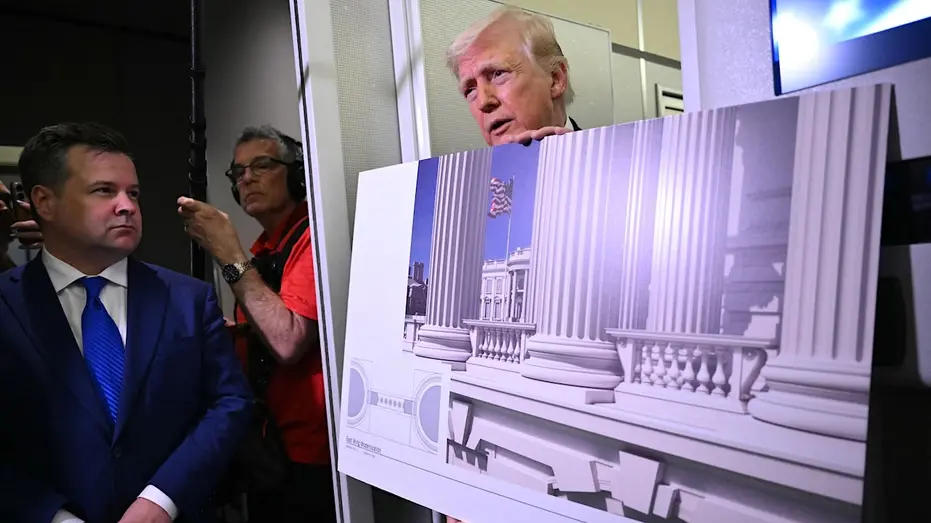
SouthernWorldwide.com – The Senate parliamentarian has rejected a $1 billion allocation within the Republican budget reconciliation bill, specifically targeting funding for White House and Secret Service security. This funding was partly linked to a planned ballroom for President Donald Trump.
Senate Parliamentarian Elizabeth MacDonough, who has held the nonpartisan role since 2012 during the Obama administration, ruled that the provision could not be included as written under budget reconciliation rules. This outcome was anticipated by both parties.
Ryan Wrasse, a spokesperson for Senate Majority Leader John Thune, R-S.D., stated on social media that Republicans would continue to attempt revisions to the legislation in hopes of gaining the parliamentarian’s approval.
“Redraft. Refine. Resubmit,” Wrasse posted on X. “None of this is abnormal during a Byrd process.”
This decision represents a setback for efforts to pass the funding with a simple majority as part of a larger package of approximately $72 billion. This broader package is primarily focused on immigration enforcement, following Democrats’ inclusion of these budgetary items during extended government shutdowns.
According to the office of Senator Jeff Merkley, D-Ore., the Senate Budget Committee ranking member, MacDonough ruled that the security funding provision falls under chamber rules requiring 60 votes for most legislation to pass.
“While we expect Republicans to change this bill to appease Trump, Democrats are prepared to challenge any change to this bill,” Merkley commented.
The parliamentarian’s role involves interpreting Senate rules, including the permissibility of legislative provisions. Although MacDonough is considered nonpartisan by Senate standards, she previously served as an advisor to former Vice President Al Gore during the Bush v. Gore election challenge in 2000, which was ultimately decided by the Supreme Court.
This ruling comes just days after several Senate Republicans expressed reservations about the $1 billion request from the Trump administration. Some indicated they required significantly more details before supporting taxpayer funding for a project Trump himself had claimed would be privately financed.
One unnamed official noted that if an employee presented a billion-dollar project with minimal explanation, the response would likely be, “You made that number up.”
An additional $180 million was proposed for a White House visitor screening center. Furthermore, $600 million was earmarked for Secret Service training, protection for Trump and other officials, counter-drone measures, and other security needs. This comes in the wake of Trump narrowly avoiding a third assassination attempt last month, an unprecedented occurrence.
Read more : Shai Gilgeous-Alexander Wins Second Consecutive NBA MVP Award: Report
Republicans who have defended the request have argued that Democrats and critics are misrepresenting the funding as a direct subsidy for the ballroom.
However, other Republicans stated that the administration had not adequately explained the basis for the requested amount. Senator Todd Young, R-Ind., emphasized the need for officials to provide “more details about exactly how they arrived at the figure.” Senator Rick Scott, R-Fla., added that the administration would need to justify the spending to taxpayers by explaining the expected return on investment.
The White House and Republican supporters have framed the funding request as a national security imperative, citing threats against Trump and the necessity of modernizing protective infrastructure at the White House. The administration has asserted that the ballroom would reduce the reliance on temporary outdoor structures for large events, while simultaneously enhancing security for the president, his family, and visitors.
The ballroom project has faced opposition since Trump ordered the demolition of the White House’s East Wing last year to make way for the new facility. The National Trust for Historic Preservation filed a lawsuit, contending that the administration lacked the authority to demolish the historic structure or construct a major new facility without explicit congressional approval. In April, a federal appeals court permitted construction to continue while the legal dispute is ongoing.
Trump has stated that the ballroom itself is slated to be funded by $400 million in private donations and is projected for completion around September 2028, near the conclusion of his second presidential term. The parliamentarian’s ruling does not halt the broader spending bill, but it does complicate Republican efforts to retain the White House security funds within a package they hope to pass along party lines.
Democrats have characterized the project as excessive and politically insensitive, arguing that Republicans are attempting to direct taxpayer money towards Trump’s signature construction project while American citizens are contending with escalating living costs.
Senate Minority Leader Chuck Schumer, D-N.Y., described the ballroom as “a disgrace” and urged Republicans to reject the funding.
“The bottom line is, this ballroom is a disgrace,” he stated. “The Republicans know it. Let’s see if they have the guts to do what they know is right, both substantively and politically, and tell Trump we don’t need a God — we don’t need a damn ballroom.”
It is noteworthy that the ballroom is not expected to be completed until 2028, the final year of Trump’s second and constitutionally mandated last presidential term. Trump contends that the facility will serve both Democratic and Republican administrations equally.