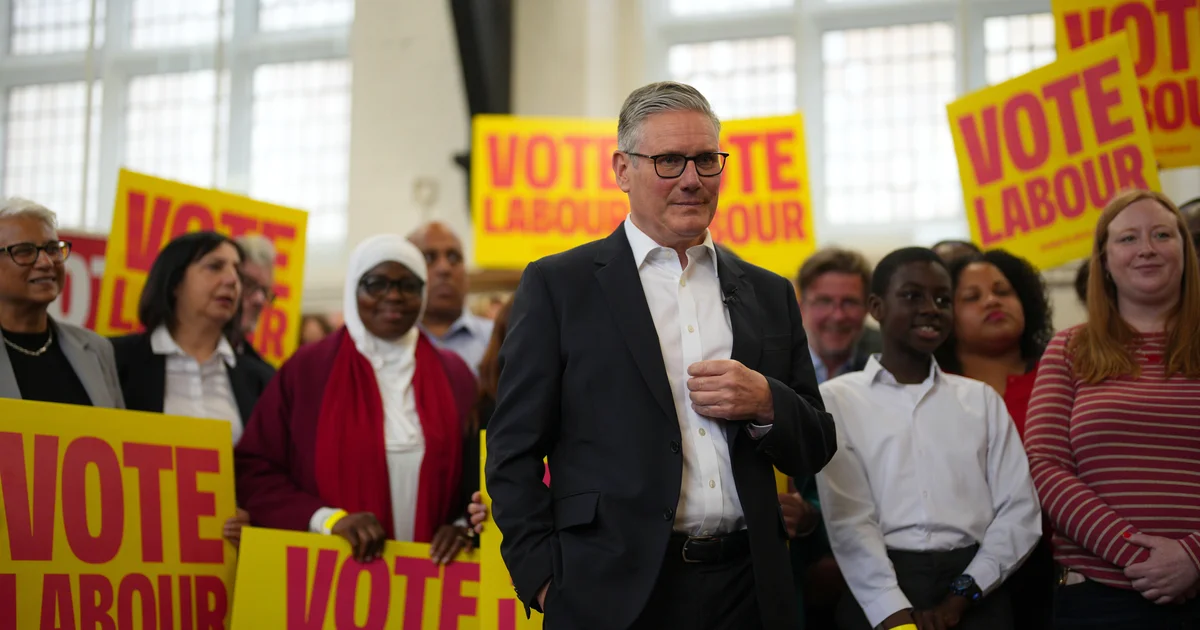
SouthernWorldwide.com – British Prime Minister Keir Starmer is facing increasing pressure to resign following a significantly disappointing performance by his Labour Party in recent local and regional elections.
The final results revealed substantial losses for Labour, with over 1,000 local council seats forfeited across England. Furthermore, the party lost its long-standing control in Wales after 27 years. In a notable shift, the anti-immigration party Reform U.K. secured nearly 1,300 seats in England and made considerable inroads in Wales and Scotland.
These elections were widely interpreted as a public referendum on Starmer’s leadership. His popularity has seen a notable decline since he led the center-left Labour Party to power less than two years ago.
Despite the unfavorable outcomes, Starmer has stated his intention to remain in his position, emphasizing the need to avoid plunging the country into further political instability. He asserted that the “right thing to do is rebuild and show the path forward.”
While Starmer’s cabinet colleagues have publicly backed him, and no prominent potential challengers have yet made a move, a growing number of Labour lawmakers are urging him to set a timeline for his departure this year. British political rules allow for a change in party leadership without necessitating a general election.
Legislator Clive Betts commented to BBC News, “There has to be a timetable.” Another lawmaker, Tony Vaughan, added that an “orderly transition of leadership” is necessary.
In an effort to signal change, Starmer has brought back two significant figures from previous Labour governments. Gordon Brown, a former Prime Minister, has been appointed as a special envoy for global finance. Harriet Harman, the party’s former deputy leader, will serve as an advisor on women and girls issues.
Starmer is scheduled to deliver a speech on Monday aimed at regaining political momentum. This will be followed by the government outlining its legislative agenda on Wednesday during the State Opening of Parliament, with a speech delivered by King Charles III.
The recent elections have marked a significant breakthrough for Reform UK, a right-wing party led by veteran politician Nigel Farage. Campaigning on an anti-establishment and anti-immigration platform, the party has gained support in traditional working-class Labour strongholds in northern England, such as Sunderland.
Reform UK also secured seats from the Conservative Party in areas like the county of Essex. Nigel Farage described the results as a “historic change in British politics,” expressing confidence that voters’ support for his party is not merely a short-term protest.
Currently, Reform UK holds only eight seats in the 650-seat Parliament, and it remains uncertain if they can replicate this success in a national election.
The elections also led to the formation of semi-autonomous administrations in Scotland and Wales, led by parties advocating for independence. However, neither party has prioritized this agenda at present.
Economic Challenges Underscore Labour’s Difficulties
Economic issues appear to be at the core of Labour’s challenges, mirroring difficulties faced by many incumbent governments globally.
Since ending 14 years of Conservative rule, which was marked by austerity measures and the impact of the COVID-19 pandemic, Labour has struggled to address the rising cost of living and stimulate a sluggish economy. These efforts are further complicated by the ongoing war in Ukraine and recent tensions involving Iran.
Starmer has also faced criticism from within his own party for proposed welfare spending cuts, some of which were later reversed following internal opposition. Some within Labour argue that the government’s achievements, such as protections for renters and an increased minimum wage, have not received adequate public recognition.
Concerns have also been raised about Starmer’s leadership style and his handling of various controversies, including the controversial appointment of Peter Mandelson, a figure with past associations with Jeffrey Epstein, as Britain’s ambassador to Washington.
However, Stephen Houghton, the outgoing leader of Barnsley council in northern England, where Labour lost seats to Reform, believes the issues are more profound than just the prime minister.
“This has been coming for 30 years around the country, in post-industrial communities, coastal communities, that have been left behind,” he stated. “You can change prime ministers all day long. If you don’t change policy, it’s not going to change.”
The election results reflect a broader fragmentation of the U.K. political landscape, moving away from the historical dominance of the Labour and Conservative parties. The Conservatives also experienced significant losses in the recent elections.
Voters were presented with a diverse range of choices, including the centrist Liberal Democrats and nationalist parties in Scotland and Wales. However, the most significant gains were made by populist parties, Reform UK and the Green Party.
The Green Party, under the leadership of Zack Polanski, has expanded its focus beyond environmental issues to include social justice and the Palestinian cause. They secured hundreds of council seats from Labour in urban and university towns, and took control of several local authorities.
Tony Travers, a professor of government at the London School of Economics, suggests that these results indicate the next national election, expected by 2029, may not result in a clear majority for any single party.
Read more: Audio captures Frontier plane hitting pedestrian on runway
“So then you’re in the world of, after the election, two or three big minority parties trying to work out how they would govern,” he observed, noting that such a scenario is traditionally considered “very un-British.”