SouthernWorldwide.com – Stephen Colbert and I have a long history.
I’ve had the opportunity to interview him numerous times, and we’ve even appeared on each other’s shows.
Regardless of whether one agrees with his liberal activism – which a significant portion of the country finds objectionable – his final broadcast raised critical questions about political retaliation, a fragmented media landscape, and the uncertain future of late-night television.
Putting aside the broader implications for a moment, my first interview with Colbert occurred when Comedy Central was testing him as the host of his own show for an eight-week trial period, and he was unsure of its longevity.
He was both amiable and possessed a quick wit, arguably on par with Jon Stewart.
During his portrayal of a blustering conservative anchor on “The Colbert Report,” he once made a subtle jab at me.
I had reported factually on Fox News that some Republicans and right-wing media personalities were criticizing Hillary Clinton’s age, 69, and suggesting she faced a dual disadvantage as a potential first female president.
Colbert, in his satirical style, twisted this into me declaring Hillary was too old.
This was factually incorrect, but I understood the dynamics of such commentary.
Therefore, I feigned offense and responded sarcastically, “It’s about time someone took on Stephen Colbert.
This guy – a fake anchor if ever there was one – has been maligning hard-working journalists for too long.
Journalists like me… Well, two can play this game, buddy.”
(Some of my critics unfortunately took the jest too seriously.)
This playful exchange did not prevent Colbert from inviting me as a guest when my book “Reality Show” was released.
He was gracious, and I enjoyed the experience.
Perhaps I shouldn’t have been surprised that most of my humorous remarks were edited out, while most of his were retained.
He was, after all, the star.
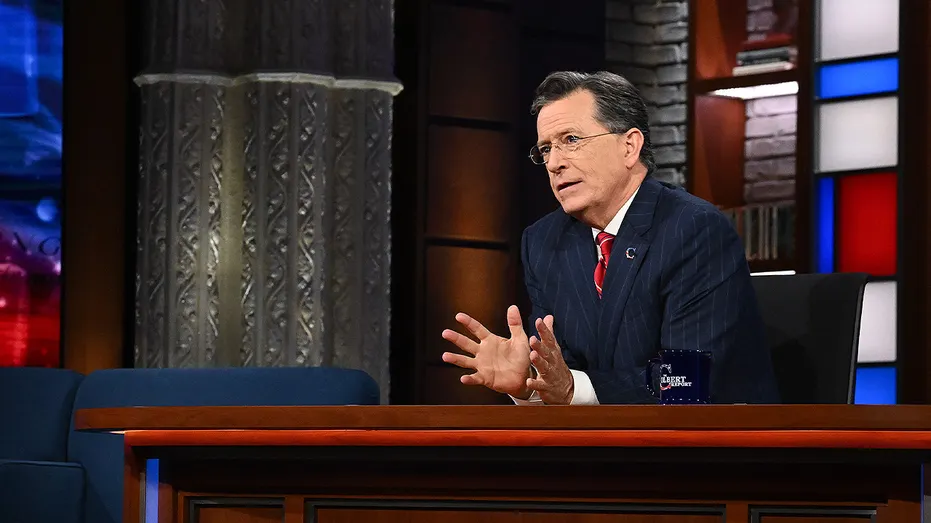
In his final monologue, Colbert told the audience, “We were here to feel the news with you.”
His speech was punctuated by appearances from actors like Bryan Cranston and Paul Rudd, who humorously competed to be his final guest (a tactic he admitted was “a very cheap stunt”).
The highlight of the evening was Paul McCartney.
McCartney’s band had made its American debut in the same theater, and he presented Colbert with a framed photograph that purportedly read, “You’re better than the Beatles.”
Baca juga di sini: Crypto and Blockchain: A Military Advantage
Following this, guests and fellow talk show hosts joined McCartney backstage for a rendition of “Hello Goodbye.”
Colbert, 62, who was raised in South Carolina, is a practicing Catholic and a former altar boy.
He has experienced a form of vertigo and was once hospitalized for a ruptured appendix during a taping.
After leaving Comedy Central, he was hired by CBS for “The Late Show,” where he initially held the third-place position in ratings.
However, after bringing in producer Chris Licht from “Morning Joe,” Colbert adopted a decidedly partisan stance and became strongly anti-Trump.
He once referred to Trump as “the Antichrist” (though he later clarified he was joking).
This shift propelled him to the number one spot in ratings.
This success, however, came with a significant drawback.
The question arises: why deliberately alienate half of one’s audience?
It was akin to consuming a potent elixir that contained a slow-acting poison.
Concurrently, Colbert’s interviews with figures like Barack Obama and Joe Biden were, to put it mildly, rather deferential.
The strong ratings prompted CBS executives to offer Stephen a long-term contract.
But last year, Colbert accused the network of accepting “a big fat bribe.”
He was referring to CBS’s payment of $16 million to settle a long-shot lawsuit filed by Trump concerning a deceptively edited “60 Minutes” segment.
This occurred just as Paramount was awaiting government approval for its proposed acquisition of Warner Bros. Discovery, which, coincidentally, was granted a week later.
This was the catalyst.
Paramount, owned by Trump associates Larry and David Ellison, announced the cancellation of “The Late Show.”
This decision was made without consulting the network’s most prominent star or discussing potential cost-saving measures for his 200-person staff.
Trump publicly stated that he “absolutely loves” the move.
This was unequivocally political retaliation; the justification of “financial reasons only” is not credible.
However, CBS has amplified Colbert’s departure into a national spectacle, with Colbert consistently criticizing the network.
What recourse did the network executives have, given they had already dismissed him?
Distinguished guests during Colbert’s final weeks included Tom Hanks, Oprah Winfrey, Julia Louis-Dreyfus, Jon Stewart, Steven Spielberg, Bruce Springsteen, and original host David Letterman.
Letterman famously assisted him in throwing furniture off the roof to smash the CBS eye logo.
(I found this gesture somewhat contrived, considering Colbert’s stated desire for an amicable parting.)
Friendly rivals Jimmy Kimmel and Jimmy Fallon agreed to air reruns on the night of Colbert’s finale, thereby shifting the spotlight to his curtain call at the Ed Sullivan Theater.
The “Late Show” slot will be filled by comedian Byron Allen.
Allen has pledged to avoid politics on his pre-recorded show and is reportedly paying CBS millions for the airtime.
This brings us to the stark financial reality.
Colbert’s show was incurring tens of millions of dollars in annual losses, a situation that is unsustainable.
The 11:35 p.m. time slots on CBS, ABC, and NBC attract a significantly smaller audience compared to the era of Johnny Carson, when viewers had to stay up late to watch his balanced comedy.
In the last quarter, Colbert and Kimmel each garnered over 2.5 million viewers, while Fallon attracted 1.3 million.
While respectable in the current media climate, Jay Leno, at his career’s zenith, averaged between 5 and 6 million viewers.
Currently, the primary impact of these late-night programs stems from short clips that are widely viewed the following morning.
Do I believe late-night shows will still exist in five years? Sadly, it’s unlikely.
The digital age has introduced constant competition for audience attention, from social media and group chats to podcasts and Substack newsletters.
All of these are readily accessible within seconds on a smartphone or smartwatch.
This realization evokes a sense of nostalgia, yet I no longer listen to AM radio or use a Walkman.
Technology inexorably advances.
One thing is certain: Stephen Colbert will have no difficulty maintaining his financial well-being.