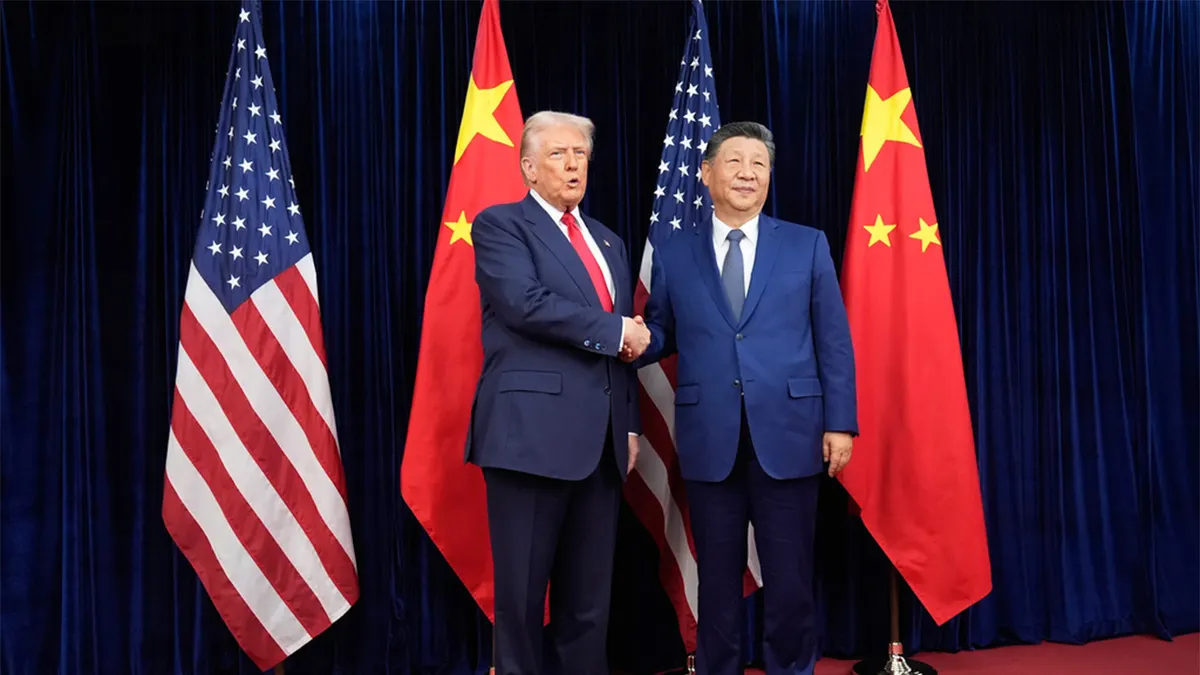
SouthernWorldwide.com – For decades, China has maintained a distinct advantage in negotiations with the United States by establishing itself as an indispensable economic entity. This was achieved by leveraging its critical role in global supply chains, which are vital to U.S. economic security. However, Washington’s previous energy policies had weakened its negotiating stance, leaving it vulnerable to China’s strategic maneuvers. President Trump’s economic and trade initiatives have fundamentally altered this dynamic, positioning the U.S. for a favorable outcome as Trump prepares to meet with Xi Jinping in Beijing.
The foundation of this strengthened position begins domestically with robust economic growth. Trump’s deregulation agenda and tax reforms have stimulated investment in American industries after a prolonged period of stagnation. His administration recognizes that a thriving and expanding American economy is not merely beneficial for its workforce; it also serves as a crucial geopolitical asset, enabling the U.S. to effectively counter pressure from the Chinese Communist Party. While China’s economic growth has been faltering, the U.S. economy has demonstrated remarkable resilience.
This resilience is partly attributed to President Trump’s efforts to boost domestic energy production. This initiative not only generates well-paying jobs but also ensures the U.S. economy possesses the necessary fortitude to navigate global economic turbulence.
Not long ago, the United States relied on the international community for its oil and natural gas supplies. Today, under Trump’s policies, the U.S. has emerged as an energy superpower and a net exporter of energy. While fluctuations in global energy markets still impact American consumers, the effect is considerably less severe than the pressure faced by Beijing. China has depended on energy imports from nations like Iran and Venezuela to sustain its manufacturing dominance. With these supply lines disrupted, Xi Jinping finds himself in a less advantageous position.
TRUMP’S TARIFF WAR WITH BEIJING IS PART OF A MULTI-PRONG STRATEGY TO SECURE AMERICA FROM A MUCH BROADER THREAT
President Trump’s emphasis on manufacturing as a cornerstone of national power underpins this broader strategy. A key element of his approach to China has been the replacement of the North American Free Trade Agreement (NAFTA) with the United States-Mexico-Canada Agreement (USMCA). Unlike NAFTA, the USMCA offers greater protections for workers and was specifically designed to secure American supply chains, which had become alarmingly reliant on China.
Baca juga di sini: Trump Criticizes "Crazy" Iran Plan Amidst US Analyst Disagreements and China Meeting
Under the USMCA, 16 out of 21 key manufacturing sectors have experienced export growth. For crucial industries such as petroleum, chemicals, and lumber, U.S. exports not only increased but grew at a significantly faster rate to Canada and Mexico compared to the rest of the world. A prime example is the U.S. automotive parts sector. By mandating that 75% of a vehicle’s value originate in North America, the agreement has facilitated the restructuring of supply chains, moving them away from Chinese factories and back to the continent. U.S. vehicle parts production has now reached $349 billion annually, exceeding 2019 levels by more than $37 billion. The automotive supplier industry has created 61,000 jobs, now employing over 930,000 workers across all 50 states. Within this integrated framework, nearly one-third of all U.S. exports are directed to Canada and Mexico.
This enhanced resilience in supply chains effectively neutralizes Beijing’s leverage at the negotiating table. China’s long-standing strategy has revolved around integrating Chinese production so deeply into global supply chains that any confrontation would prove prohibitively costly for the U.S. The USMCA directly challenges this strategy. When American manufacturers can source components from reliable North American partners operating under shared regulatory principles, China’s economic leverage diminishes.
As President Trump prepares for his visit to China, he will engage with Xi Jinping possessing unprecedented economic power. This strength is bolstered by a revitalized U.S. domestic economy driven by deregulation, a North American manufacturing base operating at record levels, and a trade framework that has substantially reduced dependence on Chinese industrial output.
China currently accounts for approximately 30% of the world’s manufactured goods while consuming only about 18%. This surplus production must find markets elsewhere, often being offloaded into global markets, with state subsidies absorbing the financial losses. For years, this strategy proved effective due to the absence of a cohesive Western counter-strategy. President Trump’s North American industrial policy represents the first significant response to this challenge. Beijing recognizes that its dominance over the global economy is beginning to wane.
The America First agenda was never intended to isolate America from the global community. Instead, it was designed to ensure that when America engages with the world, particularly with a rival as formidable as China, it does so from a position of strength. This strategic approach places Beijing on the defensive.