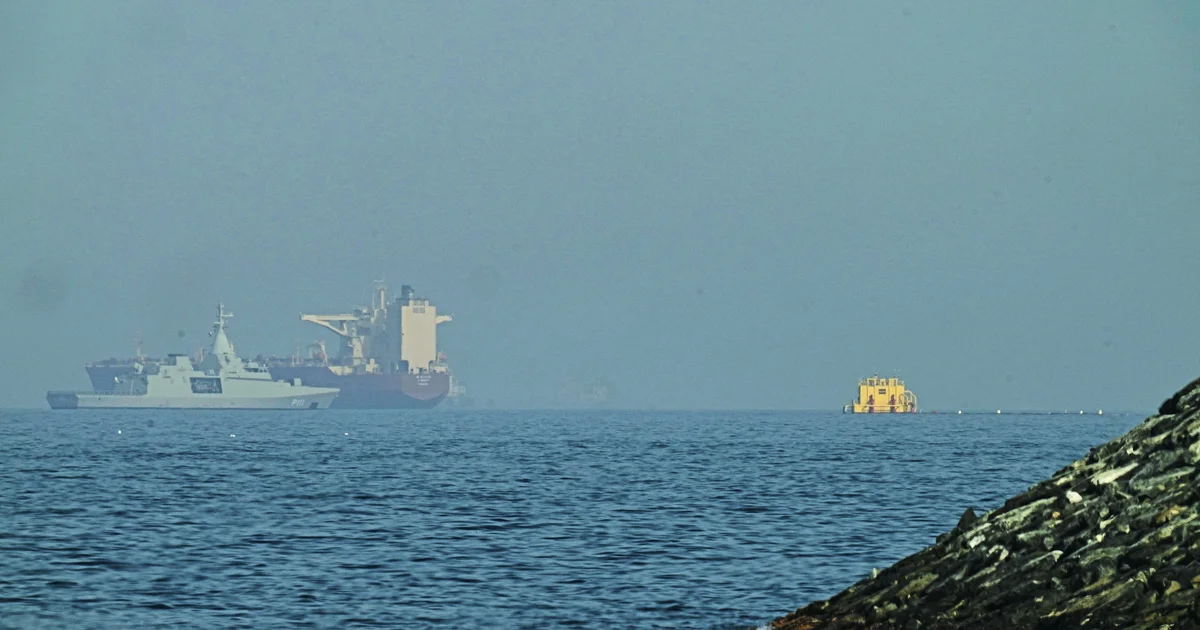
SouthernWorldwide.com – Two United States Navy destroyers successfully navigated the Strait of Hormuz and entered the Persian Gulf following an encounter with a series of Iranian threats, according to defense officials who spoke to CBS News on the condition of anonymity to discuss sensitive national security matters.
The vessels, identified as the USS Truxtun and USS Mason, were supported by Apache helicopters and other aircraft. During their transit, they faced coordinated threats that included small boats, missiles, and drones launched by Iran, which officials characterized as a sustained barrage.
Despite the intensity of these actions, neither of the U.S. Navy destroyers sustained any hits. Military officials confirmed that defensive measures, significantly enhanced by air support, were effective in intercepting or deterring every incoming threat, ensuring that no launched projectiles reached the ships.
Read more: SCOTUS allows redistricting decision to take effect immediately, igniting heated debate
This transit occurs shortly after President Trump announced on Sunday that the U.S. would assist in “guiding” ships through the Strait of Hormuz. This vital chokepoint has been a focal point of Iranian control efforts since the commencement of U.S. military operations in late February. The disruption in this region has led to hundreds of petroleum tankers and other vessels being delayed in the Persian Gulf for months, consequently driving up global oil prices.
The U.S. military’s Central Command confirmed on Monday that American destroyers had passed through the strait as part of an initiative known as Project Freedom. At the time, the military did not disclose the specific number or names of the naval vessels involved in the transit.
Central Command also stated that two U.S.-flagged commercial ships completed their transit of the strait without incident. The military has reportedly contacted numerous other shippers to encourage a resumption of traffic flow.
Admiral Brad Cooper, commander of U.S. Central Command, indicated that Iran had launched an attack against both American naval and commercial vessels passing through the strait. This led to the U.S. destroying six Iranian small boats. However, Iran’s state-run news outlets have disputed these claims, denying that their boats were destroyed and asserting that no commercial vessels have recently crossed the strait.
Iran had previously issued warnings to U.S. forces, stating they would be targeted if they entered the strait. This situation has cast doubt on a fragile four-week-long ceasefire that was in place between the two nations.
Earlier on Monday, Iran launched missiles and drones targeting the United Arab Emirates. Additionally, Iranian drones reportedly targeted an oil tanker owned by Abu Dhabi’s state energy company that was attempting to sail through the Strait of Hormuz, according to the U.S.-allied Gulf state. Iranian media also claimed that a U.S. warship was hit by missiles, a report that Central Command has refuted.
In parallel, the U.S. is enforcing a naval blockade on Iranian ports, a measure directed by President Trump. The objective of this blockade is to exert pressure on Iran while both countries engage in the exchange of proposals for a more enduring agreement. Iran, however, has described the blockade as a breach of the ceasefire.