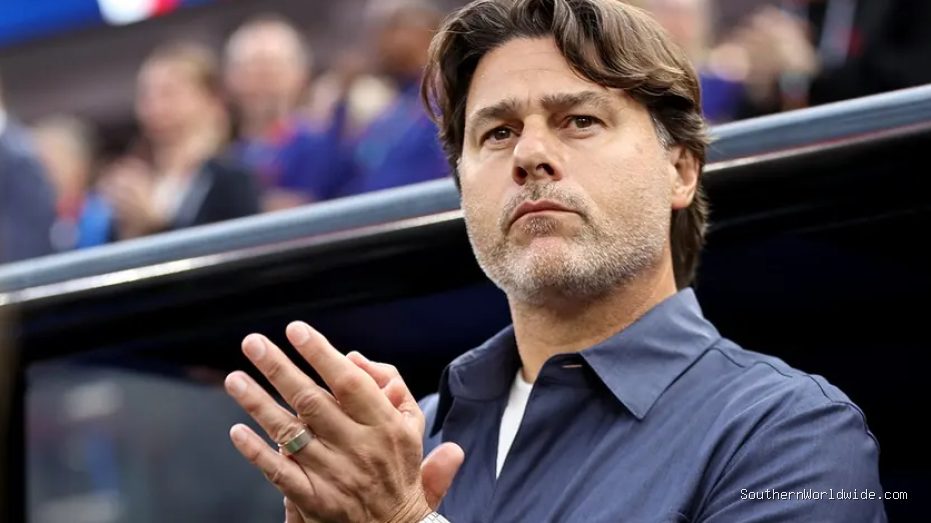
SouthernWorldwide.com – When Mauricio Pochettino was appointed as the head coach of the US Men’s National Team nearly two years ago, it was widely seen as a significant achievement for US Soccer.
Pochettino offered an external viewpoint, a distinct contrast to Gregg Berhalter, whose managerial experience was primarily within Major League Soccer (MLS). He had previously coached players in top-tier European competitions, with previous roles at Tottenham Hotspur in the English Premier League, Paris Saint-Germain in Ligue 1, and Chelsea, also in the EPL.
His initial period in charge experienced some turbulence. Notably, in the most significant tournament preceding the World Cup, his USMNT squad suffered a 2-1 defeat to Mexico in the Gold Cup Final, a match that included several controversial officiating decisions in favor of Mexico.
However, as is common with national team managers, Pochettino’s success was always going to be primarily evaluated based on the USMNT’s performance in the 2026 World Cup. The team’s campaign in this tournament has presented a mixed outcome.
Their opening match against Paraguay in Los Angeles was remarkable. The team secured a dominant 4-1 victory, showcasing an aggressive, attacking style of play characterized by composure, coordination, and exceptional movement, a level of performance rarely witnessed from a US team previously.
They followed this with a 2-0 win against Australia. Subsequently, they lost a match against Turkey, which held little consequence, as most regular starters were replaced by backup players.
Advancing from the group stage was an accomplishment, but achieving it in such a dominant fashion was even more impressive. Nevertheless, the knockout stage presented another challenge for the USMNT, which they managed to overcome with relative ease, perhaps marking the most encouraging sign of their progress yet.
While Bosnia and Herzegovina was indeed outmatched in terms of talent, the team’s resilience was evident after star player Florian Balogun received a controversial red card. The team’s ability to maintain their performance and secure a win, highlighted by a top-level free-kick goal from Malik Tillman, was commendable.
This victory set the stage for what was arguably the most significant opportunity for a USMNT team in decades: to defeat Belgium in a home World Cup and advance to the quarterfinals.
The outcome of that crucial match is well-known. The USMNT suffered a devastating 4-1 loss, reverting to a style of play that many long-time fans find all too familiar. The team exhibited poor coordination, weak defensive play, an excessive number of turnovers from key players, and made unforgivable mistakes.
Therefore, the question arises: how should Pochettino’s performance be judged? This is precisely the evaluation US Soccer must undertake. Following their exit from the World Cup, they issued a statement that seemed to indicate a desire for his return, suggesting that the decision ultimately rests with him.
“We had positive conversations with Mauricio before the World Cup about the future,” the statement read. “We agreed we would continue those conversations following a chance to rest and reflect post World Cup. We have a great deal of respect and gratitude for Mauricio, his staff and everyone part of the program. We have shared excitement about our potential and also shared clarity about the amount of work at all levels still required to achieve our ambition.”
Pochettino himself stated his intention to take some time to consider his future and the federation’s aspirations.
“In the next few weeks, we can start to talk if the federation wants to talk,” he commented after the match. “Right now it’s about resting a little bit, to think, to have conversations with the federation to see what the decision is. I’m so happy. We’ve built a very good relationship. Now is not a moment to talk about [my future].”
He will undoubtedly have several options available, whether that’s a return to the Premier League, a move to Italy, or elsewhere. However, retaining Pochettino should be a paramount objective for US Soccer.
His halftime adjustments played a crucial role in bringing the USMNT back into contention during the match. It is not his fault that 38-year-old Tim Ream was the most capable available center-back. Nor is it his responsibility that the starting goalkeeper quite literally kicked the ground while attempting to clear the ball, directly leading to a goal for Belgium.
While the frustration over another Round of 16 exit is understandable, it is evident that the pool of US players is the strongest it has ever been, and it continues to improve.
There are numerous structural issues that need addressing within the coaching and administration of soccer at the youth level, which fall more under the purview of US Soccer than the USMNT head coach. However, concerning team selection, player development, and tactical strategies, there are few coaching candidates available who would represent a better choice for the US.
This excludes highly improbable pursuits of individuals like Pep Guardiola, Carlo Ancelotti, or Jurgen Klopp. Notably, Klopp is reportedly in advanced discussions to take over the German National Team following their own disappointing World Cup exit.
This juncture represents a critical period for US Soccer, and ensuring the success of the next cycle is of utmost importance. The hope is that they make the right decisions.