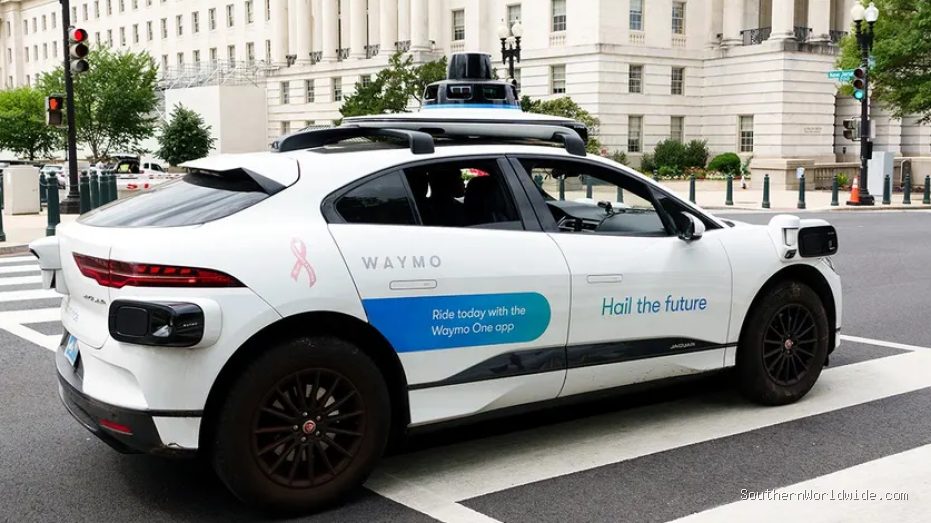
SouthernWorldwide.com – Waymo, the autonomous vehicle company owned by Alphabet, has initiated a voluntary recall affecting 3,871 of its vehicles. This recall is specifically for those equipped with the company’s 5th Generation Automated Driving System. The issue, as reported to the National Highway Traffic Safety Administration (NHTSA), involves a software vulnerability that could potentially allow a Waymo vehicle to mistakenly enter a closed freeway construction zone and continue driving.
In response to this safety concern, Waymo is temporarily halting its freeway operations. The company is actively working on a software fix to address the problem. This recall brings to the forefront critical questions regarding the ability of robotaxis to navigate the dynamic and often unpredictable conditions that human drivers encounter daily.
WAYMO UNDER FEDERAL INVESTIGATION AFTER CHILD STRUCK
The recall has been assigned NHTSA Campaign Number 26E035000. It specifically targets the 3,871 Waymo vehicles that utilize the company’s 5th Generation Automated Driving System (ADS). According to the official filing with federal authorities, the autonomous system may allow a vehicle to enter and proceed at speed within freeway construction zones. This is attributed to the software’s potential failure to accurately recognize such zones or a tendency to prioritize avoiding other perceived freeway hazards.
Waymo’s internal timeline indicates that the first series of incidents occurred in Phoenix. The company documented one such event on April 11 and five more on April 19, where vehicles drove past ramp closure signs and entered pre-planned freeway construction zones.
Following these events, similar issues were reported in the San Francisco Bay Area. On May 18, seven Waymo vehicles were observed entering active freeway construction lanes by driving between cones. The federal filing states that in these instances, the system either failed to identify the construction zone or assigned greater importance to avoiding other road hazards.
Waymo initially restricted its freeway driving capabilities after the Phoenix incidents, implementing operational changes. However, after the San Francisco Bay Area events, the company broadened the suspension of freeway driving while it conducted a thorough investigation to pinpoint and resolve the root causes of these failures.
Importantly, Waymo has stated that no collisions or injuries were reported in connection with these specific incidents. Nevertheless, the company acknowledges that its review prompted the temporary restriction of freeway operations as it develops and deploys additional software safeguards.
The federal filing details that Waymo will update the Automated Driving System to enhance its ability to detect and avoid entering construction zones. The proposed remedy also includes the implementation of additional operational protocols to further bolster safety.
As Waymo is the owner of all affected vehicles, the company will be responsible for applying the remedy directly. An update to the filing will be submitted once the software fix has been successfully deployed.
A Waymo spokesperson provided a statement to CyberGuy, saying:
“Waymo’s mission is to be the world’s most trusted driver, and the data shows that we’re making roads safer in the communities in which we operate.
We identified an area of improvement regarding performance around freeway construction zones. We voluntarily restricted freeway operations last month while making improvements, proactively notified state and federal regulators, and decided to file a voluntary software recall with NHTSA.
We continue to safely serve riders on surface streets in all the cities where we operate.”
Waymo’s own safety documentation offers further context. The company reports that its rider-only vehicles have accumulated 170.7 million miles driven without human intervention as of December 2025. Furthermore, Waymo claims that its “Waymo Driver” has been involved in 92% fewer serious injury-or-worse crashes compared to an average human driver over the same distance in its operating cities, though this safety data primarily focuses on surface-street driving.
WAYMO DRIVERLESS CARS OVERRUN ATLANTA NEIGHBORHOOD, CIRCLING CUL-DE-SACS AND ALARMING FAMILIES WITH KIDS
Construction zones are inherently dynamic environments. Lane markings can disappear, cones can be repositioned, and temporary signage may contradict the established road layout that a vehicle expects. Even experienced human drivers can become disoriented when a familiar route is suddenly obstructed.
For an autonomous vehicle, these evolving conditions present a complex, real-time software challenge. The vehicle must interpret what constitutes a lane, a barrier, a sign, or a hazard. It also needs to adapt when its internal map no longer aligns with the physical reality of the road.
While freeways are designed for predictability, construction zones introduce a significant element of unpredictability. Even with advanced sensors, detailed maps, and sophisticated trained models, a driverless system must consistently make the safest decision when the road environment changes without prior warning.
Waymo began offering freeway rides to the public in the San Francisco Bay Area, Phoenix, and Los Angeles in November 2025.
The company has also been actively expanding its ride-hailing services.
According to Waymo’s official blog, the company is laying the groundwork for ride-hailing operations in over 20 additional cities by 2026, including major international hubs like Tokyo and London.
This recall directly impacts the core promise of robotaxis. The expectation is that robotaxis will reduce the incidence of human error on the road. However, the reality of road conditions often proves more complex than software can easily process in real-time.
This discrepancy can lead to a trust deficit. While the public generally accepts that human drivers make mistakes and can understand their reasoning, a bad decision by a driverless car can feel more disconcerting, especially when there is no human driver to assume responsibility.
Public perception of Waymo will not solely be based on its safety statistics. It will also be shaped by unusual incidents observed on the road, viral videos, and the company’s responsiveness in addressing problems as they arise.
For current Waymo riders, the immediate implication of this recall is that freeway rides may be temporarily unavailable. Waymo has confirmed that its surface-street services continue to operate normally in all its service areas. However, routes that would typically utilize freeways might take longer to complete.
Before booking a ride, it is advisable to check the route, fare, and estimated travel time within the app. During the ride, users are encouraged to utilize the in-app support options if they encounter any issues. Waymo advises riders to tap “Help,” select “Get help,” and then call for immediate assistance. In emergency situations, users should dial 911.
For those sharing the road with robotaxis, it is recommended to treat them as any other vehicle but to exercise extra caution around construction zones. Drivers should not assume that a driverless car will perceive a temporary closure in the same way a human driver would. Maintaining a safe distance and staying attentive, particularly in challenging road conditions, is advised.
Your smartphone contains a wealth of personal information, including emails, passwords, photos, and banking applications. In a recent CyberGuy Live replay, Kurt the CyberGuy provided a step-by-step guide on simple phone security enhancements. The session covered improving privacy settings, identifying the latest phone scams, utilizing trusted security tools, and offered a practical checklist for staying protected. The replay and checklist are available at: CyberGuyLive.com.
WAYMO TEAMS UP WITH WAZE TO SPOT POTHOLES FASTER
While Waymo’s safety data is impressive and should not be disregarded, this recall underscores how quickly public confidence can be eroded when a robotaxi encounters a complex and fluid road situation. Construction zones are ubiquitous, their conditions can change rapidly, and they often pose challenges even for human drivers. This highlights the critical need for driverless cars to be thoroughly prepared for such scenarios before widespread deployment on freeways.
Ultimately, the true test for Waymo lies not in its ability to navigate clear roads, but in its capacity to make the safest decision when the road environment undergoes sudden and significant changes.
Following a recall like this, would you still opt for a driverless car on the freeway, or would you prefer to stick to surface streets until the technology demonstrates further reliability? Share your thoughts by writing to us at Cyberguy.com.