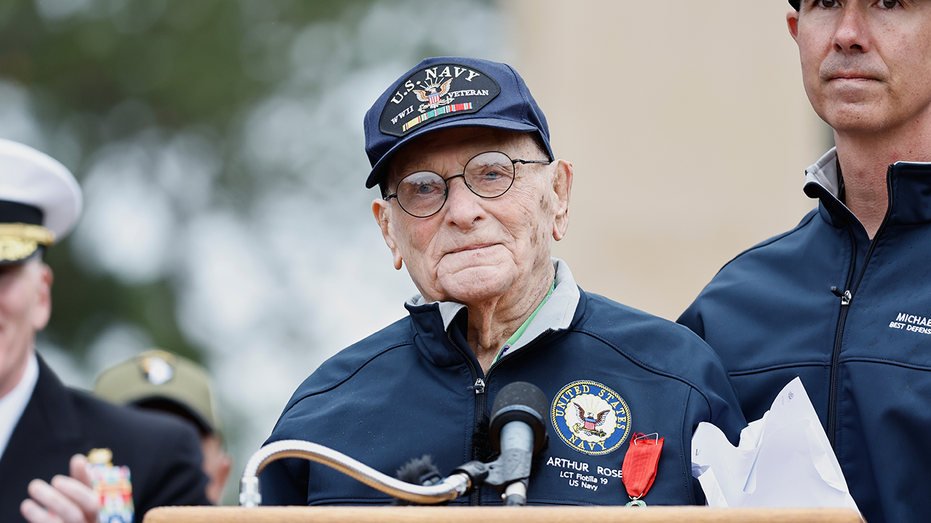
SouthernWorldwide.com – World War II veteran Arthur Rose shared a profound, single-word feeling that encapsulated his emotions just before the pivotal D-Day landings, a sentiment he recounted 82 years later at a commemoration ceremony in Normandy, France.
Rose was reading a letter he had penned a few days after the historic June 6, 1944, invasion. In it, he described his initial disbelief about his potential involvement in such a massive undertaking.
“Dear mom and dad and kids, About a month before we landed, I had a feeling I might be part of the invasion. I couldn’t quite believe, though, that I would,” he read to the assembled crowd. He further elaborated on his thoughts at the time, questioning his role. “I kept thinking, what could I possibly do in an invasion? Pull engines in the middle of a battle? I figured men like me would come along afterwards — after they cleared the wreckage and the damage had passed.”
However, his role evolved significantly as D-Day approached. “But two weeks before D-Day, I was told I would go along and do whatever I could,” Rose continued from his letter. He vividly recalled the scene at the assault port, describing it as a hive of activity and immense preparation.
“We had moved to the assault port. Thousands of ships and landing craft of every description filled the harbor. Everyone worked day and night preparing fuel, provisions, ammunition and secret material. Everything was checked and rechecked and checked again. You can imagine the confusion and activity,” he shared, painting a picture of the meticulous planning involved.
The loading of supplies marked a clear indication that the invasion was imminent. “Then came the day we began loading supplies for the invasion: food, blankets, ammunition, and all the countless things that would be needed once the men landed in France,” Rose recounted. The official confirmation of the date brought a new wave of anticipation. “We knew then the invasion could not be far. Then came the word: D-Day will be June 6th,” he read.
When asked to describe his feelings leading up to the invasion, Rose admitted it was difficult to pinpoint with a single emotion. He revealed it was not outright fear, nor was it pure excitement. “I can’t describe the feeling exactly. It wasn’t fear, and it wasn’t excitement. Just a funny feeling — nervousness, expectancy, and wondering what was going to happen next,” he confessed.
The initial attempt to sail was fraught with challenging weather conditions, leading to a disheartening postponement. “Then we sailed. The sea was rough, windy, and miserable. I was seasick most of the time. Everyone expected bombing, submarines, battleships, and all hell to break loose at any moment. But the first attempt was called off because the sea was too rough, and we returned to the harbor. That was a real letdown,” he explained.
The following day brought a renewed attempt, this time with the daunting reality of conflict becoming apparent as they neared the French coast. “The next day, we sailed again. Near the coast of France, we could see flashes in the distance and hear the explosions continuously. In went the landing craft. We expected terrible destruction, as there was shelling, and men died. But not all of us,” he stated grimly.
Once ashore, the veteran’s role shifted to crucial logistical support amidst the chaos of war. “Then our work truly began: back and forth, day and night, bringing in equipment, medical supplies, and ammunition. What had once been just another stretch of French coast had suddenly become a vast harbor filled with hundreds of ships and thousands of men.”
At a poignant moment during his reading, Arthur Rose paused, expressing a sense of detachment from his own written words. “I don’t remember writing this,” he stated aloud, before continuing with the letter’s conclusion.
He concluded his letter with a message of reassurance to his family. “I will always be grateful to my commander for taking me along. Don’t worry about me. I am well, and whole, and happy. Love, Art,” he read, ending his powerful account of a soldier’s perspective on one of history’s most significant turning points.