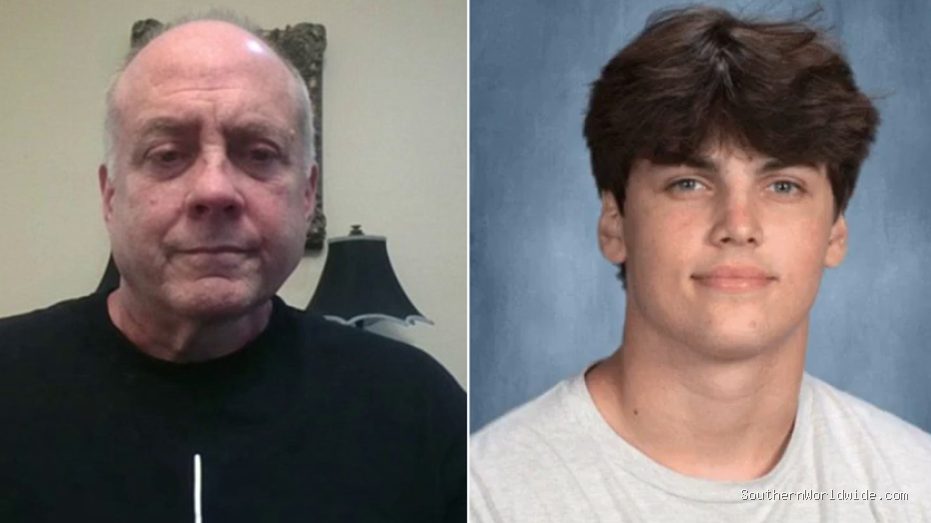
SouthernWorldwide.com – A Howard University professor has sharply criticized the victim-impact statement delivered by the father of slain Texas teen Austin Metcalf, asserting that the teen’s death was not solely a consequence of the actions of Karmelo Anthony, but also a reflection of his father’s parenting and values.
Dr. Stacey Patton, a professor at Howard University’s School of Communications, expressed her views in an opinion piece published on Substack. Titled “Dear Jeff Metcalf: Your Son Is Dead Because You Failed to Teach Him That Black Boys Have Boundaries,” the piece suggested that Anthony may have been acting in self-defense.
Patton directly addressed Jeff Metcalf, stating, “YOU failed to teach your boy that Black children have boundaries.” She continued, “YOU failed teach humility, restraint, or the sacred fact that another person’s body is not your jurisdiction. YOU failed to teach him that another child’s space is not a challenge to be conquered. YOU failed to teach him that ‘community’ does not mean white boys get to decide who belongs and who does not.”
This commentary followed a day after Anthony was sentenced to 35 years in prison for the murder of Metcalf. The case gained national attention after the then 19-year-old Anthony fatally stabbed 17-year-old Metcalf during a confrontation at a high school track meet in April 2025. The incident has ignited broader debates about race, with supporters of Anthony arguing he faced differential treatment due to his race, while critics have dismissed attempts to frame Metcalf’s murder as a race-related issue.
Patton further elaborated on her critique, writing, “YOU obviously failed to teach your son that touching, confronting, crowding, testing, or policing another person can have consequences.” She added, “And YOU failed to teach him that the same world that cheers white boys for being bold and aggressive will not always be there to save them when they mistake somebody else’s restraint for permission.”
She strongly rebuked Jeff Metcalf for his statement that Anthony had failed his parents by choosing to murder his son. Patton argued, “It is easier to stand in a courtroom and call Karmelo Anthony a failure than it is to admit that Austin’s death did not begin with the knife.” She posited that the tragedy began with lessons that taught his son he had the right to challenge boundaries, with adults who praised white male entitlement, and with cultural narratives that portrayed Black boys as threats without acknowledging their potential fear.
Patton also suggested that Jeff Metcalf’s victim-impact statement was influenced by racism. She focused on his assertion that Anthony “does not belong” in the community due to his actions. Patton interpreted this statement as more than just a father’s grief, calling it “a declaration of removal” and “the language of somebody who believes he has the authority to decide who gets to stay, who must disappear, and whose presence contaminates the social order.” She concluded with the observation, “Like father, like son.”
She continued, “Your words landed on top of centuries of Black children being told they do not belong in white schools, neighborhoods, playgrounds, pools, churches, white juries, white imaginations, and white definitions of innocence.” She added, “They landed on top of every Black boy this country has turned into a threat before he ever had a chance to be a child.”
Patton claimed that Metcalf’s son was not the sole victim, asserting that Anthony’s family was also experiencing grief. “Austin is dead. Your family is devastated,” Patton wrote. “That matters. Karmelo Anthony is alive but caged inside a racial imagination that had already convicted him. And that matters, too. Two families are shattered. And a whole country is using the tragedy to rehearse the same old script about Black guilt and white innocence.”
She summarized her stance by stating, “My argument is simple: Black children are children. They do not become monsters because white America needs one, and their humanity is not up for debate because a verdict has been rendered.”
Patton’s commentary is part of a growing discourse that views the murder case as being rooted in race. Representative Jasmine Crockett, D-Texas, also raised questions about the role of race in Anthony’s conviction on her podcast. Crockett questioned the fairness of Anthony’s trial, spreading a claim that the jury was entirely white, which she suggested could have compromised their impartiality.
“I’m not necessarily convinced — not that I could tell you the name of one person on this jury — that we had 12 impartial white folk out of Collin County sitting on a jury for this young black man,” Crockett stated.
Crockett further suggested that Black mothers experience greater daily agony than the victim’s family. “Black women, especially black women who have black male children, live in fear and agony every single day,” she expressed. “A fear and agony that I promise you the Metcalfs probably had never spend a day living that way.”