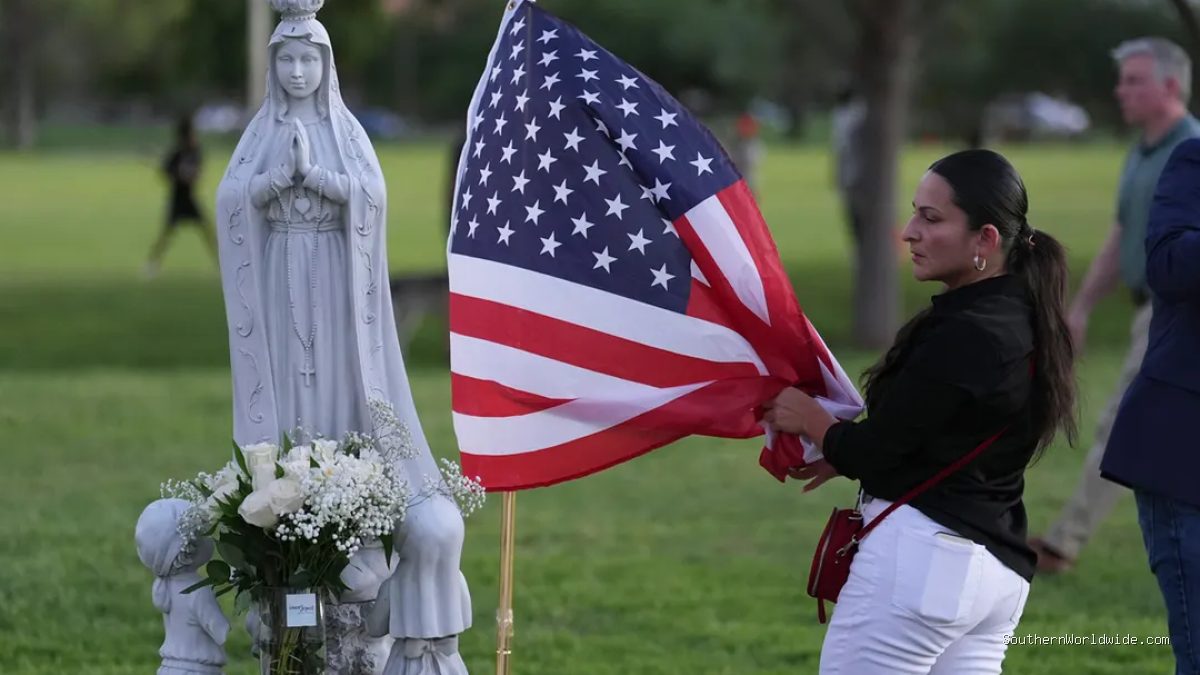
SouthernWorldwide.com – While Americans readily recall the names of their nation’s Founding Fathers like Washington, Jefferson, Adams, Hamilton, and Franklin, the concept of a “Founding Mother” often draws a blank. This might stem from a prevailing notion that America’s inception was solely a political endeavor, confined to statehouses, battlefields, and constitutional conventions. The focus has historically been on the men who architected the republic’s political framework, frequently overshadowing those who significantly contributed to its moral character.
Nations, however, are not solely sustained by their constitutions. They are also bound together by vital institutions such as schools, hospitals, charitable organizations, and cohesive communities. A shared moral conviction and a steadfast belief in mutual neighborly responsibility are equally crucial for their endurance.
It is in this light that, 250 years after her birth, we should acknowledge Elizabeth Ann Seton. She was an educator, a humanitarian, and a Catholic saint, deserving recognition as a Founding Mother and one of the most quietly influential figures in post-Revolutionary America.
Born in New York in 1774, Elizabeth Ann Bayley Seton was, in essence, a child of the Revolution. Her formative years coincided with the nascent, fragile stages of the American experiment, immersed in the civic and intellectual milieu of the early republic. Her father, Dr. Richard Bayley, was a pioneer in New York’s public health sector and was connected to prominent figures like Alexander Hamilton and John Jay. Through her marriage into the esteemed Seton family, Elizabeth became part of the social circles of the nation’s political and mercantile elite.
She attended events alongside individuals associated with George Washington and lived among the architects of the nascent republic. Elizabeth possessed a deep understanding of the aspirations and anxieties of a nation in the process of self-invention.
However, her most profound and lasting contribution to America would not emerge from the political arena.
Instead, it would be forged through acts of service.
Long before women held public office or wielded significant institutional power, Elizabeth played a key role in establishing one of the nation’s earliest women-led charitable organizations: the Society for the Relief of Poor Widows with Small Children. This organization was founded, governed, funded, and operated entirely by women, a remarkable achievement for the 1790s.
Tragedy later struck, dismantling the life she had known.
Her husband’s business faced financial ruin, and illness soon followed, leading to death. Widowed at the age of 29, with five children and the responsibility of caring for extended family, Elizabeth experienced firsthand the pervasive insecurity that characterized daily life for countless Americans in the early republic.
It was at this juncture that she made a decision that caused considerable consternation within polite society: she converted to Catholicism.
In the context of the early nineteenth-century United States, her conversion was a deeply controversial act. Many Americans harbored suspicion and distrust towards Catholics, and embracing the faith carried significant social repercussions. Nevertheless, Elizabeth Ann Seton chose to accept these consequences.
This decision underscored one of the most fundamental promises of the American experiment: the primacy of conscience over conformity.
She prioritized faith over social ease, conviction over status, and truth over acceptance. This narrative transcends religious spheres and is intrinsically an American story.
In 1809, she founded the Sisters of Charity of St. Joseph’s in Emmitsburg, Maryland. This marked the establishment of the first religious congregation for women in the United States. The subsequent impact of this foundation profoundly shaped the nation in ways that remain largely unappreciated by many Americans.
At a time when government-provided social services were virtually nonexistent, Mother Seton and the Sisters of Charity established vital institutions dedicated to the care of widows, orphans, immigrants, children, and the sick. They founded schools, organized extensive charitable networks, and transformed compassion from a personal sentiment into a structured, enduring force.
In many respects, they were instrumental in building America’s social infrastructure even before the nation fully recognized its critical need.
This enduring legacy continued well beyond Elizabeth’s passing in 1821. The Sisters and Daughters of Charity went on to educate successive generations of children, provide aid on Civil War battlefields, respond to epidemic outbreaks, support immigrants, and establish hospitals and various ministries across the country. Their work became an integral part of the fabric of American life.
Perhaps most significantly, Elizabeth Ann Seton played a crucial role in fostering reconciliation between America and Catholicism.
During an era when Catholics were often marginalized and viewed with suspicion, her unwavering commitment to service, patriotism, education, and sacrifice demonstrated that the Catholic faith could indeed strengthen the republic rather than pose a threat to it. Through visible acts of charity and contributions to the public good, she helped make Catholicism understandable and accepted within the American consciousness.
Today, as the nation grapples with ongoing debates about its future, many of the virtues that historically sustained the republic—sacrifice, civic responsibility, a shared moral compass, care for the vulnerable, and commitment to the common good—appear to be in decline.
Elizabeth Ann Seton firmly believed that a genuine love for one’s country demanded more than mere pronouncements. It necessitated active service.
While America’s founders constructed the republic’s governing machinery, Mother Seton dedicated herself to building its conscience.
This profound contribution certainly aligns with the definition of a Founding Mother.