SouthernWorldwide.com – Robert White Jr., a member of the D.C. Council representing at-large, has emerged victorious in the Democratic primary, positioning himself to succeed Eleanor Holmes Norton in Washington D.C.’s non-voting congressional seat. This marks a significant transition, as White is poised to become the district’s first new member of Congress since 1991.
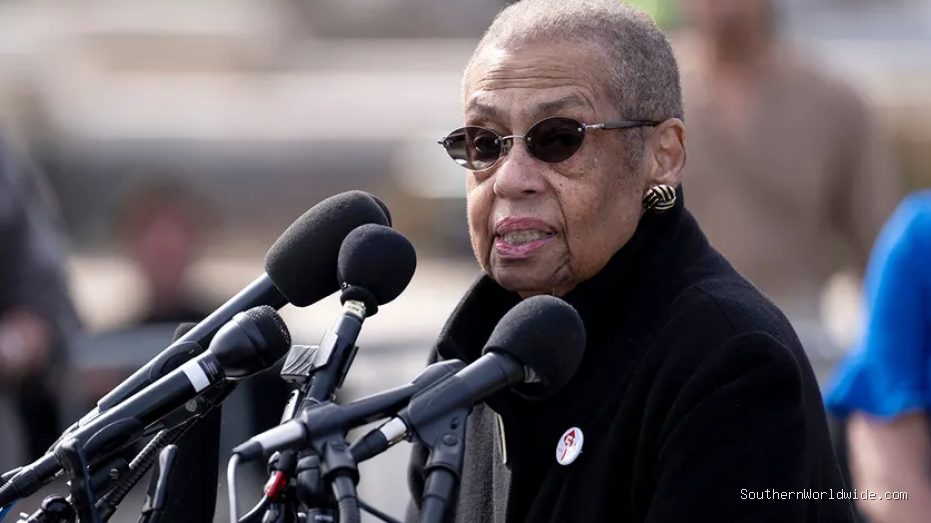
The contest for D.C.’s delegate position was an open seat, a rare occurrence, following Eleanor Holmes Norton’s decision not to seek re-election. Norton, at 88 years old, had served an impressive 18 terms in Congress. Her departure after such a long tenure has created a significant opening for new leadership.
As the Democratic nominee, White will proceed to the general election in November. Given Washington D.C.’s strong Democratic leanings, the party’s nominee is widely expected to win against any Republican or third-party challengers.
The role of D.C.’s delegate, while not carrying a vote on the House floor, allows for the introduction of legislation, participation in committees, and advocacy for the district’s interests on Capitol Hill. This election takes place against the backdrop of D.C.’s ongoing efforts to achieve statehood, enhance home rule, and reduce federal control over the nation’s capital.
This primary election was conducted using D.C.’s new ranked-choice voting system. Despite the implementation of this new system, Robert White Jr. successfully secured the Democratic nomination.
White has been an at-large member of the D.C. Council since 2016. Prior to his council service, he worked as a legislative counsel in Eleanor Holmes Norton’s congressional office. He entered the race for delegate after withdrawing from a potential mayoral bid, stating his belief that the district required a more assertive voice in Congress, especially as federal scrutiny on D.C. intensified.
Eleanor Holmes Norton was first elected in 1990 and took office in 1991. She quickly became a prominent and recognizable political figure representing D.C. in Congress. Her retirement concludes a tenure of 18 terms, spanning approximately 35 years, which was largely defined by her persistent advocacy for D.C. statehood, home rule, and full congressional representation for the capital.
For a considerable portion of D.C. voters, Eleanor Holmes Norton has been the only congressional delegate they have ever known. Her decision to step down after 18 terms created the first genuinely competitive race for this seat in decades. This opening triggered a fervent competition among local Democrats eager to claim one of the district’s most symbolically important political positions.
Robert White Jr. will now move forward to the November general election. In the heavily Democratic landscape of Washington, D.C., the Democratic nominee is strongly favored to win the delegate seat.
On the Republican side, Denise Rosado is running unopposed for the GOP nomination. Additionally, at least one third-party candidate, Kymone Freeman, has also declared their candidacy for the non-voting delegate position.