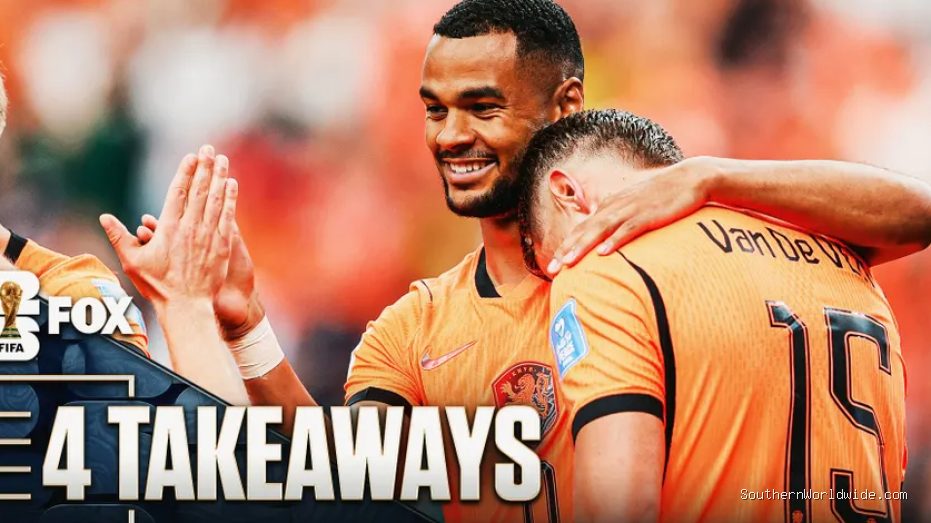
SouthernWorldwide.com – Total Football is back and the Netherlands have announced their arrival at the World Cup with a dominant 5-1 victory over Sweden.
The highly anticipated European clash, the first match of a busy World Cup Saturday, saw the Oranje emerge as commanding victors. This impressive win propelled them to the temporary top of Group F, awaiting the result of Japan’s match against Tunisia.
Ronald Koeman’s squad delivered a near-flawless performance, showcasing confidence and fluidity. Evoking the legendary era of Rinus Michels and Johan Cruyff, their play was characterized by attacking vigor, tenacious defense, and a prolific goal-scoring display. When the Netherlands play with this intensity, their chances of achieving something special in this World Cup are significantly elevated.
While Sweden did have their moments, and the Dutch defense occasionally showed vulnerability when losing possession, the Netherlands ultimately deserved their emphatic win. The team’s performance suggests they are serious contenders for the title.
Prior to the tournament, I had expressed my belief in the Netherlands’ legitimate shot at winning the World Cup. As far back as November, I ranked them sixth in my top 10 power rankings for the tournament. Koeman’s astute management has been evident, and this team is steadily demonstrating its potential to achieve what it has never done before: win the World Cup.
Although the journey is still long, the Netherlands’ performance today underscored their status as genuine contenders.
Here are the key takeaways from their commanding victory:
The philosophy of Total Football, which emerged in the 1970s, gifted the world a distinct identity for the Netherlands. This revolutionary concept, characterized by fluid positioning, stretching opponents by maximizing pitch width, collective pressing, and mid-game formation shifts, propelled the Dutch to the 1974 World Cup final. Though they ultimately lost to West Germany, the impact of this philosophy was undeniable.
Koeman had previously noted the challenges of implementing “TF” (Total Football) at this World Cup due to varying weather conditions in different cities. However, the enclosed and air-conditioned stadium in Houston provided the ideal environment for the team to fully express its identity.
Throughout the match, there were numerous examples of players occupying diverse spaces and posing a significant threat when entering the penalty box. Denzel Dumfries, in particular, was omnipresent on the right wing, even drifting centrally during attacks. His cross led to Cody Gakpo’s opening goal. The midfield pairing of Frenkie de Jong and Ryan Gravenberch was also exceptional, dictating play and providing crucial cover in the center of the park.
The depth of the squad was also on full display, with Crysencio Summerville coming off the bench in the second half to score his second goal of the tournament, highlighting the team’s dynamic attacking arsenal.
During the match, the Netherlands consistently committed eight players into the opposition’s box, a tactic aimed at overwhelming Sweden and preventing them from escaping their own half.
Today in Houston, the Netherlands served as a powerful reminder of why they pioneered the most influential and attack-minded football philosophy in the world. It also suggests that this philosophy might finally lead them to World Cup glory.
A persistent question mark for the Netherlands, arguably the best international team never to have won the World Cup, has been their struggle for consistent attacking quality despite their aesthetically pleasing play. Memphis Depay, the nation’s all-time leading scorer, is now 32 and no longer the 90-minute threat he once was.
However, in Brian Brobbey, they may have found their solution. His physicality, ability to hold up play, and directness in front of goal were incredibly refreshing. He embodies the classic, old-school No. 9 whose sole focus is to attack the goal and score, reminiscent of Gerd Müller or Hristo Stoichkov.
Gakpo was equally brilliant, causing immense disruption on the left wing. His perfectly timed runs, combined with his clinical finishing, proved to be another weapon that Sweden could not contain.
Both Brobbey and Gakpo scored braces in the match.
Their contributions are pivotal to the Netherlands’ success in this tournament.
The familiarity between the two sides was evident, with a combined 11 Dutch and Swedish starters playing in the Premier League. This included Sweden’s attacking duo of Arsenal’s Viktor Gyökeres and Liverpool’s Alexander Isak, who faced his Reds teammate Virgil van Dijk. Brobbey, playing for Sunderland, was up against Aston Villa’s Victor Lindelof, the Swedish captain. Sweden’s team was managed by former Brighton, Chelsea, and West Ham manager Graham Potter. Further Premier League influence was seen with Newcastle United’s Anthony Elanga coming on to score Sweden’s sole goal.
Consequently, the match had a distinct Premier League feel, with both teams, particularly the Netherlands, exhibiting an aggressive, forward-thinking approach.
However, on this occasion, Koeman’s side thoroughly earned their victory.
Another match saw the hydration break met with audible boos. If you have followed my previous analyses, you will know my strong opposition to these breaks. Football is a sport that thrives on rhythm and tempo, which necessitates uninterrupted 45-minute halves. This is how the game has always been played, and I sincerely hope these “breaks” are a thing of the past after this World Cup.
Yet, as I’ve stated in previous columns, these breaks are a reality for this tournament. Therefore, managers must strategically utilize them for tactical adjustments. In the first half, Potter effectively did this, as Sweden emerged from the break with improved performance and more shots on goal than the Netherlands.
In the second half, Sweden began to pose more problems for their opponents, partly due to the introduction of Anthony Elanga. However, the break disrupted their momentum, allowing Koeman to make advantageous substitutions for the Netherlands. Ultimately, football is a game of two halves, and fans have paid good money to witness continuous action. Their vocal discontent and hope for the cessation of this rule after the tournament are entirely justified.
The Netherlands will face Tunisia in Kansas City on Thursday, aiming to secure their group position. Meanwhile, Sweden faces a crucial match against Japan in Dallas, located in Arlington.