SouthernWorldwide.com – A fragile ceasefire, which many Iranians describe as not truly feeling like a ceasefire, has emboldened some individuals within Iran to speak out, despite facing what they perceive as significant personal risks.
These accounts emerge as President Donald Trump has threatened to strike Iran “very hard” if the country does not accept a U.S.-backed deal. This statement follows renewed military escalations that jeopardized already delicate negotiations. The latest U.S. strikes were a response to the downing of a U.S. Apache helicopter near the Strait of Hormuz, an action Trump attributed to the Iranian regime. Iran reportedly retaliated with attacks in the region.
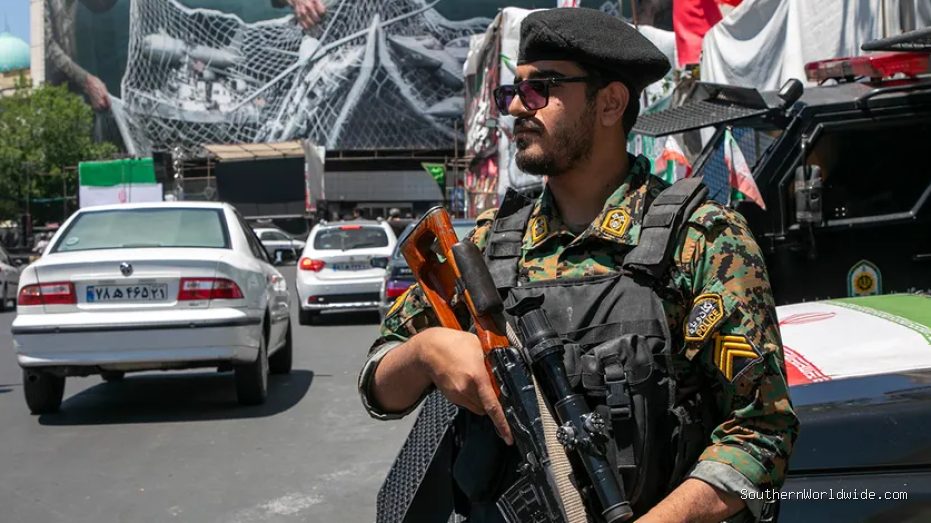
Inside Iran, three young individuals have shared their experiences of a nation where repression is increasingly evident, the Islamic Revolutionary Guard Corps (IRGC) is expanding its street presence, and ordinary citizens are struggling to afford basic necessities.
RED CROSS SHARES AUDIO OF IRANIAN CIVILIAN EXPLAINING SITUATION ON THE GROUND IN TEHRAN: ‘NO RESPITE’
They painted a consistent picture: checkpoints on major streets, fear of the Basij (a hardline volunteer militia under the IRGC), and the Revolutionary Guards themselves. They also noted a renewed enforcement of hijab rules, widespread layoffs, long queues at bakeries, and a growing sentiment among young Iranians that their future has vanished.
“The influence of the Revolutionary Guards has always been present, and everything has operated within their ideological framework. Now, their interference is more obvious and easier to see,” Hassan stated. “Now the curtain has simply been pulled back.”
Milad described a city transformed by security forces.
“The atmosphere in cities and government offices has become much more securitized. Security forces are now visible around almost every major square and intersection, and there are numerous checkpoints throughout the cities,” he explained. “Individuals affiliated with the security apparatus or the Basij are increasingly being given positions of authority and influence.”
Milad mentioned that at the war’s outset, authorities seemed to relax some social restrictions, including hijab enforcement. However, he noted that this pressure has since returned, and the regime is not only targeting opponents but also silencing supporters who cross political boundaries.
IRAN REGIME REPORTEDLY ISSUED NATIONWIDE SHOOT-TO-KILL ORDERS AS PROTEST DEATH TOLL SURGES
“For example, a group staged a sit-in protest against negotiations with the United States,” Milad recounted. “Security forces intervened and told them that they were disrupting public security. They were warned that if they did not leave, they would be arrested.”
Ali, a student in Tehran, Iran, expressed that the IRGC’s control feels more overt than ever.
“No one dares get into trouble with people who are members of organizations like the Basij, because they can report your name and have you arrested,” he added. “They have become more brutal than ever, and people know that if they take to the streets, the Revolutionary Guards can easily kill them and no one can do anything about it.”
Ali observed that Basij members, who once concealed their affiliation, now display it openly.
FORMER IRANIAN PRISONERS REVEAL TORTURE HORRORS AS REGIME KILLS PROTESTERS ON SIGHT DURING CRACKDOWN
These testimonies come against the backdrop of Iran’s extensive history of violently suppressing dissent.
Iran International reported that over 36,500 people were killed during the January crackdown. Amnesty International described January 2026 as the deadliest period of repression by Iranian authorities in decades, stating that deaths rose into the thousands.
Milad, who claimed to have witnessed the crackdown, detailed its impact on ordinary Iranians.
“Before the war, we couldn’t even breathe. We couldn’t sleep at night,” he said. “The conditions were very difficult for most people who had seen that massacre. After the war, we were able to sleep more easily at night, and we felt a bit more at ease. Now, even though the war is still ongoing, we continue to worry about the families of the martyrs and those who are in prison, under torture, and facing the executioner.”
US ECONOMIC CHOKEHOLD ON IRAN REACHES PEAK LEVERAGE AS COLLAPSE RISKS EMERGE
The economic strain is also palpable in daily life.
Iran was already grappling with inflation, currency collapse, corruption, and sanctions before the war.
Since then, growing economic hardship has been reported, with businesses struggling due to high prices, supply-chain disruptions, internet blackouts, and rising unemployment. Iran’s official statistics center reported an annual inflation rate of 53.7% in April, with food inflation exceeding 115%, according to the Associated Press.
Ali commented that many young Iranians see almost no viable path forward.
“The economic situation has become so bad that almost all industries are on the verge of collapse and are simply trying to survive,” he stated. “Many companies have laid off workers, including me. Many of my engineering-student friends have also been laid off. Families can no longer financially support their children.”
“I see many more older men and women than before who clearly were not garbage collectors but are now searching through trash,” Ali observed.
“Almost all of us young people are convinced that we have no future,” he added. “At best, if there is anything left from what we earn, we can spend it on going to a café. Buying a phone or clothes has become difficult; buying a car is a dream. Prices have become so high that some days we can barely afford our two main meals and nothing else. Snacks, fruit, and similar things are no longer part of life.”
Milad echoed this sentiment, stating that layoffs, unpaid salaries, and escalating utility bills are burdening families.
“The government is trying to collect more money from people through higher taxes. Utility bills for water, electricity, and gas have become extremely expensive,” he said.
He noted that bakeries remain crowded not only due to war concerns but because bread has become one of the few affordable food items remaining.
“Bread has become the main staple on many family tables,” Milad remarked. “Medical costs are extremely high, and many people are afraid to visit a doctor because the costs of medication, tests, and treatment are so expensive.”
Hassan, however, suggested that the economic hardship is bearable for some Iranians who believe it could eventually contribute to the downfall of the Islamic Republic.
“We believe that with the return of a government that truly represents the people, under the leadership of Crown Prince Reza Pahlavi, economic conditions will improve in the future,” he expressed.
Reza Pahlavi, the son of Iran’s late shah, has lived in exile for decades and has increasingly positioned himself as a unifying figure for Iranians aspiring to a post-Islamic Republic future. His supporters, both inside and outside Iran, advocate for any transition to include a referendum and a democratic system.
EXILED IRANIAN PRINCE SAYS REGIME ‘VERY CLOSE TO COLLAPSING’ AMID NATIONWIDE UNREST
“I would like to tell the Western world that appeasement of the Islamic Republic is futile,” Hassan stated. “These are dishonest and deceptive people who, according to their religious beliefs, practice taqiyya in order to deceive others and maneuver their way through difficult situations.”
“These are not people who can be reformed,” he continued. “Appeasement of them is harmful to the entire world. It is extremely naive to believe that meaningful negotiations can be conducted with such individuals.”
Ali believes the clerical regime would relinquish uranium if its leaders were allowed to retain power.
“We only hope that the Islamic Republic falls, whether through war or through an agreement,” Ali said. “The clerics are far too shameless to fight to the death over uranium. They would be willing to hand over the uranium to the United States if it meant staying in power and continuing to plunder Iran. But they are certainly careful to avoid suffering the same fate as Gaddafi.”
His message to Washington was direct.
“The only message I have for the U.S. government is: save the people of Iran from the clerics and free Iran from the Islamic Republic,” Ali urged.
Milad indicated that many Iranians are watching Trump closely and fear another instance where the West opts for negotiation over supporting the people protesting in the streets.
“Iranian people have hope that the American administration will be strong and stand on their side,” he said. “We don’t want another Obama situation. Iranian people and their blood are not oil prices.”
“We have one message to the president, and that is to continue,” Milad concluded. “Here in Iran, we no longer say, ‘Obama, Obama, either with us or with them.’ Now we’re saying: ‘Trump, don’t be Obama. You are with us, not with them. President Trump, stay the course.’”