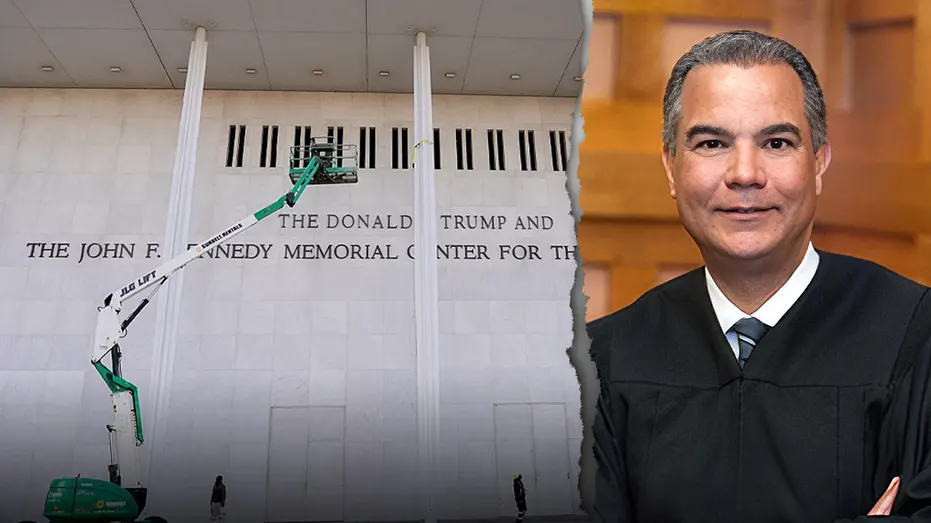
SouthernWorldwide.com – U.S. District Judge Christopher Cooper is currently facing a judicial misconduct complaint lodged by a conservative watchdog organization. The group contends that Judge Cooper should have recused himself from a lawsuit concerning President Donald Trump’s endeavor to rename the Kennedy Center.
The Center to Advance Security in America (CASA) has alleged that Judge Cooper should have stepped aside from the case. Their reasoning is based on his wife, Amy Jeffress, having a history of representing clients described by the group as “anti-Trump.” In May, Judge Cooper made a ruling against Trump, permanently blocking the renaming of the Kennedy Center.
This ruling came after Representative Joyce Beatty, a Democrat from Ohio, filed a lawsuit. CASA subsequently filed its complaint with the U.S. Court of Appeals for the District of Columbia Circuit. They assert that Judge Cooper failed to disclose or recuse himself, despite what they term significant financial and professional interests stemming from his wife’s involvement in litigation against Trump.
Curtis Schube, CASA’s Director of Research and Policy, stated that CASA is filing a judicial complaint against Judge Christopher Cooper, who was appointed by Obama. The complaint concerns his potentially unethical behavior due to his failure to recuse himself from the “frivolous” Kennedy Center lawsuit filed against President Trump. Schube highlighted his wife’s financial interests in opposing President Trump’s agenda through litigation.
The complaint emerges just over a week after Trump publicly criticized Judge Cooper, citing a “conflict of interest.” Trump pointed to Cooper’s wife, Amy Jeffress’s, established record of representing some of Trump’s most vocal opponents. This includes Lisa Page, a former FBI lawyer known for her anti-Trump stance, and currently representing former President Joe Biden in ongoing litigation against the Trump Justice Department.
Schube further elaborated, describing Cooper’s wife as a longtime Democrat activist and attorney, Amy Jeffress. He noted her past role as counsel to the January 6th committee and her current work as former President Biden’s personal lawyer. Jeffress is also representing Biden in current legal actions against President Trump. Schube believes there was a clear necessity for Cooper to recuse himself, or at the very least, disclose these conflicts.
By failing to do either, Schube argues, Cooper has created, at a minimum, an appearance of impropriety. He believes this situation warrants a thorough investigation. The complaint itself does not challenge the substance of Judge Cooper’s ruling regarding the Kennedy Center.
However, it does contend that Judge Cooper’s participation in the case could raise legitimate questions about his ability to remain impartial. This is in accordance with the federal judiciary’s Code of Conduct. The complaint emphasizes a deep concern that a sitting federal judge did not recuse himself. It also points out that he adjudicated a case from which he and his spouse financially benefit.
The complaint states that a significant portion of Cooper’s wife’s business model appears to be predicated on handling litigation that is inherently anti-Trump in nature. CASA posits that Judge Cooper may have violated Canon 1 of the judicial code. This canon mandates that judges must uphold the integrity and independence of the judiciary.
According to the filing, Canon 1 requires a judge to maintain the integrity and independence of the judiciary. The complaint pointedly notes that Judge Cooper presumably returns home each night to his wife, whose career is built on suing President Trump. CASA further argued that Cooper is in violation of Canon 2.
Canon 2 requires judges to steer clear of situations that could create an improper appearance, even in the absence of actual misconduct. The complaint specifically references instances where the appearance of a relationship could affect a judge’s capacity to adjudicate a case. These include situations where public confidence is undermined and where spousal relationships might influence judicial conduct.
The complaint asserts that both of these problematic scenarios are present in Judge Cooper’s case. Additionally, the complaint argues that Cooper violated Canon 3. This canon mandates that judges must remain fair and impartial. It also states that recusal may be necessary when a judge’s spouse’s interests or potential partisan influences could reasonably cast doubt on that impartiality.
In its conclusion, the complaint urges the D.C. Circuit to investigate Judge Cooper. It requests that they determine whether any disciplinary action is warranted. Judge Cooper was appointed by President Barack Obama and has been serving on the U.S. District Court for the District of Columbia in Washington, D.C. since 2014.
Cooper has been a recurring target of conflict of interest allegations from Trump and his supporters. The judge previously faced scrutiny during the prosecution of Michael Sussmann, an attorney linked to the Clinton campaign. This case was part of a broader probe by Special Counsel John Durham into the FBI’s Crossfire Hurricane investigation. That investigation centered on the now-discredited Russian-Trump collusion theory.
At that time, critics argued that Judge Cooper should have recused himself. Their reasoning was that his wife, attorney Amy Jeffress, represented former FBI lawyer Lisa Page. Page was a significant figure connected to the FBI’s Crossfire Hurricane investigation.