SouthernWorldwide.com – New York City is expanding its use of small street activity sensors designed to count pedestrians, cyclists, buses, and vehicles. The city states that the objective is to achieve safer street designs, enhance traffic planning, and gain a clearer understanding of actual road usage patterns. While this might seem like a uniquely New York issue, it actually signals a potential direction for many cities across the United States.
Across the U.S., towns and cities are grappling with similar challenges. Drivers often exceed speed limits on busy roads, pedestrians cross streets outside of designated crosswalks, cyclists maneuver between parked cars, and buses get caught in traffic congestion. City officials frequently have to make critical safety decisions with limited data. However, these new sensors offer the capability to monitor these patterns around the clock.
The primary promise of this technology is increased street safety. Yet, a significant concern revolves around privacy. The central question is whether cities can implement this technology without creating a pervasive feeling of being constantly observed.
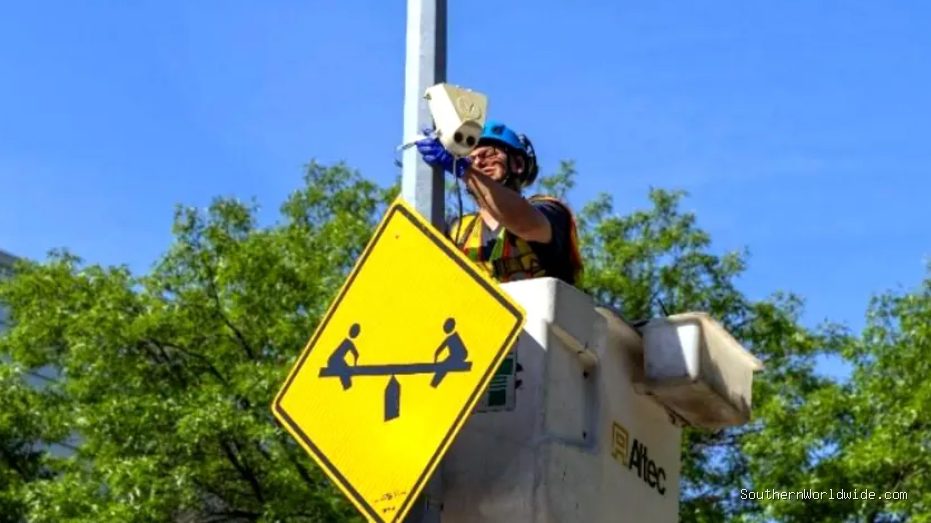
The New York City Department of Transportation has announced plans to extend its street activity sensor program to approximately 100 locations throughout the five boroughs. The city initially piloted these sensors at 20 intersections in a program that commenced in 2023. The current plan involves adding about 80 more locations.
The underlying technology for these sensors utilizes a form of artificial intelligence known as computer vision. In essence, the device analyzes the street scene and categorizes what it detects, such as a pedestrian, cyclist, car, truck, bus, or scooter. The NYC DOT asserts that the processing occurs in real-time, with video frames being deleted almost immediately after the sensor has collected the necessary count.
These devices are typically mounted on existing city street infrastructure, like poles or signs. Beyond simply counting different types of road users, the sensors can also measure speeds, record turning movements, and map the flow of people through a street or intersection.
Traditional methods for traffic studies often rely on human observers stationed near a road to manually count traffic. While this approach can be effective, it has inherent limitations.
An observer might count vehicles for only a few hours, and a city might collect data during specific times of the day. External factors such as inclement weather, school schedules, holiday traffic patterns, or ongoing construction can skew the recorded data. Smart street sensors effectively address these limitations.
They are capable of collecting street activity data continuously, providing transportation officials with a more comprehensive perspective on activity over extended periods. For instance, a sensor might reveal that pedestrians frequently cross mid-block each morning because the nearest crosswalk is inconveniently located. It could also indicate that cyclists consistently swerve to avoid parked delivery trucks, or that vehicles tend to turn too quickly near schools or bus stops. This type of detailed information can empower cities to redesign their streets based on actual observed behavior, rather than solely on theoretical traffic flow models.
Street safety improvements often arise only after a serious incident has occurred—a crash, a formal complaint, or significant public attention drawn to a dangerous intersection.
Smart sensors have the potential to enable cities to intervene proactively. These sensors can identify what transportation officials refer to as “near-misses,” which are close calls that may not always be documented in official crash reports.
Consider a scenario where a car door opens unexpectedly near a cyclist, a driver turns while a pedestrian is already crossing, or a delivery truck obstructs a driver’s view at a busy corner. While no one may be injured in such instances, the recurring pattern can signal genuine danger.
If sensors detect repeated near-misses in a specific location, city planners may have a stronger justification to take action before an actual accident occurs. This could involve installing a new crosswalk, adjusting traffic signal timings, reconfiguring a bike lane, or modifying how curb space is utilized.
Perhaps the most insightful aspect of this technology lies in its ability to reveal everyday habits that may not be apparent through traditional planning methods. Roads often function differently than depicted on planning maps. People tend to cross where it is most convenient, cyclists may avoid lanes that feel unsafe, and drivers might accelerate on streets that feel excessively wide. Buses can be delayed when curb space becomes congested. Sensors are capable of documenting these real-world patterns.
This data can help cities answer practical questions: Are pedestrians consistently crossing at the same unsafe location each day? Do cyclists avoid a particular bike lane due to obstructions by cars? Do buses experience significant delays near busy loading zones? Are drivers frequently turning too fast near schools? Is a recently implemented street redesign actually proving effective? More accurate answers can lead to better decision-making, but this is contingent on cities presenting the data in a manner that is accessible and understandable to the public.
This is where many individuals may hesitate. A sensor on a street pole might sound beneficial, but it can also evoke a sense of unease.
New York City emphasizes that the sensors have been designed with privacy as a key consideration. According to the Department of Transportation, video footage is processed in real-time and subsequently deleted. The city states that only anonymized data is retained, with faces and license plates deliberately obscured.
This implies that the system is intended to preserve traffic pattern information without capturing or storing personal identities.
Despite these assurances, privacy concerns are unlikely to be entirely dispelled by official statements alone. It is reasonable for the public to inquire about the types of data collected, the duration of data storage, access protocols, and the possibility of future policy changes.
These questions are crucial for any city contemplating the adoption of similar technology. While safer streets are undoubtedly important, so too are clearly defined boundaries regarding the extent of street-level data a city can collect.
If public funds are used to finance street sensors, taxpayers should have access to the findings generated by these devices. New York City has indicated that some of this information will be made available on its open data portal. However, street safety advocates are calling for more frequent and regular reporting, which is a vital step.
A city should not collect data from public streets only to subsequently obscure the results within a difficult-to-access system. Residents should be able to ascertain whether the technology is contributing to safer crossings, improved bicycle routes, more efficient bus services, or a reduction in dangerous close calls.
Public reporting also plays a critical role in fostering trust. If a city claims that sensors enhance privacy, it should provide evidence of how this is achieved. If officials assert that sensors improve safety, they should present the resulting data. Without such transparency, even a beneficial technology can be perceived as an additional layer of surveillance.
Even if you do not reside in New York, this deployment is noteworthy. Your local city government may be observing how New York implements this technology. If the program proves effective in helping planners make safer decisions more rapidly, similar sensors could appear near schools, busy intersections, bicycle corridors, or downtown streets in other communities.
For frequent pedestrians, the data could support the implementation of better crosswalks and safer traffic signal timings. Cyclists might benefit from more compelling evidence to advocate for protected bike lanes. Drivers could potentially see new street designs aimed at reducing traffic speeds, altering turning patterns, or adjusting parking configurations. Bus riders may experience improvements if cities utilize the data to identify specific points of transit delay.
However, it is imperative for cities to establish clear policies before these systems become widespread. They should articulate precisely what the sensors collect, what data is deleted, who reviews the information, and how the public can access the outcomes. While achieving safer streets is a commendable objective, maintaining public trust is an integral part of realizing that goal.
Smart street sensors possess the potential to assist cities in rectifying dangerous road conditions before any injuries occur. This represents the most compelling argument for this technology. If a city can identify risky patterns, detect near-misses, and redesign streets based on empirical data, it could ultimately save lives. Concurrently, cities must approach privacy concerns with utmost care. Individuals should not be compelled to choose between enhanced street safety and reasonable limitations on public surveillance. The most beneficial application of this technology would provide planners with superior information while ensuring personal details remain outside the system. New York City’s program may serve as a significant test case, but this discussion has now evolved into a national conversation.
Would the presence of smart street sensors make you feel more secure, or would it make public streets feel overly monitored? We invite you to share your thoughts by contacting us at Cyberguy.com