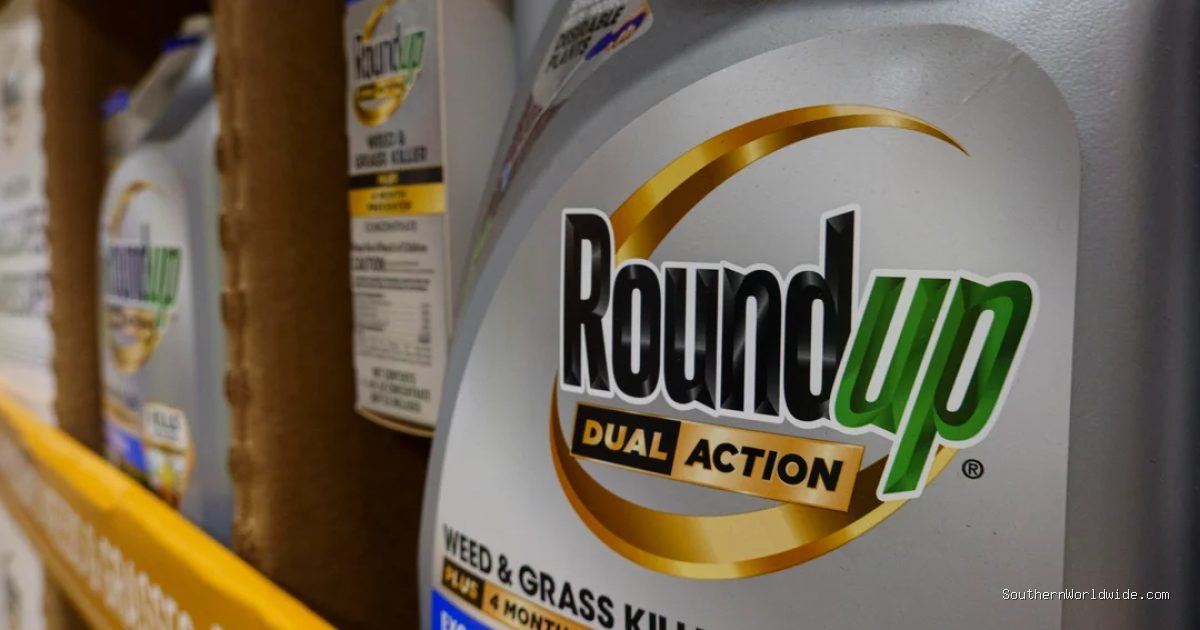
SouthernWorldwide.com – The Supreme Court has ruled in favor of Monsanto, determining that the company cannot be held liable under state laws for failing to warn consumers about potential cancer risks associated with its weedkiller, Roundup, on its product labels.
In a 7-2 decision, the high court concluded that the Federal Insecticide, Fungicide, and Rodenticide Act (FIFRA), a federal law governing pesticide sales and labeling, prevents lawsuits filed in state courts that claim Monsanto inadequately warned about cancer risks on Roundup’s packaging.
The U.S. Environmental Protection Agency (EPA) has previously stated that Roundup is safe for use and does not mandate a cancer warning on its label. The Supreme Court’s ruling on Thursday reinforced that federal law requires Monsanto to adhere to EPA-approved labels unless the agency itself approves or mandates different labeling.
Justice Brett Kavanaugh delivered the majority opinion, with Chief Justice John Roberts and Justices Samuel Alito, Sonia Sotomayor, Elena Kagan, Amy Coney Barrett, and Clarence Thomas concurring. Justices Ketanji Brown Jackson and Neil Gorsuch dissented from the decision.
Monsanto has been involved in a significant number of lawsuits concerning its Roundup product. This latest ruling is anticipated to halt thousands of legal actions brought by consumers who alleged that Monsanto failed to disclose the potential cancer-causing properties of the weedkiller.
Bayer, a German pharmaceutical giant, acquired Monsanto and its Roundup product line in 2018.
“The U.S. Supreme Court decision is good for science, farmers, and industries that depend on regulatory clarity for innovation,” Bayer stated in a message to CBS News. “It should help significantly contain the Roundup litigation after nearly a decade of legal battles.”
Bayer also indicated its ongoing efforts to secure final approval for a $7.25 billion class settlement proposed in February. This settlement aims to resolve current and future claims related to Roundup’s use and is currently under review by a Missouri state court. If approved, Monsanto would be obligated to make annual payments for up to 21 years.
The Central Issue in the Supreme Court Case
The Supreme Court case originated in 2019 when John Durnell, a gardener from Missouri, filed a lawsuit. Durnell is one of over 100,000 individuals nationwide who have sued Monsanto, alleging that glyphosate, the primary ingredient in Roundup, led to their development of cancer.
Durnell’s suit claimed that over two decades of exposure to Roundup resulted in his diagnosis of non-Hodgkin’s lymphoma, a form of blood cancer. The core of the legal dispute revolved around FIFRA, enacted in 1947, which establishes a standardized system for pesticide labeling and requires manufacturers to register their products with the EPA before sale.
For many years, the EPA has conducted assessments on glyphosate-based pesticides to determine potential adverse health effects, including cancer risks, and has consistently found Roundup to be safe when used as directed. Consequently, the product’s label has not included a cancer warning.
Bayer contended that FIFRA’s regulations prevented them from unilaterally altering the product’s “precautionary warnings” to include a cancer advisory.
While the EPA has concluded that Roundup is safe for use as directed, a working group from the International Agency for Research on Cancer (IARC), part of the World Health Organization, classified glyphosate as “probably carcinogenic to humans” in 2015.
Following IARC’s classification, the EPA conducted its own extensive reviews of glyphosate’s carcinogenic potential. These reviews concluded with the “strongest support” for classifying the chemical as “not likely to be carcinogenic to humans.” Based on these analyses, the EPA determined in 2019 and 2020 that a cancer warning was unnecessary and has continued to approve labels for glyphosate-based pesticide products that do not feature such warnings.
Despite the EPA’s findings, the IARC’s classification prompted numerous lawsuits from plaintiffs who asserted that their use of Roundup had caused their cancers and sought to hold Monsanto accountable for failing to warn about the alleged carcinogenic risks.
Among these plaintiffs was Durnell, who filed his lawsuit against Monsanto in a Missouri state court in 2019. A jury ultimately ruled in favor of Durnell on one claim—that Monsanto failed to warn consumers about Roundup’s alleged cancer risk—and awarded him $1.25 million in damages in 2023. Bayer has stated that it no longer sells Roundup products containing glyphosate but continues to offer other versions of the herbicide through retailers like Home Depot and Lowe’s.
The Missouri Court of Appeals upheld the jury’s decision, rejecting Monsanto’s arguments that FIFRA preempted Durnell’s lawsuit. The Missouri Supreme Court subsequently declined to review the case.
A Legal Win for the Trump Administration
This ruling represents a legal victory for the Trump administration. However, it could present political challenges, particularly as some within the “Make America Healthy Again” movement advocate for stricter regulations on pesticide use.
The Trump administration had supported Monsanto’s position in the case, arguing in a filing that federal law vests the EPA with the authority to determine the necessity of pesticide warnings for protecting human health and the environment. The Justice Department asserted that the EPA’s thorough review of evidence and its own analyses confirmed that Roundup’s existing labeling adequately safeguarded user health.
In a separate action, President Trump signed an executive order in February aimed at increasing the production of glyphosate-based herbicides. He cited concerns that a shortage of the substance could jeopardize agricultural productivity and strain the domestic food system.
The Associated Press contributed to this report.